Introduction
In heavy industrial fields such as mining, ports, and metallurgy, ultra-long-distance belt conveyor systems, as core equipment for material transfer, connect the production process. However, in actual operation, the problem of uneven material particle size has always been a constraint on the stability of the system. Large pieces of material are prone to cause blockages at chutes, transfer points and conveyor belt interfaces, which not only lead to system shutdowns for blockage clearance and production interruption, but also accelerate equipment wear such as belt wear and roller deformation due to impact loads. At the front end of the conveying system, the particle size of materials is regulated, and Mineral Sizer is gradually replacing traditional crushing equipment. Compared with traditional crushing equipment, Mineral Sizer performs better in handling complex materials, precisely controlling particle size and adapting to harsh working conditions, and can provide stable material conditions for subsequent conveying processes.
The technical principles and advantages of Mineral Sizer
Overview of Working Principle
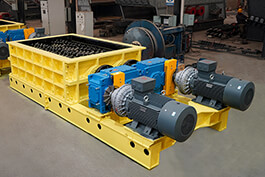
The Mineral Sizer is driven by two independent motors to rotate two toothed rollers in opposite directions. When the material enters the crushing chamber, the teeth on the toothed rollers exert a shearing force on the material. The contact between the tooth tips and the material generates a tensile effect. For materials of different hardness, the rotational speed of the toothed rollers and the tooth shape can be adaptively adjusted. The materials are gradually crushed to the preset particle size in the crushing chamber.
The precision of particle size control
The particle size control accuracy of Mineral Sizer mainly relies on the precise matching of tooth profile design and tooth tip clearance. According to the hardness of the material, such as coal, ore, limestone, etc., the tooth pitch, tooth height and tooth tip Angle are customized. For hard materials, sharp teeth are used and arranged densely to enhance shear force, while for soft and sticky materials, wide teeth are used and the tooth spacing is increased to prevent adhesion. Meanwhile, the gap between the toothed rollers can be adjusted steplessly through hydraulic or mechanical adjustment mechanisms. Combined with the "guiding - crushing" effect of the tooth shape on the material, it can ensure that the particle size distribution of the discharged material is concentrated, effectively avoiding the problem of conveying blockage caused by particle size fluctuations.
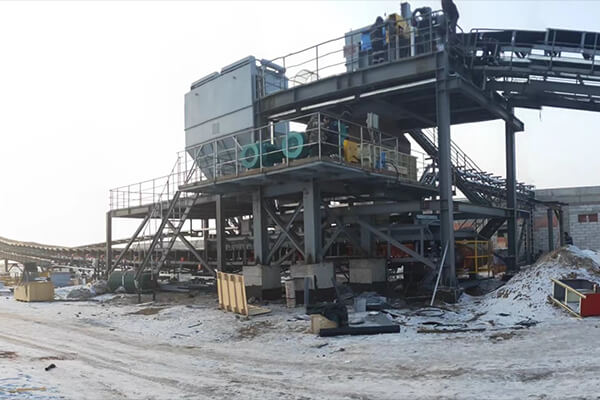
The comparative advantages over traditional crushing equipment
Compared with traditional jaw crushers, cone crushers and other equipment, Mineral Sizer adopts an integrated design in structure, with a compact volume and a weight of only 60% to 70% of traditional equipment with the same processing capacity. It has low requirements for the installation foundation. The toothed roller adopts a modular design. The crushing teeth can be replaced independently without the need to disassemble the entire toothed roller, and the maintenance time is shorter than that of traditional equipment. In terms of energy consumption, due to the adoption of the "shear-stretching" crushing mechanism, the unit crushing energy consumption is lower than that of traditional extrusion equipment, especially when dealing with medium and low hardness materials, the advantage is more obvious.
Suitable for sticky wet and hard materials
To address the equipment clogging issues that are prone to occur during the rainy season in mines or when handling sticky and wet materials with high moisture content, Mineral Sizer's toothed rollers, in combination with the spiral arrangement of toothed shapes, can produce a self-cleaning effect during rotation, peeling off the materials adhering to the toothed claws.
The key role of Mineral Sizer in stabilizing particle size
Belt load homogenization
The stability of the belt operation in an ultra-long-distance conveying system directly depends on the uniformity of the load distribution. Large pieces of material present in uncrushed materials will form local concentrated loads during the conveying process, exerting strong impacts on the belt, leading to accelerated local wear of the belt, and even causing belt deviation, tearing and other faults. By crushing the materials to a uniform particle size, Mineral Sizer forms a uniform material layer distribution on the belt, reducing the impact load and lowering the local wear rate of the belt.
Energy consumption optimization
When a large amount of fine powder and large pieces are mixed in the material, the fine powder is prone to fill the gaps between the large pieces, resulting in an increase in the internal friction coefficient of the material and an increase in the running resistance of the conveyor belt. The irregular shape of large pieces of material will increase the frictional resistance between the material and the conveyor belt and chute. The uniform particle size material output by Mineral Sizer has improved fluidity, with uniform pore distribution within the material layer, reduced internal friction coefficient, and at the same time, decreased frictional resistance of large pieces of material on the equipment.
Effective strategies for reducing blockages in the conveying system
Eliminate Oversize material
Large pieces of material are the primary factor causing blockages in ultra-long-distance conveying systems, especially in narrow areas such as the corners of chutes, conveyor belt joints, and discharge ports, where large pieces of material are prone to form "bridging" blockages. Mineral Sizer, by preset crushing particle size, usually set according to the minimum passage size of the conveying system, such as less than half of the inner diameter of the chute, can effectively intercept and crush materials of extremely large size, keeping the maximum particle size of the materials entering the conveying system within a safe range.
Improve the flow characteristics of materials
The flow characteristics of materials depend on particle size distribution, shape and moisture content. Among them, uneven particle size distribution is the key reason for poor fluidity. Fine powder is prone to adsorb on the surface of large pieces, increasing the adhesion between materials and causing accumulation and blockage of materials at chutes and transfer points. By precisely controlling the particle size distribution of the output, Mineral Sizer reduces the standard deviation of the material particle size, decreases the mixing ratio of fine powder and large pieces, and at the same time makes the material shape more regular through particle size shaping, thereby reducing the adhesion between materials.
Conclusion
The clogging problem of ultra-long-distance belt conveyor systems essentially stems from the contradiction between uneven material particle size and the mismatch between system operation requirements. However, Mineral Sizer provides an efficient solution to this contradiction from the source through precise particle size control. Its "shear-stretching" crushing mechanism, precise particle size regulation capability, and adaptability to sticky, wet, and hard materials This gives it a significant advantage in the pretreatment stage. Not only can it directly enhance the stability and economy of the conveying system by evenly distributing the belt load and reducing operational energy consumption, but it can also indirectly improve the overall production process efficiency by optimizing the downstream feeding conditions.