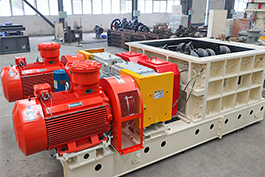
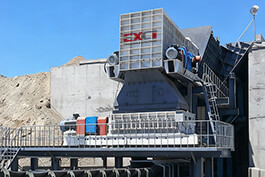
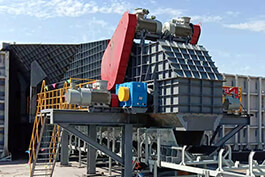
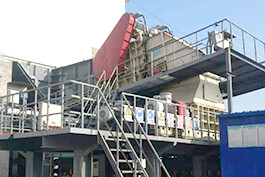
Coal is a globally abundant and important thermal energy resource that can be widely applied in thermal power generation, deep processing of coal chemical products, and other fields. Most of the world's larger coal mines use open-pit mining. Under the current circumstances, the crushing stage in coal mining mostly uses the
mineral sizer for primary and secondary crushing. The sizer is a modern crushing device that combines crushing and screening functions. It features low speed and high torque, and crushes materials through shearing, stretching, and bending forces. Compared with traditional crushers such as jaw crushers, gyratory crushers, cone crushers, and impact crushers, it has advantages such as high processing capacity, low operating costs, simple structure, and long replacement cycle of spare parts. It remains the best choice for coal crushing worldwide.
What is a mineral sizer?
As an advanced crushing device, the sizer has an essential difference in design concept and operation mode from traditional jaw crushers, gyratory crushers, or impact crushers. Its core advantage lies in achieving material crushing through controlled shearing, stretching, and bending forces, rather than relying on high-speed impact or intense compression.
High-capacity compact design:
The mineral sizer adopts a highly integrated engineering layout and innovative space optimization strategy. While ensuring a single-machine processing capacity of 800–1200 tons per hour (depending on the material type and feed size), the overall machine dimensions are reduced by approximately 30% compared to traditional jaw or gyratory crushing equipment of the same level. Its compactness is supported by two core technologies: one is a unique crushing mechanism based on the principle of dual eccentric shaft synchronous drive and progressive shearing crushing, which significantly improves the energy transfer efficiency per unit volume; the other is a fully modular structure design, including quickly disassemblable crushing cavity components, independently suspended drive units, and standardized interface lubrication and hydraulic systems. This not only significantly shortens the on-site installation and later maintenance periods but also makes it suitable for mobile crushing stations in open-pit mines with terrain restrictions, pre-crushing positions beside shafts in underground mines, and renovation projects of old concentrators where the clear height of existing buildings and the bearing capacity of the foundation are strictly required.
Processing hard materials:
This equipment is equipped with composite toothed roller teeth that have been strengthened through a special heat treatment process. The alloy layer on the tooth surface adopts a gradient composition design - the surface layer is a high-hardness cobalt-based carbide (with a microhardness of up to 92 HRC), the transition layer is a high-toughness nickel-based alloy, and the base material is a high-strength low-alloy steel. This multi-layer structure enables it to stably handle various feed materials with compressive strength ranging from 30 MPa (such as lignite and mudstone) to 200 MPa (such as granite, basalt, and quartzite) during actual operation, and the tooth wear rate is 40% lower than the industry average under long-term continuous operation. Field application data shows that in comparative tests at the Pilbara iron ore mining area in Australia and a large open-pit coal mine in Inner Mongolia, the roller tooth wear of the EXCT equipment after continuous operation for 3,000 hours under the same working conditions was only 62% and 57% of that of similar competing products, respectively, verifying its material adaptability and structural durability under extreme working conditions.
Precise control of product particle size and minimum fine powder content:
.jpg)
The mineral sizer achieves dynamic control of the output particle size at the millimeter level through an adjustable gap control system (Adjustable Gap Control System). The minimum set gap can be as small as 15 mm, and the maximum can be up to 80 mm, with a regulation accuracy of ±1.5 mm, and it supports online adjustment without stopping the machine. Combined with the streamlined liners on the high-strength inner walls of the crushing chamber and the optimized material retention time distribution, the equipment maintains a stable output particle size qualification rate (proportion of -50 mm) above 95% under typical working conditions (such as crushing medium-hard limestone), while the -5 mm fine powder content is controlled below 8%, which is on average 12–18 percentage points lower than that of traditional hammer or impact crushers. This feature has a direct positive impact on the efficiency of subsequent dry screening, dust suppression in belt conveyor systems, and power consumption optimization of downstream ball mills. This has been demonstrated in a field test at a copper mine in Chile, where the unit energy consumption of the SAG mill decreased by 6.3% in the crushing stage before the mill.
The powerful adaptive design can handle complex materials: In response to the common challenges in mining sites such as large fluctuations in moisture content, numerous clay layers, and mixed frozen blocks, the
mineral sizer integrates three key adaptive technologies. Firstly, the rotor adopts a spiral guide channel + centrifugal slinger self-cleaning structure, combined with periodic pneumatic blow-off interfaces, which can actively remove wet and sticky materials adhering to the tooth surface. Secondly, the crushing chamber is equipped with replaceable anti-blocking grilles and inclined discharge chutes, effectively guiding the high-flowability fine materials and low-flowability coarse blocks to be discharged separately. Thirdly, the surface of the cavity liner is treated with laser cladding micro-convex texture, enhancing the biting ability of wet materials and suppressing slippage. In the actual operation in the low-temperature mining area in northern Canada (with an ambient temperature as low as -40°C) and a certain kaolin-associated phosphate mine in Yunnan, the equipment maintained continuous stable operation for 72 hours without blockage under the complex raw ore conditions with a moisture content of 12-18% and a clay particle content exceeding 25%, with the average daily processing capacity fluctuation being less than ±3%.
Overload protection:
The system has established a three-level intelligent overload protection system of "perception - judgment - response": The bottom layer is equipped with high-sensitivity strain gauges and vibration acceleration sensors to monitor the spindle torque, bearing temperature rise and abnormal vibration of the machine body in real time; the middle layer PLC controller identifies the intrusion of non-crushable foreign objects (such as shovel teeth, anchor rods, and metal support parts) based on the preset threshold model; the top-level actuator then activates the hydraulic quick-opening device (response time ≤ 1.2 seconds) and the reverse point unloading program to automatically and safely discharge the foreign objects from the discharge port. This system has passed the ISO 13849–1 PL e safety level certification. In the three-year operation record at a platinum group metal mine in South Africa, it has successfully handled 27 foreign object incidents without a single structural damage or shutdown accident caused by overload.
Automation operation:
The mineral sizer is deeply integrated with a modular PLC control system that complies with the IEC 61131–3 standard, supporting multiple industrial communication protocols such as PROFINET, EtherNet/IP, and Modbus TCP, and can be seamlessly integrated into the mine MES system and digital twin platform. The operation interface provides multi-level permission management, historical operation data traceability (including hourly production capacity, energy consumption, and particle size distribution histogram), predictive maintenance alerts (based on bearing vibration spectrum analysis and lubricating oil particle counting), and remote parameter setting functions. In the BHP Newman Hub intelligent mine project in Australia, this equipment serves as the core unit for pre-crushing and has achieved unattended continuous operation, with an average mean time between failures (MTBF) of 4,200 hours and a stable overall equipment efficiency (OEE) of over 89.6%, fully demonstrating its high compatibility and reliability in the modern digital mine architecture.
The dominant position of the Mineral Sizer in coal mining stems from its redefinition of the essence of crushing:
Physically: From "violent crushing" to "precise shearing"
Traditional crushing equipment (such as jaw crushers and hammer crushers) mostly rely on high impact energy and strong compression to break materials, and their crushing methods have a distinct "violent crushing" feature - materials undergo brittle fractures under random collisions and stress, easily generating a large amount of over-crushed fine powder, flaky and needle-like particles. This not only reduces the recovery rate of useful minerals but also exacerbates the decline in subsequent screening efficiency and dust escape. In contrast, the new Mineral Sizer achieves a physical mechanism transformation from "crushing by pressure" to "shearing by control" and from "random collision" to "controlled shearing" through the synchronous reverse rotation of two rollers and precise tooth profile engagement, forming a controllable shearing force field and a progressive biting path. This enables materials to break along natural joint planes or weak planes in a directional manner. The energy utilization rate is increased by approximately 35%, and the output particle shape is nearly cubic, with the content of flaky and needle-like particles being less than 12%. This significantly improves the quality of aggregate gradation and transportation stability, and has been verified in engineering applications for the processing of crushed stones for highway asphalt concrete and pre-treatment before grinding in metal mines.
Process level: From "crushing + screening" to "integrated crushing and screening"
In the traditional process chain, crushing and screening are usually arranged as two separate processes, with buffer silos, belt conveyors and multiple levels of vibrating screens needed in between, resulting in a long process, large land occupation, multiple transfer points, and high risks of secondary crushing and dust generation of materials. The equipment integrates a built-in dynamic screening module (Integrated Dynamic Screening Module) at the outlet area of the crushing chamber, featuring adjustable-inclination stepped screening plates and an air-assisted cleaning system. This enables qualified particle size materials to be separated in real time under the combined action of centrifugal force and gravity and directly enter the next process, while oversized materials are automatically redirected to the crushing area for recycling. This integrated design eliminates the primary screening station and return belt conveyor in the traditional process, shortening the process flow by over 40%, reducing intermediate transfer points by 3 to 5, and lowering the overall system power consumption by 18 to 22%. In a copper mine expansion and renovation project in Chile, this single measure saved 1,200 square meters of factory building area and reduced the start-up response time of the entire crushing line to less than 90 seconds.
Economic aspect: From "initial equipment cost priority" to "optimal total life cycle cost"
In the past, mining enterprises often focused on the initial purchase price when selecting equipment, neglecting long-term factors such as operation and maintenance costs, energy consumption, frequency of spare parts replacement, downtime losses, and residual value depreciation. The economic assessment of the mineral sizer comprehensively covers the entire life cycle of the equipment (Typical Life Cycle of 15–20 years), including acquisition cost (CAPEX), energy consumption (annual electricity savings of approximately 15%), average annual costs for lubrication and wear parts (28% lower than traditional equipment), unplanned maintenance time (MTTR reduced by an average of 65%), capacity guarantee rate (OEE increased to over 89%), and the feasibility of remanufacturing core components after retirement (main shaft and gearbox support two refurbishments). A third-party life cycle cost analysis (LCCA) report shows that under the same processing scale and working conditions, the 15-year comprehensive cost of the
mineral sizer system is 11.3% lower than the traditional two-stage crushing + independent screening solution, with an investment payback period of approximately 4.7 years. Moreover, its modular structure supports flexible capacity expansion in the future, avoiding repetitive investment, which aligns with the development direction of sustainable operation and lean asset management in modern mining.
Therefore, crushing is an important link in the current coal mining process, and the use of mineral sizer as the mainstream crushing method is of paramount importance.


.jpg)