Introduction
In the solid waste recycling system, screening serves as a crucial step, separating materials of different particle sizes and properties. Effective screening can enhance the purity of the recycled materials and create favorable conditions for subsequent processing and reuse. Traditional screening equipment has problems such as low screening efficiency, frequent clogging and high maintenance costs when dealing with complex solid waste.
As a new type of highly efficient screening equipment, Flip flow screen can effectively overcome the drawbacks of traditional screening equipment in the application of solid waste recycling, bringing higher efficiency and quality.
The working principle of Flip Flow Screen
Double-layer excitation
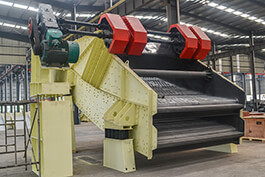
The double-layer excitation motion mechanism of Flip flow screen consists of two relatively vibrating screen frames that are nested or connected to each other in the main structure, called Frame I and Frame II, and the two screen frames generate relatively opposite and alternating motions. When box I moves to the left, box II moves to the right, and vice versa.
When dealing with solid waste, materials often adhere to the screen surface due to their own stickiness, moisture characteristics and the friction between them and the screen mesh, which hinders the smooth progress of screening. Such a movement mechanism generates a powerful inertial force, effectively breaking the adhesion and cohesion between materials, causing the materials to jump and roll violently on the screen surface and pass through the screen quickly, greatly improving the screening efficiency.
Polyurethane screen plate
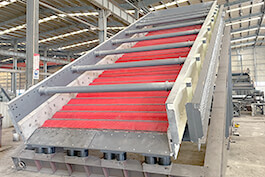
The alternating tension and relaxation of the polyurethane screen plate, under high-frequency vibration, the screen plate undergoes periodic deformation of "tension - relaxation - tension". When the screen plate is tightened, the screen holes are stretched, making it easier for materials to pass through. When relaxed, the sieve plate regains its elasticity and ejects the particles blocked in the sieve holes.
During the screening process, the attachments and blockages of the materials will be automatically removed as the screen plate deforms. When the sieve plate is loose, the elastic restoring force around the sieve holes will spring away the adhered materials. When tightened again, new materials can pass through smoothly, effectively avoiding the clogging of the screen holes and ensuring the continuity and efficiency of the screening.
Polyurethane has outstanding wear resistance, with its wear resistance being more than five times that of ordinary rubber screen plates. It can maintain a long service life when dealing with hard and rough solid waste. Its excellent elasticity enables the screen plate to deform repeatedly under high-frequency vibration without being easily damaged, and it can also effectively reduce the impact of materials on the screen surface and lower noise. When dealing with construction and demolition waste, the hard materials such as concrete blocks and bricks and stones cause significant wear and tear on the screen plates. Polyurethane screen plates can withstand such high-intensity friction, while traditional metal screen plates may quickly show signs of wear, deformation or even cracking.
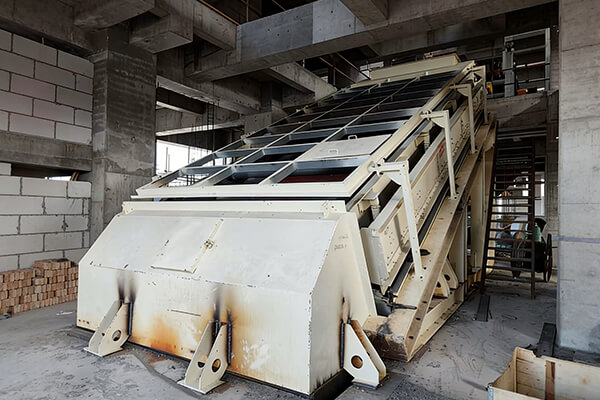
Flip Flow Screen VS Traditional Vibrating Screen
When traditional linear screens handle viscous materials, the materials tend to accumulate on the screen surface, causing the screen holes to be blocked and the screening efficiency to drop sharply.
The banana sieve has certain innovations in its screen surface design, using a screen plate with a graded and segmented slope. However, when dealing with materials with high humidity and high viscosity, it still cannot avoid clogging problems, and its screening accuracy is limited, with poor separation effect on fine particles.
The high-frequency self-cleaning feature and high-acceleration movement of Flip Flow Screen significantly reduce the frequency and time of manual screen cleaning, with less downtime for maintenance and high screening efficiency, ensuring the continuous and stable operation of the production line.
The Application of Flip Flow Screen in Solid Waste Recycling System
Pre-treatment of municipal solid waste
In the pretreatment system of municipal solid waste (MSW), the application goal of Flip flow screen is to separate small-sized organic matter, fine soil and viscous substances with high moisture content. Urban domestic waste is complex in composition, including various recyclables, organic matter, inorganic matter and water. If the organic matter and fine soil cannot be effectively separated, it will affect the purity and processing efficiency of subsequent recyclables.
During the screening process, the garbage mixture is conveyed to the Flip flow screen. Under the effect of high acceleration generated by the double-layer excitation motion mechanism, the materials jump and roll vigorously on the screen surface. Small-sized organic matter, fine soil and sticky substances with high moisture content pass through the flexible polyurethane screen plate rapidly, while coarse garbage remains on the screen surface for further processing. This process creates favorable conditions for subsequent sorting procedures such as air separation and magnetic separation, increasing the recovery rate of recyclables and effectively reducing the amount of waste entering landfills or incinerators.
Recycling of construction and demolition waste
The key to the recycling and treatment of construction and demolition waste (C&D) lies in the precise separation of fine aggregates, dust and clay particles to enhance the purity of the recycled materials. Construction and demolition waste contains a large amount of concrete blocks, bricks, stones, wood, etc. At the same time, it often contains wet soil or damp fine powder. If these substances are not separated, it will affect the quality and reuse value of the recycled aggregates.
When traditional screening machines handle these wastes, due to the moisture and stickiness of the materials, the screen holes are prone to clogging, resulting in extremely low screening efficiency. Flip flow screen can effectively separate fine materials of 0-10mm or 0-20mm, precisely separating fine aggregates, dust and clay particles from concrete blocks, bricks, stones, etc. Through this fine screening, the purity of the recovered aggregates has been significantly improved and they can be directly used in the production of recycled concrete, bricks and other building materials, achieving efficient resource recovery and recycling.
Kitchen waste and composting systems
In the kitchen waste and Composting system (Composting), the application goal of Flip flow screen is to screen, remove impurities and sort out fine compost products after the compost is mature or before fermentation. The semi-finished compost materials formed by the fermentation of kitchen waste usually have the characteristics of high humidity, high viscosity and rich fiber. If they are not effectively screened, it will lead to uneven quality of compost products and affect their application effects in agriculture, horticulture and other fields.
The semi-finished compost materials with high humidity and high viscosity are constantly in contact with the flexible polyurethane screen plate under the action of Flip flow screen. The high-frequency "tensioning - relaxation - tensioning" periodic deformation of the sieve plate enables the material to pass through the sieve holes smoothly, while automatically removing the adhering substances and blockages on the sieve plate. After screening by Flip flow screen, impurities in the compost were effectively removed and fine compost products were sorted out.
The application advantages of Flip Flow Screen
Recycling efficiency
In urban domestic waste recycling, traditional screening machines have difficulty separating fine recyclables smaller than 3mm. Flip flow screen can achieve classification of fine particle sizes ranging from 3mm to 15mm and achieve a high recycling rate.
Maintenance cost
The high-frequency self-cleaning feature of Flip flow screen can automatically remove attachments and blockages. The long service life of polyurethane screen plates is also an important factor in reducing maintenance costs. Compared with traditional steel wire screens, the wear resistance of polyurethane screen plates is more than five times that of traditional steel wire screens.
Adaptability and flexibility
The parameter adjustability of Flip flow screen can adapt to the characteristics and processing volume requirements of different wastes. The amplitude, frequency and screen surface Angle can all be flexibly adjusted according to the nature of the materials and processing requirements. When dealing with materials with high humidity and high viscosity, the amplitude and frequency can be appropriately increased to enhance the jumping and tumbling of the materials and improve the screening efficiency. When handling fragile materials, the amplitude can be reduced to minimize damage to the materials.
Conclusion
Flip flow screen effectively solves the problems of low screening efficiency, frequent clogging and high maintenance cost faced by traditional screening equipment when dealing with complex solid waste in the solid recovery system. It significantly improves the recovery efficiency and material purity, reduces maintenance cost and downtime, and demonstrates strong adaptability and flexibility.


.jpg)