Introduction
In the fields of coal mining, clay processing, and other mineral processing industries, the selection of crushing equipment directly affects production efficiency, product quality, and operational costs. Among numerous crushing devices, mineral sizers have gradually become the preferred equipment for processing coal, clay, and similar materials. This article will start from the characteristics of coal, analyze the working principle of mineral sizers and their matching degree with these materials, and further demonstrate the unique advantages of mineral sizers from the perspective of engineering and operational benefits, so as to explain why mineral sizers are suitable for processing coal.
Analysis of the Characteristics of Coal
Coal, as a common energy and industrial raw material, has obvious structural characteristics that determine its crushing requirements. Firstly, coal has low to medium hardness.Its Mohs hardness is generally between 1 and 3, which belongs to relatively brittle materials and is easy to break under external force.Secondly, coal has a typical layered or jointed structure. During the formation process of coal, due to the influence of geological processes, natural weak interfaces such as layers and joints are formed inside. These weak interfaces make coal have directional crushing properties, that is, it is easier to break along the joint surface.
However, these characteristics also bring key pain points to coal crushing. Traditional crushing equipment mostly adopts impact and extrusion crushing modes. For coal with layered and jointed structures, such crushing modes often cannot accurately act on the weak interfaces. Instead, they apply excessive force to the coal particles, resulting in serious over-crushing. A large number of fine powders generated by over-crushing not only reduce the yield of qualified products but also lead to the loss of coal calorific value. For example, in thermal power generation scenarios, excessive coal fines are easy to fly away during combustion, reducing combustion efficiency and increasing environmental pollution. Therefore, the core requirement for coal crushing is to avoid over-crushing while ensuring crushing efficiency.
Working Principle of Mineral Sizers and Material Matching
Crushing Mode
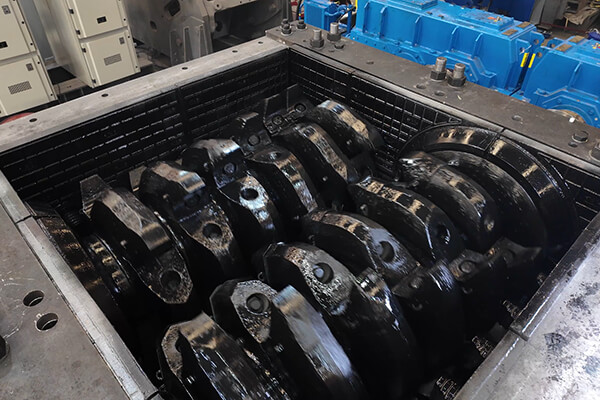
During the operation, the toothed rollers run at low speed and apply high pressure to the materials entering the crushing cavity. Under the combined action of the toothed rollers, the materials are subjected to shear stress and tensile stress at the same time.
The biggest advantage of this crushing mode is that it can make full use of the natural weak interfaces of the materials. For materials with layered, jointed, or uneven internal structures (such as coal and clay), the shear and tensile forces can accurately act on these weak interfaces, causing the materials to break along the weak interfaces.
Minimizing Over-Crushing For Coal
As mentioned earlier, coal has obvious layered and jointed weak interfaces. When coal enters the crushing cavity of the mineral sizer, the shear and tensile forces generated by the rotating toothed rollers first act on these weak interfaces. The energy input during the crushing process is mainly used to expand the cracks along the weak interfaces, rather than breaking the coal particles into smaller fragments by force.
This energy utilization method directly leads to two key results: on the one hand, the energy consumption is more targeted, avoiding energy waste caused by blind crushing; on the other hand, the final product has a uniform particle size, and the content of fine powder (over-crushed products) is extremely low. The reduction of fine powder content not only improves the yield of qualified coal products but also effectively retains the calorific value of coal. Taking coal used in coking as an example, uniform particle size can ensure sufficient contact between coal and air during coking, improve coking quality; for thermal coal, low fine powder rate can reduce dust pollution during transportation and combustion and improve combustion efficiency. Therefore, mineral sizers can significantly improve the economic value of coal products.
Analysis of Engineering and Operational Benefits
Energy Efficiency and Cost Advantages
Mineral sizers have significant advantages in energy efficiency and operational cost control, which is another important reason for their wide application in coal and clay processing. In terms of energy consumption, the "selective crushing" mode of mineral sizers makes energy mainly act on the weak interfaces of materials. Compared with traditional impact and extrusion crushing, which require overcoming the overall strength of materials, the energy consumption of mineral sizers is reduced by 30%-50% when processing soft materials such as coal and clay.
In terms of equipment wear and maintenance costs, the low-speed operation of mineral sizers greatly reduces the wear of vulnerable parts. Traditional high-speed impact crushers have serious wear on hammer heads, liners, and other parts due to high-speed collision and friction, and need to be replaced frequently. In contrast, the toothed rollers of mineral sizers operate at low speed and are in gentle contact with materials. The wear rate of the tooth plate is much lower than that of the hammer head of traditional equipment. The replacement cycle of vulnerable parts is extended by 2-3 times, which not only reduces the purchase cost of vulnerable parts but also shortens the equipment downtime caused by maintenance. For enterprises that pursue continuous production, the reduction of downtime directly translates into an increase in production capacity and economic benefits.
Environmental and Safety Advantages
With the increasing emphasis on environmental protection and production safety, the environmental and safety advantages of mineral sizers have become more prominent. In terms of noise and vibration control, the mineral sizer adopts a low-speed and heavy-duty operation mode. During the working process, there is no violent collision between the equipment and materials, so the noise generated is much lower than that of traditional high-speed impact crushers. The noise level is usually controlled below 85 decibels, which is in line with the national occupational health standards. At the same time, the low-speed operation also reduces the vibration of the equipment. The stable operation of the equipment not only reduces the damage to the foundation and surrounding buildings but also improves the working environment of the operators.
In terms of dust emission control, the low over-crushing rate of mineral sizers directly leads to low dust generation. The mineral sizer minimizes the generation of fine powder through selective crushing, so the dust emission is significantly reduced. In addition, the crushing cavity of the mineral sizer can be equipped with a dust cover, which further collects the generated dust, making the production process more in line with the increasingly strict environmental protection requirements. This not only helps enterprises avoid environmental protection penalties but also assumes social responsibility for environmental protection.
System Integration
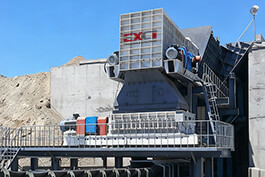
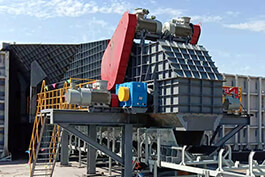
Mineral sizers also have obvious advantages in system integration, which can adapt to different production scenarios. Compared with traditional crushing equipment (such as cone crushers) which have complex structures and large volumes, mineral sizers are usually designed to be more compact.
This mobile operation mode is especially suitable for clay processing in construction waste treatment and road construction projects, greatly improving the flexibility and adaptability of production.
Conclusion
From the perspective of material characteristics, mineral sizers' "shear-tension" selective crushing mode can accurately match the low hardness, layered structure of coal, solving the key pain points of over-crushing of coal by traditional equipment. From the perspective of engineering and operation, mineral sizers have obvious advantages in energy efficiency, cost control, environmental protection, safety, and system integration, which can significantly improve production efficiency, reduce operational costs, and enhance the adaptability of production systems.


.jpg)