Introduction
In heavy industries such as mining, metallurgy and building materials, Apron feeder often needs to continuously handle materials with extremely high specific gravity such as ores and rocks, and is subject to continuous heavy loads, impact loads and harsh working conditions. The heavy-duty design of Apron feeder covers core carrying, stable support, power transmission and detailed protection. This article will analyze the internal logic of its load-bearing capacity from four dimensions: chain and pallet, idler wheel and frame, power transmission system, and key design details.
The Core Load-Bearing System
Heavy-Duty Crawler Chains
Key components and materials
The core components of the Apron feeder, such as links, pins and bushings, are all made of heavy-duty specifications at the level of bulldozers or excavators. The materials are selected from high-strength alloy steel and formed through casting or forging processes, making the chains not only have extremely high tensile strength, but also be able to withstand the instantaneous stress caused by the impact of materials, avoiding link breakage or pin deformation. Compared with ordinary conveyor chains, its overall strength is increased by 3 to 5 times, and it can meet the working conditions where a single section of the pallet can carry several tons of materials.
The load-bearing mechanism of the chain
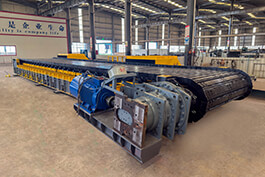
The chain is formed by the continuous connection of chain links to create a closed circular structure, which evenly transfers the weight of the material on each pallet to the entire running track. When the materials fall on the pallet of the apron feeder, the load is transferred to the chain link fixed to it, and then diffuses to the entire chain system through the linkage of adjacent chain links, so that the load is dispersed to each support point of the track and avoids damage to local chain links due to concentrated force.
Overlapping Pans
Shape design
The Apron feeder pans adopt a unique lapping structure. Adjacent pans form a continuous conveying surface through precise lapping fit, effectively preventing material leakage into the internal structure of the equipment and avoiding the wear of moving parts by dust and particles. The side of the pallet is designed with high flanges to prevent heavy materials from overflowing due to vibration or tilting during transportation.
Pallet material and thickness
The material of Pans can be high-strength and high-wear-resistant manganese steel or alloy steel. The thickness is calculated and designed based on the load-bearing capacity. For super-large load conditions, thickening treatment or composite wear-resistant layers will be adopted in the concentrated force areas to further enhance its anti-deformation and anti-wear capabilities.

The Foundation for Stable Operation
Support Roller System
Structure and Layout
The idler wheels adopt a roller structure and are fixed to the frame through bearings and shaft seats. The layout density of the idler wheels is determined based on the length of the pallet and the load-bearing requirements. Generally, 4 to 6 idler wheels are set within each meter of length to form a continuous support surface, ensuring that the pallet remains in a stable support state throughout operation.
The principle of distributed load
Due to the dense distribution of the idler wheels, the heavy load applied by the materials is evenly distributed on each idler wheel and then transferred to the frame beam by the idler wheels. This can effectively prevent the pallet from bending or deforming due to excessive local force, while reducing the force intensity of each individual idler wheel and extending its service life.
Robust Main Frame
Structural form
The frame adopts heavy-duty channel steel or box-shaped welded structure. The channel steel is made of high-strength steel and forms an integral frame through precise welding. The box-shaped structure is formed by welding steel plates into a closed rectangular cross-section, which has stronger resistance to twisting and bending. For the super-large load Apron feeder, the frame will also be equipped with reinforcing ribs at the key force-bearing parts or use thick-walled steel plates to further enhance the local strength.
Overall rigidity
During the design stage, engineers will conduct strength checks on the frame through finite element analysis to ensure that the deformation is controlled within the allowable range when it bears the maximum static and dynamic loads. This can guarantee the straightness of the running tracks of the chain and the pallet, avoid problems such as chain jamming and tooth skipping caused by frame deformation, and at the same time ensure the fit accuracy of each component of the apron feeder. Enhance the overall operational stability.
Power and Transmission
Heavy-duty drive unit
The drive system selects high-torque, low-speed drive motors and reducers. The motor power is precisely calculated based on the rated conveying capacity of the equipment and the specific gravity of the material. During the soft start process, the motor speed gradually increases and the driving force slowly increases to avoid damage to components such as the chain and pallet caused by the impact load generated by the instant start, ensuring the smooth start of the apron feeder.
Tensioning device
The Apron feeder is equipped with a reliable screw tensioning mechanism. By adjusting the extension and retraction of the screw, the tension of the chain is controlled to ensure that the chain is always in the optimal tensioning state, avoiding problems such as tooth skipping and chain disconnection caused by chain relaxation, reducing the wear between the chain and the sprocket, and improving the transmission efficiency.
Critical Design Details
Sealing and Lubrication
The key moving parts of Apron feeder, such as heavy-duty bearings, pins, bushings, etc., all adopt multiple sealing structures, such as the combination of lip seals and dust covers, effectively preventing dust, water and material particles from entering the interior of the components and avoiding accelerated wear. Meanwhile, it is equipped with a centralized lubrication system, which delivers lubricating oil to each lubrication point at regular intervals and in fixed quantities through oil pumps, ensuring that the moving parts are always in a good lubrication state, reducing the coefficient of friction and extending the service life of the components.
Conclusion
The integrated heavy-duty design system of Apron feeder for carrying - supporting - power - protection. The interlocking structure of the chain and the pallet serves as the core load-bearing unit, the support system composed of the idler wheel and the frame, and the power transmission system provides suitable torque and reliable power transmission. The detailed designs such as impact buffering, sealing and lubrication make the Apron feeder a reliable equipment for heavy-duty material transportation in the heavy industry field. It provides a solid guarantee for the continuous and efficient operation of the production line.