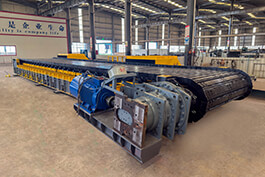
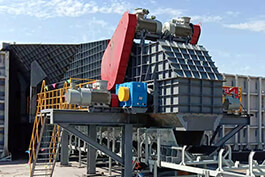
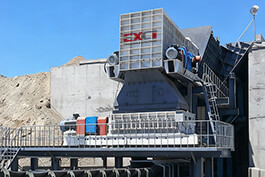
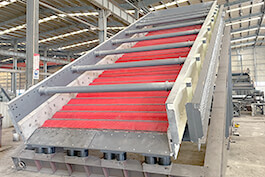
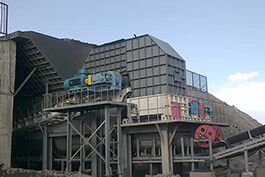
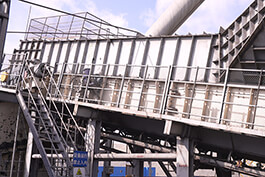
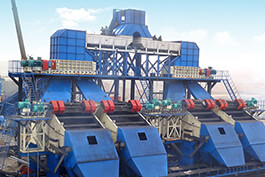
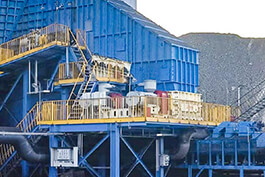
In the complex and harsh working environment, the support frame, as the "backbone" of the apron feeder, bears multiple loads including material weight, dynamic vibration, and impact force. The choice of rugged steel as the material for the support frame is not arbitrary but a scientific decision made based on engineering mechanics principles, practical application requirements, and life cycle cost considerations. This article will deeply analyze the inherent reasons for this design from three core dimensions of load-bearing—static load distribution, dynamic load stability, and impact load resistance—and combine structural details and economic benefits to fully interpret the importance of the rugged steel support frame.
Uniform Distribution of Material Weight
The most basic and continuous load borne by the apron feeder during operation is the static load composed of the self-weight of the apron plates, chains, and the bulk materials they carry. The rugged steel support frame achieves efficient bearing and uniform distribution of this static load through the collaborative design of structure and components, laying the foundation for the stable operation of the equipment.
Collaboration between Frame and Carrier Rollers
The support frame serves as the installation and support base for the carrier rollers, and the rational layout of the carrier rollers directly determines the effect of static load transmission. In the design, a large number of carrier rollers are closely arranged along the length direction of the frame, and each carrier roller is precisely installed on the frame through bearings and brackets.
Frame Material and Structure
Selection of Steel Materials
High-strength low-alloy structural steel (such as Q345 series) is usually the first choice for the support frame of apron feeders. Compared with ordinary carbon steel, this type of steel has higher yield strength and tensile strength under the same weight, which can effectively resist the permanent plastic deformation caused by long-term static load. At the same time, it has good weldability and toughness, which provides favorable conditions for the manufacturing of large-scale welded frames. In the production process, the steel plates need to undergo strict quality inspection, including mechanical property testing and non-destructive testing, to ensure that there are no internal defects such as cracks and inclusions, which lays a material foundation for the frame's long-term load-bearing capacity.
Structural Form
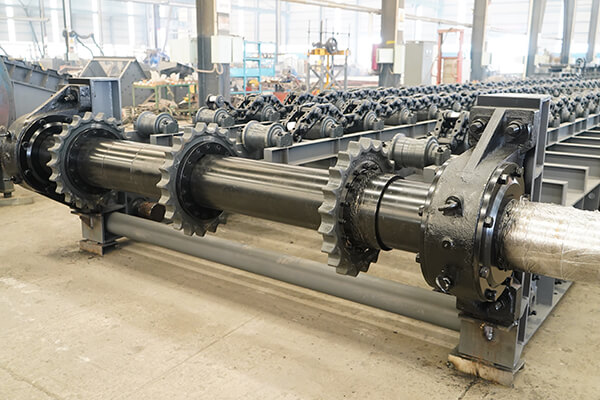
The support frame usually adopts a welded structure composed of heavy-duty thickened channel steel or I-steel, and the key stress parts are reinforced with web plates to form a rigid frame structure. This structural design has two core advantages: on the one hand, the thickened section steel provides sufficient cross-sectional moment of inertia, which can effectively resist the bending moment generated by the static load, preventing the frame from bending and deforming; on the other hand, the welded connection between the components forms an integrated force system, which avoids the stress concentration caused by the traditional bolted connection and improves the overall rigidity of the frame.
Handling Dynamic Load
Mass Damping Effect
The rugged steel support frame has significant mass damping effect due to its large self-weight and high rigidity. During the operation of the heavy duty apron feeder, the drive system will generate periodic vibration due to the meshing of gears and the rotation of shafts, and the chain will also produce vibration due to the alternating stress during the meshing with the sprocket and the movement on the carrier rollers. These vibrations will be transmitted to the frame through the drive base and carrier roller brackets. The large mass of the frame makes it have a large inertia, which can slow down the response speed to vibration and reduce the amplitude of vibration; at the same time, the high rigidity of the frame can avoid resonance caused by vibration frequency approaching the natural frequency of the frame. This not only reduces the noise generated by equipment operation (vibration is an important source of industrial noise), but also avoids the loosening of fasteners (such as bolts, nuts) caused by long-term vibration and the fatigue damage of structural components, extending the service life of the apron feeder.
Ensuring Motion Accuracy
The plates and chains of the apron feeder need to run along a fixed path to ensure uniform material conveying and avoid material leakage or equipment collision. During operation, the chain and apron plates will not deviate due to frame deformation, and can run smoothly along the design path. This not only improves the conveying accuracy of the equipment (such as ensuring a stable feeding amount), but also reduces the abnormal friction between the apron plates and the side plates of the frame, as well as between the chain and the guide rail, reducing the maintenance workload and extending the service life of the wearing parts.
Structural Design to Resist Impact
Quality of Welding Joints
Welding joints are the weak links in the frame structure, especially under the action of impact load, they are prone to cracking or failure. Therefore, the welding process of the steel frame has extremely high requirements. Usually, full penetration welding is adopted for the key stress joints of the frame, and the welds are required to have the same mechanical properties as the base material.
Reinforcement of Key Areas
The impact load on the frame is not evenly distributed, and the area under the feed inlet is the most severely impacted. Therefore, the frame design will carry out targeted reinforcement on these key areas. Common reinforcement measures include adding additional reinforcing ribs, using thicker steel plates for the local frame, and installing special impact-resistant support plates. The carrier rollers in this area are usually designed with larger diameter and thicker wall thickness, and the brackets are also reinforced to improve the ability of the carrier roller system to bear impact, thereby reducing the impact force transmitted to the frame.
Structural Details and Maintainability
Modularization and Installation
Apron feeders mining used in large-scale projects usually have a long length (up to tens of meters) and a large weight. If the frame is manufactured as a whole, it will face great difficulties in transportation and on-site hoisting. Therefore, the steel frame usually adopts a modular design, that is, it is divided into multiple sections (such as 3-5 meters per section) for manufacturing in the factory. Each section of the frame is processed with high precision, and flange connection plates with bolt holes are reserved at the joints. During on-site installation, the sections of the frame are connected into a whole through high-strength bolts. The high-strength bolts can provide sufficient pre-tightening force to make the joint have the same rigidity as the integral frame, avoiding the reduction of the overall load-bearing capacity of the frame due to the joint. At the same time, the modular design also provides convenience for the replacement of local frame components in the future.
Anchoring of Load-Bearing Components
The support frame is not only a load-bearing structure but also a installation base for key components such as the drive device, bearing seat, and carrier roller. For example, the installation surface of the drive device is processed by milling to ensure flatness and perpendicularity; the bearing seat of the drive shaft and driven shaft is fixed on the frame through positioning pins and high-strength bolts to prevent displacement during operation. These fixed points are designed with sufficient local rigidity. For example, reinforcing ribs are added around the anchor bolt holes to avoid local deformation of the frame caused by the load of the drive device, ensuring that the key components are always in the correct installation position, thereby improving the operation stability of the equipment.
Life Cycle and Environmental Adaptability
Apron feeders usually work in harsh environments such as high humidity, high dust, and strong corrosion (such as in coal mines and chemical plants). The steel support frame, as a non-wearing part with a long service life, needs to have good environmental adaptability. Therefore, the frame will undergo strict surface treatment after manufacturing. The common process is: first, carry out sandblasting derusting to remove the rust and oxide layer on the surface of the steel; then apply a primer with strong adhesion and corrosion resistance; finally, apply a topcoat with wear resistance and weather resistance.
Conclusion
The design of the rugged steel support frame is a core part of the heavy duty apron feeder's overall design, and its strength and rigidity directly determine the equipment's reliability, service life, and operation efficiency. From the perspective of investment return, the heavy-duty design of the frame is not a redundant cost input but a core non-consumable investment with high return.