Introduction
Throughout the entire production process of the mine, Mineral Sizer, as the core crushing equipment, continuously withstands the impact and compression of heavy loads. Its stable operation directly determines the mine's production capacity and operational safety. Recently, in order to ensure the delivery quality of the customized equipment for Bulgarian customers, after completing the production and processing of the crushing shaft and the load-bearing box, we carried out high-precision non-destructive testing (NDT) on these two key components. Through scientific detection methods, we identified potential hazards such as fatigue cracks and casting defects, laying the first line of defense for the long-term reliable operation of the equipment under high-intensity working conditions.
Inspection of the crushing shaft and box of Mineral sizer
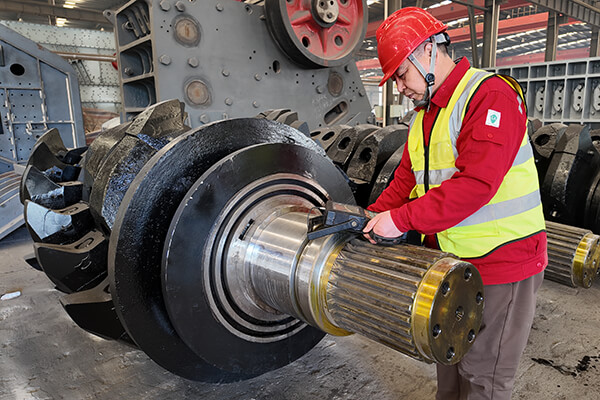
Crushing shaft
The crushing shaft transmits the crushing power to the Mineral Sizer and needs to withstand huge torque and frequent impact loads during operation. Fatigue cracks are highly likely to occur at stress concentration areas such as the journal, keyway and the transition point of diameter change. The initial size of the crack is tiny, but it will rapidly expand under alternating loads. Once it breaks, it will directly lead to equipment shutdown, not only causing huge production losses but also potentially triggering on-site safety accidents, posing a serious threat to production order and personnel safety. This inspection adopts advanced ultrasonic flaw detection technology, which can accurately identify whether there are cracks, pores and other defects inside the crushing shaft, ensuring that each crushing shaft has excellent mechanical performance and reliability.
Load-bearing box
The box body fixes the crushing shaft and disperses the vibration load of the mineral sizer. Its structural integrity is directly related to the stability of the entire machine. Due to the equipment being in a high-frequency vibration state for a long time, stress accumulation is prone to occur at the welds of the box and the structural connection points, which may lead to weld cracking or structural fatigue. If not detected in time, minor defects will deteriorate continuously under constant vibration, eventually leading to deformation of the box, misalignment of components, and triggering a chain of faults.
The necessity of detection
Many defects of mining machinery are often hidden inside the components or deep on the surface, making it difficult to detect them with the naked eye. These "invisible" tiny defects, under the heavy-load and high-frequency impact conditions of Mineral Sizer, can evolve into fatal damage, leading to unplanned downtime. Data shows that in the faults of mining machinery, accidents caused by internal defects of components account for over 30%. Therefore, precise non-destructive testing is a key means to warn of risks in advance and prevent accidents.
Ultrasonic flaw detection (UT)
Detection target
For this inspection of the crushing shaft, ultrasonic flaw detection (UT) technology was mainly adopted, focusing on key areas prone to defects such as the interior of the shaft center and the transition zone of the diameter change. This technology utilizes the propagation characteristics of ultrasonic waves in metal materials to precisely detect hidden defects such as cracks, pores, and inclusions inside. At the same time, it determines the location, size, and shape of the defects through waveform analysis, ensuring that the overall axial strength of the crushing shaft meets the design standards and satisfies the requirements of heavy-load working conditions.
Rigorous process
To ensure the accuracy of the test results, the technical team strictly follows the standardized testing procedures and controls every detail throughout the process. Before the inspection, the staff thoroughly cleaned the surface of the crushing shaft to remove oil stains, rust and oxide scale, ensuring that the inspection surface was clean and flat to avoid impurities affecting the ultrasonic transmission. Subsequently, apply the coupling agent evenly on the detection surface to fill the tiny gaps on the surface, reduce the energy loss of ultrasonic waves at the interface between air and metal, and achieve efficient transmission of sound waves into the interior of the component.
During the inspection process, technicians hold ultrasonic probes and conduct precise point-by-point scanning along the axial and circumferential directions of the crushing shaft. At the same time, they closely monitor the A-scan waveform on the flaw detector screen. By observing the changes in parameters such as amplitude, sound path, and waveform shape, they can determine in real time whether there are internal defects. For stress concentration areas such as diameter changes, a multi-angle scanning method is adopted to repeatedly verify the data, ensuring there are no blind spots in detection and eliminating potential hazards to the greatest extent.
Conclusion
The successful completion of the non-destructive testing work for the key components of the Bulgarian customer Mineral Sizer not only verified the reliability of our production process but also demonstrated our high sense of responsibility for the safe operation of the customer. In the future, we will continue to adhere to the bottom line of quality, incorporate high-precision non-destructive testing into the key links of equipment production, and rely on professional technology and a rigorous attitude to provide global mining customers with safer and more reliable crushing equipment solutions, helping customers achieve efficient, safe and sustainable production and operation.


.jpg)