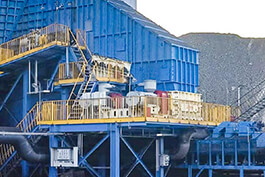
In the screening operations of the coal, mining and chemical industries, the screening of moist fine-grained viscous materials has always been a technical challenge that plagues production. The traditional Linear Vibrating Screen has frequent problems such as clogged Screen holes and decreased screening efficiency when dealing with this kind of materials. However, the Flip Flow Screen, with its unique screen surface movement mechanism, is gradually becoming the preferred equipment for processing difficult-to-screen materials.
The underlying logical differences between the two screening techniques
Flip Flow Screen
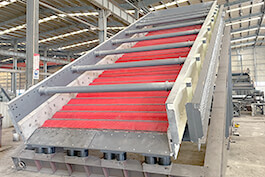
The core innovation of Flip Flow Screen lies in the synergy between its dual-mass vibration system and the polyurethane rubber screen surface. The equipment consists of two U-shaped screen boxes, inner and outer. Driven by an eccentric shaft, the two screen boxes move in opposite linear reciprocating motion with a phase difference of 180°. The polyurethane screen surfaces installed on the crossbeams of the inner and outer screen boxes then undergo alternating tension and relaxation movements, capable of completing over 800 expansion and contraction cycles per minute.
The effects of high-frequency relaxation exercises:
When the sieve holes expand, they become larger; when they contract, they return to their original state, allowing particles close to the size of the sieve holes to pass through smoothly and fundamentally avoiding the phenomenon of holes getting stuck.
The screen surface can transfer a vibration intensity of up to 30 to 50 times the gravitational acceleration to the material, causing the moist and sticky material layer to quickly loosen and stratify, achieving efficient screening.
Linear Vibrating Screen
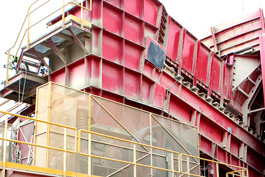
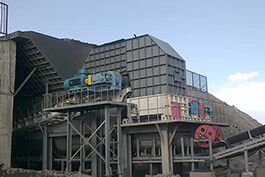
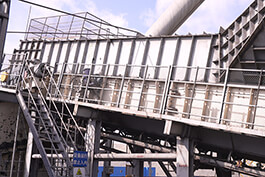
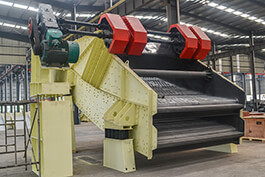
The Linear Vibrating Screen adopts a design where two vibration motors rotate synchronously in opposite directions, generating a directional linear excitation force that drives the materials on the screen surface to perform parabolic jumping motion. The vibration direction usually forms an Angle of 30° to 60° with the screen surface, the amplitude is controlled within the range of 4 to 6mm, and the vibration frequency is generally 800 to 1500 times per minute. This stable linear vibration trajectory enables the material to be conveyed forward uniformly, with high screening accuracy. It is particularly suitable for the large-scale processing of hard and dry materials with strict particle size requirements.
The essential differences in technology
Vibration mode
The Screen surface of the Flip Flow Screen itself performs relaxation motion of expansion and contraction, while the screen surface of the Linear Vibrating screen follows the screen body to perform longitudinal linear motion.
Screen surface material
The Flip Flow Screen is made of highly elastic polyurethane rubber, while the Linear Vibrating Screen is mostly made of stainless steel or manganese steel.
Applicable scenarios
Flip Flow Screen specializes in sticky and wet materials, while Linear Vibrating Screen is more suitable for hard and dry materials. This difference determines that the two perform fundamentally differently in the handling of difficult-to-screen materials.
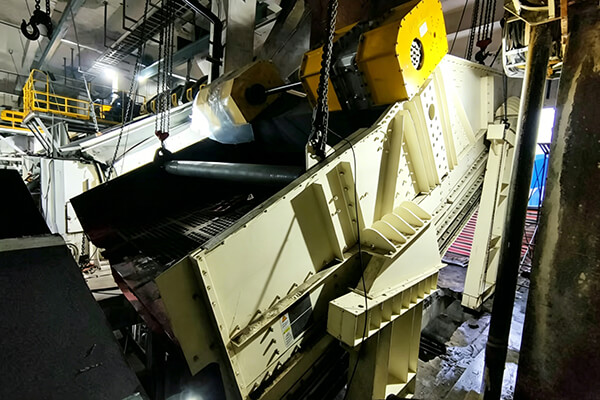
Comparison of core performance
Screening efficiency
The screening efficiency of Flip Flow Screen stands out in the field of difficult-to-screen materials, and the processing capacity can reach 1.5 to 2 times that of traditional classification screens. In the practical application of Liujiakou Coal Preparation Plant, after replacing the original classification Screen with the double-layer Flip Flow Screen, the coal carrying capacity of the system increased. The renovation data of Zhangji Coal Preparation Plant also confirmed this point.
Linear Vibrating Screen has an advantage in terms of screening accuracy. Its stable vibration trajectory is suitable for scenarios with strict particle size requirements. However, when dealing with damp and sticky materials, the screening efficiency will significantly decrease due to the easy adhesion of the materials to the screen surface.
Anti-clogging performance
During the screening process, moist fine-grained materials tend to clump together due to the tension of the surface hydration film and the sticky force of the mud, especially forming a covering film at the corners and dead corners of the screen surface that blocks the screen holes. The adhesion of moist fine-grained materials on different material screens varies significantly: the adhesion thickness on the polyurethane screen is the smallest, while the adhesion phenomenon is severe on the carbon steel and alloy steel screen surfaces.
The polyurethane Screen surface of Flip Flow Screen constantly deforms during high-frequency relaxation motion. The adhered materials are bounced off when the screen surface contracts, fundamentally preventing adhesion and blockage. The stainless steel or manganese steel Screen surface of Linear Vibrating screen frequently encounters clogging problems when handling viscous materials, requiring frequent shutdowns for cleaning, which seriously affects the continuity of production.
The key considerations in selection decisions
Material moisture content
When coal with an external moisture content of 6% to 9% is subjected to 6mm or 3mm screening, ordinary vibrating screens are difficult to operate effectively. At this time, Flip Flow screens should be given priority. For drying materials, Linear Vibrating Screen is still an economical and efficient choice.
Material viscosity
Viscous materials tend to form a stable adhesive layer on Linear Vibrating Screen, causing Screen hole blockage. However, the polyurethane screen surface and high-frequency relaxation motion of Flip Flow Screen can effectively solve this problem.
The proportion of difficult-to-screen particle sizes
When the proportion of particles close to the size of the sieve holes in the material is relatively high, the high-acceleration loosening effect of the Flip Flow Screen can significantly increase the sieving rate.
Selection decision
When the material has the characteristics of being damp and sticky, or when fine particle size screening of less than 6mm needs to be processed, Flip Flow Screen should be the preferred option. Its screen surface, with over 800 relaxation movements per minute, a material acceleration of up to 50g, and the low adhesion property of polyurethane material, can handle difficult-to-screen materials.
When the material is hard, dry, highly abrasive and the screening accuracy is strictly required, the simple structure, convenient maintenance and durable metal Screen of Linear Vibrating screen remain a more economical and reliable choice.
For scenarios with high processing capacity requirements, Flip Flow Screen can achieve rapid stratification on the sloping screen surface at the feeding end, and the material penetration rate through the screen is high. The multi-layer combination design of Linear Vibrating Screen is suitable for high-volume continuous operation. The final decision should be made through a systematic analysis based on the material characteristics, processing capacity requirements, on-site conditions and the full life cycle cost.
Conclusion
Flip Flow Screen and Linear Vibrating Screen are not a simple substitution relationship, but specialized solutions tailored to the characteristics of different materials. In the specialized field of handling difficult-to-screen materials, the Screen surface relaxation mechanism and high-acceleration vibration of Flip Flow Screen have effectively solved the clogging problem of traditional screening equipment, providing a new technical path for improving quality and efficiency in industries such as coal and mining.


.jpg)