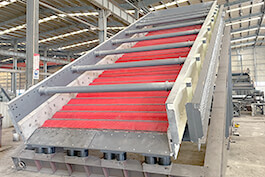
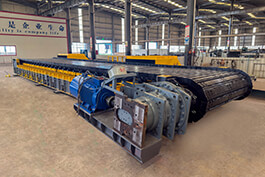
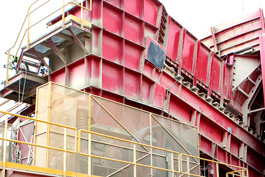
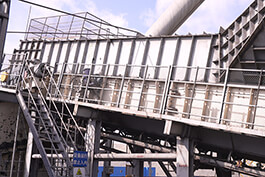
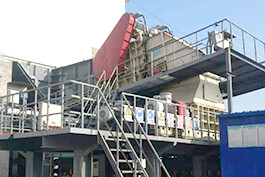
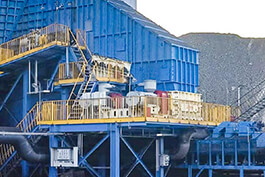
In the coal conveying workshop of a thermal power plant, the raw coal preparation section of a coal preparation plant, or the front end of a crushing production line in a mine, a precisely selected Disc screen often determines the operational efficiency of the entire production line. Insufficient processing capacity will cause the upstream belt conveyor to frequently press materials and shut down. Inadequate screening accuracy will subject the crusher to unnecessary wear and tear.
Unreasonable power configuration means paying an additional electricity bill of hundreds of thousands of yuan every year. Facing the numerous Disc Screens models in the market, how to quickly lock in the optimal configuration according to the actual working conditions?
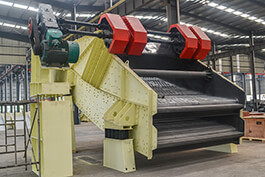
All models of GZS series Disc Screens
GZS1208 and GZS1412
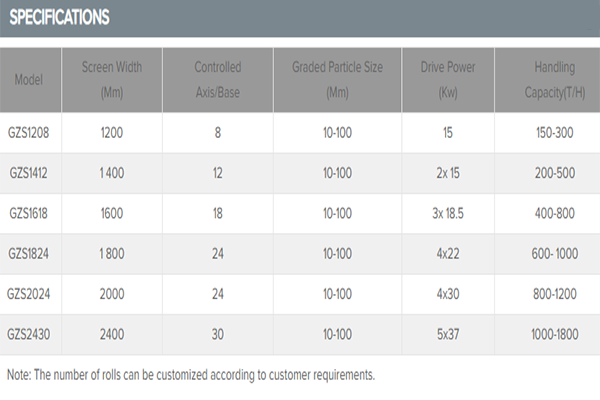
The GZS1208 is a compact model in the series, with a screen width of 1200 millimeters and 8 screen shafts arranged. Its designed processing capacity ranges from 150 tons per hour to 300 tons per hour. This scale is suitable for small-scale cogeneration projects, coal conveying systems in self-owned power plants of chemical enterprises, or as test lines and backup screening units for large-scale projects. Its advantages lie in its small land occupation, strong adaptability to the renovation of old factories, and no need for large-scale civil engineering changes to the existing belt corridors.
GZS1412, with the screen surface width expanded to 1400 millimeters, the number of screen shafts increased to 12, and the processing capacity range jumped from 200 tons per hour to 500 tons per hour. It can be seen from the parameter changes that the width of the screen surface has only increased by approximately 17%, but the number of shafts has risen by 50%, and the upper limit of processing capacity has increased by 67%. This indicates that in the design of Disc Screens, the contribution of the screen shaft density to production capacity sometimes even exceeds the simple expansion of the screen surface width.
GZS1618 and GZS1824
The screen surface width of GZS1618 is 1600 millimeters, with 18 screen shafts arranged, and the processing capacity can reach 400 tons to 800 tons per hour. Its 18-axis design means that the material has more opportunities to roll and pass through the screen on the screen surface, which makes it more adaptable to raw coal with complex particle size composition and large fluctuations in fine particle content.
The GZS1824 pushes the screen surface width to 1800 millimeters, further increases the number of screen shafts to 24, and the processing capacity ranges from 600 tons per hour to 1,000 tons per hour. When the width of the screen surface exceeds 1600 millimeters, the load distribution of each single screen shaft tends to be uniform, allowing for a higher feeding speed, but the capacity gain per unit width begins to decline marginally. GZS1824 is more suitable for projects that have strict requirements for the processing capacity of a single device and where the on-site space allows for horizontal expansion.
GZS2024 and GZS2430
The screen width of GZS2024 is 2000 millimeters, with 24 screen shafts and a processing capacity ranging from 800 tons to 1,200 tons per hour. It has the same number of shafts as GZS1824, but the width of the screen surface has increased by 11% and the upper limit of processing capacity has risen by 20%.
The screen surface width of GZS2430 reaches 2400 millimeters, with 30 screen shafts arranged. The processing capacity ranges from 1,000 tons per hour to 1,800 tons per hour. The dense arrangement of 30 screen shafts gives it a natural advantage in screening accuracy. For inferior coal with high gangue content and many soil interlayers, it can achieve more thorough particle size classification.
Common parameters
A review of the technical specifications of the six models reveals that the nominal classification particle sizes of all models range from 10 millimeters to 100 millimeters. But this does not mean that the GZS series can only handle materials within this range. In fact, by replacing screen plates of different thicknesses and tooth shapes, the lower limit of the classification particle size can be reduced to 6 millimeters, and the upper limit can be extended to 150 millimeters.
For instance, in the depowdering process of a coal preparation plant, the use of thin parabolic screen plates can control the effective classification particle size at around 6 millimeters, and screen out a large amount of pulverized coal to reduce the load of subsequent washing and selection. In the pre-screening conditions of mines, the thickened plum blossom-shaped screen plates can withstand the impact of 200mm grade raw ore while ensuring efficient screening of large pieces over 100mm.
Processing capacity
Match the peak processing capacity of the project with the design range of the model, but a reasonable safety margin needs to be reserved. In engineering practice, it is not recommended to keep the equipment operating within the upper limit range of the nominal processing capacity for a long time. Take GZS1618 as an example. Its upper limit is 800 tons per hour. If the project peak reaches 750 tons per hour, it seems to be within the range. However, considering factors such as fluctuations in incoming material particle size, moisture content changes, and equipment aging, the actual effective production capacity may only be 85% to 90% of the nominal value. Therefore, a more prudent approach is to conduct reverse selection at 80% of the peak processing volume.
Specifically, within the range of 150 to 300 tons per hour, GZS1208 is the only economically reasonable choice. With a capacity of 300 to 500 tons per hour, the cost-performance advantage of GZS1412 begins to emerge. With a capacity of 500 to 800 tons per hour, the GZS1618 is the mainstream configuration and one of the best-selling models in the entire series. The comprehensive indicators of GZS2024 are the most balanced, ranging from 800 to 1,200 tons per hour. For demands exceeding 1,200 tons per hour, GZS2430 must be considered, or a redundant solution of multiple medium models connected in parallel should be adopted - the latter is actually more flexible in continuous production scenarios where maintenance and rotation are required.
On-site space
Disc Screens are not isolated devices. They need to be arranged in coordination with upstream feeding belts, downstream chutes or crushers, and lateral bypass channels. The compact size of GZS1208 and GZS1412 makes them highly competitive in the renovation projects of old power plants. For models GZS1824 and above, special attention should be paid to the reservation of maintenance passages. The maintenance core of Disc Screens lies in the replacement of screen plates and the adjustment of chain tensioning. These operations usually need to be carried out from the side or top of the screen body.
Take GZS2430 as an example. Its screen surface width is 2400 millimeters, and with the bearing boxes and guards on both sides, the overall width may exceed 3000 millimeters. If there are no maintenance channels of at least 4000 millimeters on both sides, the later maintenance will be extremely difficult. In addition, for large-sized drive motors, the layout of the electrical control cabinet and the direction of the cable tray also need to be incorporated into the spatial planning during the selection stage.
Material characteristics
Under the same processing capacity and space conditions, the difference in materials may lead to fundamental differences in model selection. The best compatible models for dry thermal coal and moist lignite in the GZS series are not the same.
For dry coal with a moisture content of less than 10%, all six models are competent. The selection mainly depends on the processing capacity and on-site space. However, when the moisture content exceeds 15%, especially when it falls into the category of 20% to 30% lignite or raw coal during the rainy season, the number of screen shafts becomes a key variable. More screen shafts mean a denser interlaced arrangement of screen plates.
The material undergoes more rolling and self-cleaning actions on the screen surface, significantly increasing the probability of wet and sticky coal lumps being crushed and passing through the screen. The content of impurities in the materials will also affect the selection. If there are many impurities such as gangue, wood blocks and iron wires in the raw coal, the 30-axis arrangement of GZS2430 provides higher screening accuracy, which can retain most of the impurities in the material on the screen and protect the downstream crusher.
On the contrary, if the particle size composition of the material is relatively uniform and there are few impurities, there is no need to blindly pursue a high number of shafts to avoid the procurement cost and later maintenance burden caused by excessive configuration.
The key steps from selection to implementation
After the initial selection of the Disc Screen model is completed, there are still several key steps to ensure that the selection results are smoothly transformed into on-site benefits.
First, on-site investigation and dimension verification are required, especially for the height of the feed inlet, the Angle of the discharge chute and the maintenance space of the large-sized model. A three-dimensional model collision check needs to be conducted with the technical team of the manufacturer.
Secondly, the confirmation of the drive electrical control scheme is required. Whether to configure frequency conversion, whether to require a remote monitoring interface, and whether to achieve interlocking control with the upstream belt conveyor should be clearly stated in the technical annex of the contract.
Finally, there is the agreement on the material and service life commitment of the screen plates. For high-wear conditions, the theoretical service life of Mn13 high manganese steel screen plates can reach over 8,000 hours. However, the actual service life is closely related to the hardness of the material and the feeding method. It is recommended to request the manufacturer to provide reference service life data under the same working conditions.
If you need specific project selection, including processing capacity verification, power calculation and installation dimension drawing, please feel free to contact our technical team to obtain a detailed solution.


.jpg)