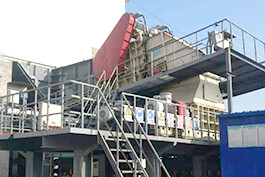
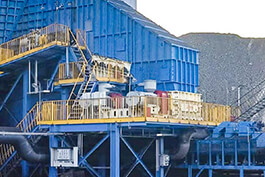
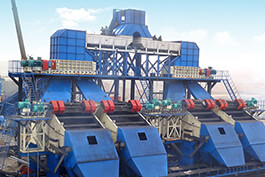
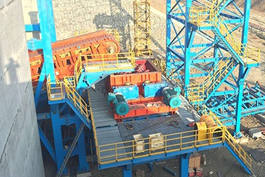
The differences in working conditions and materials require different designs of apron feeders. The parameters should be adjusted and component models should be selected according to the working conditions and applications. Before determining the final specifications of the equipment, various factors need to be considered.
Consideration Factors for Apron Feeder Parameter Setting
Material Characteristics
Considering the appropriate pan width, the maximum lump size of the material must be determined so that the pan can accommodate the maximum material lump. Generally, the minimum width is taken as twice the maximum lump size of the material. After determining the pan width, the thickness of the material layer on the pan and chain speed need to be considered. When selecting the pan, the material lump size, density and feeding method of the Apron Feeder should be considered comprehensively. When trucks directly unload materials onto the pan, impact rails are generally installed in the hopper area.
Capacity
The capacity is mainly determined by three parameters: pan width, material layer thickness and chain running speed. The calculation formula can be expressed as: capacity equals pan width multiplied by material layer thickness multiplied by material density multiplied by chain speed. When setting actual parameters, a 10% to 20% capacity margin should be reserved to avoid exceeding the equipment load due to material fluctuations during actual production. The running speed of the pan needs to be set according to the on-site discharge rhythm and the processing capacity of subsequent equipment. It should neither be too fast, causing blockage in the subsequent process, nor too slow, failing to meet production capacity requirements. Generally, the chain running speed of Heavy Duty Apron Feeder is set within the range of [ ]m/min to [ ]m/min, and it can be flexibly adjusted according to feeding distance and capacity requirements.
Installation Inclination Angle
Heavy Duty Apron Feeder generally adopts inclined installation. Without affecting material flowability, reasonably increasing the installation inclination angle can shorten the overall length of the equipment, reduce the occupied space and equipment manufacturing cost. The setting of installation inclination angle needs to be adjusted according to the angle of repose of the material. It is usually 3 to 5 degrees smaller than the material angle of repose to avoid excessive inclination causing the material to automatically slide down on the pan, making it impossible to stably control the feeding amount. The conventional installation inclination angle range is 18 degrees to 23 degrees. For some sticky materials with poor flowability, the inclination angle can be appropriately reduced.
Hopper Discharge Opening
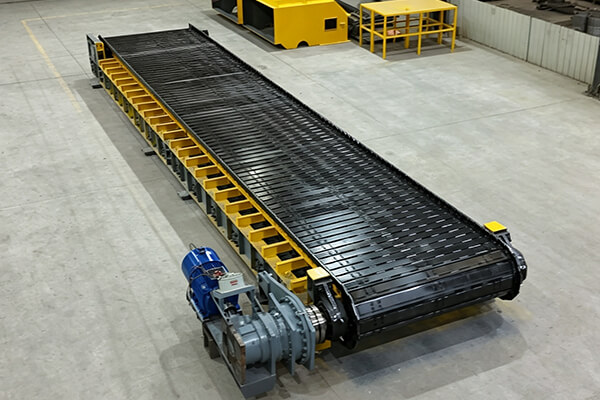
The hopper discharge opening is related to the power requirement of the equipment. The longer the discharge opening, the greater the power required to drive the feeder. Therefore, an effective material storage section needs to be set inside the hopper, and it should match the overall length of the equipment and chain tension. Chain tension is an important parameter for power calculation and also determines the specifications of traction chains, rollers and feeder frames.
Drive Device
The core parameter of the drive device is driving power, which needs to be calculated according to the total running resistance. The power selection also needs to reserve a reasonable safety margin to ensure stable equipment start-up and long-term heavy-load operation. Our Apron Feeder uses an explosion-proof three-phase variable frequency motor connected with a reducer through a coupling. It adopts electrical frequency converter soft start, which has the characteristics of heavy-load starting, gradual acceleration, reducing starting impact, lowering motor starting current and improving motor service life.
Design Points of Heavy Duty Apron Feeder
Deviation and Problems of Idealized Calculation Method
When calculating the driving power of Heavy Duty Apron Feeder, calculation needs to be carried out according to certain formulas. When calculating the transmission efficiency of the transmission chain, attention should be paid to some other issues. For example, the motor of Heavy Duty Apron Feeder may not start when the load is too large or due to other factors, while sometimes the motor can operate under overload conditions. When calculating with driving power, the operation of Heavy Duty Apron Feeder is considered according to a relatively ideal operating condition. It only considers the friction resistance of ore against the pan during operation of Heavy Duty Apron Feeder, while other influencing factors are ignored, resulting in certain deviation in driving power calculation and causing the selection of the main drive motor to be too small.
Calculation Method of Driving Power and Total Resistance
Therefore, when calculating the driving power of Heavy Duty Apron Feeder, the total resistance on the transmission chain needs to be calculated, so as to obtain the circumferential force that the driving sprocket should transmit to the chain belt, and thus obtain the current power calculation method.
Analysis of the Composition of Total Running Resistance
The total running resistance of Heavy Duty Apron Feeder mainly includes: the total friction resistance generated by the mechanical movement of the feeder, the friction resistance between running materials and side plates, lifting slope resistance, and additional resistance caused by chain belt rigidity, bending and other factors. Among them, the total running resistance refers to the combination of the friction resistance of the upper and lower branch supporting rollers in the supporting device, the self-weight friction resistance of the chain belt device, the friction resistance generated by the normal pressure of conveyed materials on the chain belt, and the hopper pressure friction resistance. These resistances play an important role in calculating the operating efficiency of Heavy Duty Apron Feeder.
Material Flow Friction, Slope and Additional Resistance
During the operation of Heavy Duty Apron Feeder, the material forms a rectangular cross-sectional material flow between the chain belt and the side plates. The resistance formed between the material and the chain belt mainly depends on the pressure of the material on the side plate surface and the friction coefficient between the material and the surface, which needs to be considered in the equipment force analysis. When calculating Heavy Duty Apron Feeder, the influence of material slope resistance and other additional resistances on equipment operation also needs to be considered.
Optimization Design
For Heavy Duty Apron Feeder, chain tension is very important for the design cost of the complete machine and the design, selection and matching of components. It directly affects the selection of chain, motor, reducer, hydraulic system and other external supporting components, and also has a direct impact on the design strength and stiffness of the complete machine.
From the simplified relationship between total running resistance and material layer thickness, it can be seen that the most direct and effective method to reduce chain tension is to reduce the feeding thickness of Heavy Duty Apron Feeder. However, from the perspective of selecting an appropriate pan speed, pan speed is a decreasing function of material layer thickness. After reducing the material layer thickness, the pan speed must be increased to ensure the conveying capacity. Excessive pan speed will increase chain wear and reduce service life.
At the same time, from the simplified relationship between power consumption and material layer thickness, it is not difficult to see that in terms of reducing energy consumption, the material layer thickness is not the smaller the better, nor the larger the better, but there is an optimal value.


.jpg)
.jpg)