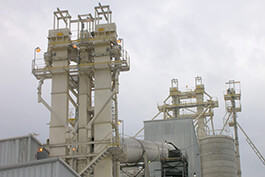
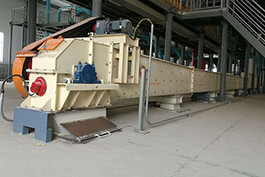
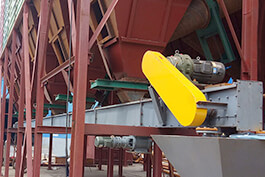
What are tubular drag conveyors?
Tubular drag conveyors are used in a closed conveying pipe. They feature cooperating chains and sprockets as the driving components. Scrapers are arranged on the chains. The chains drive the scrapers to move along the closed conveying pipe. The sealed pipe is equipped with feeding and discharging ports to allow materials to enter and exit the closed conveying pipe. Materials entering the sealed pipe through the feeding port are pushed and moved by the chains and scrapers and then discharged from the discharging port, thus achieving the conveying of materials.
The problems and deficiencies of tubular drag conveyors.
Tubular drag conveyors have the advantages of light weight, low energy consumption, good sealing performance, and flexible and convenient layout. During the transportation of powder, granular and other materials, they can effectively prevent the dust and fine impurities in the materials from scattering, protecting the environment. In recent years, due to the enhanced environmental awareness of people, tubular drag conveyors have been increasingly widely used in the transportation of grain materials, especially in the process of grain storage and retrieval. The closed environment of tubular drag conveyors can effectively prevent dust during the transportation of grains, protecting the environment. The flexible layout feature of tubular drag conveyors enables them to be arranged in various forms such as planar circular layout within the grain silo, planar circular layout on the silo roof, circular layout on the inner wall of the silo, and mobile layout within the silo, which can better achieve the mechanized transportation function of bulk grains in and out of the silo, thereby improving the efficiency of storage and retrieval.
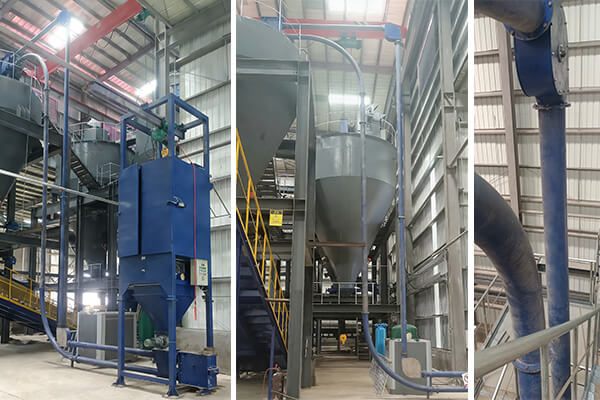
Sprockets are the main transmission components of tubular drag conveyors, including driving sprockets and turning sprockets. The driving sprocket is connected to the power component to provide power input for the movement of the chain and scraper. The turning sprocket is responsible for the entry and exit of the chain and its direction change. During the transportation of grains and other granular materials by tubular drag conveyors, when the materials are moved to the sprocket area, they rub and collide with the sprocket. After long-term operation, the sprocket is prone to wear. Sprocket wear can cause pitch changes and increased equipment vibration. To ensure the normal operation of tubular drag conveyors, worn sprockets must be replaced in a timely manner. However, the sprockets and chains of tubular drag conveyors are in a closed environment, which makes sprocket replacement difficult and inconvenient. Therefore, technicians have designed the sprockets of tubular drag conveyors as split structures, that is, the sprocket is split into two halves along the axial direction of the sprocket hub. When the sprocket is replaced, the two halves can be removed from the inspection port of the tubular drag conveyor. However, the sprocket split along the axial direction is fixed to the chain tooth plate only by the shear force of the bolts after assembly. In actual operation, it is prone to loosening and failure, affecting the operation of the chain, and further affecting the cooperation and service life of the sprocket and chain, as well as the conveying efficiency of the tubular drag conveyor.
In addition, in the existing tubular drag conveyors, since each turning node requires the arrangement of sprockets and corresponding transmission components, the inner cavity of the shell at the turning node needs to have a larger space. This leads to the fact that when the tubular drag conveyor transports materials to each turning node, the materials enter the larger inner cavity of the turning node from the smaller inner cavity of the closed conveying pipe. Due to the increase in space, the gap between the scraper of the tubular drag conveyor and the inner wall of the turning node cavity increases, causing the materials to disperse at the turning node. Some materials cannot be carried away by the scraper and remain in the inner cavity of the turning node, resulting in severe material accumulation at the turning node of the tubular drag conveyor. Especially for horizontally arranged tubular drag conveyors, the material accumulation at the turning node is particularly serious. When transporting grain materials, the grain materials remain in the turning node for a long time, which is prone to mold and deterioration, affecting the quality of the grain materials for the next transportation. Therefore, When tubular drag conveyors are used to transport grain materials, after each conveying operation, the covers of all turning nodes must be opened for cleaning. This operation is troublesome and requires a large amount of cleaning work, increasing the operating cost of
tubular drag conveyors.
How to solve the above problems through technological improvements.
To overcome the shortcomings of the existing technology, we have developed and improved a tubular drag conveyor. This conveyor divides the hub of the chain wheel of the tubular drag conveyor radially into two parts and the chain tooth plate of the chain wheel into two rotationally symmetrical parts. In this way, when the hub and the chain tooth plate are assembled, the chain tooth plate of the chain wheel is clamped by two hubs, and the flange surfaces of the hubs come into contact with the two sides of the chain tooth plate, generating double the friction force to prevent the chain tooth plate from loosening and avoiding the safety hazard of bolts only being subjected to shear force. The split structure makes it convenient to maintain and replace the chain wheel.
Meanwhile, a U-shaped arc-shaped wear-resistant groove is set in the shell body at the turning point of the tubular drag conveyor, and the arc-shaped wear-resistant groove is connected to the two sides of the shell body at the turning point through the conveying pipe. The chain and the scraper move in the arc-shaped wear-resistant groove, and the gap between the scraper and the inner wall of the arc-shaped wear-resistant groove is small. The turning of the grain material during the conveying process is achieved through the arc-shaped wear-resistant groove, effectively avoiding the residue of grain material at the turning point and preventing material accumulation.
To solve the above technical problems, the technical solution is implemented as follows: A tubular drag conveyor, including a power shell, a turning shell, a tensioning shell, a tensioning device, a power device, a driving chain wheel, a turning chain wheel, a chain, a scraper, a conveying pipe, an inlet and an outlet. The power shell, one or more turning shells, and the tensioning shell are connected through the conveying pipe to form a ring-shaped planar conveying channel. The conveying channel is provided with an inlet and at least one outlet, which are set on the conveying pipe. The power shell is provided with a driving chain wheel, which is relatively rotatably connected to the power shell through a shaft and a bearing assembly. The turning shell is provided with a turning chain wheel, which is relatively rotatably connected to the turning shell through a shaft and a bearing assembly. The tensioning shell is provided with a tensioning chain wheel, which is relatively rotatably connected to the tensioning shell through a shaft and a bearing assembly.
The driving chain wheel, the turning chain wheel, and the tensioning chain wheel are connected through the chain. The chain is provided with multiple scrapers evenly arranged along the length of the chain. A power device is provided outside the power shell, which provides power for the rotation of the driving chain wheel. The driving chain wheel drives the tensioning chain wheel and the turning chain wheel to rotate through the chain, thereby driving the chain and the scraper to move along the conveying channel. The material enters the conveying channel from the inlet and is pushed by the moving scraper to move along the conveying channel and be discharged from the outlet. A tensioning device is provided in the tensioning shell to adjust the tension of the chain. Among them, the driving chain wheel, the turning chain wheel, and the tensioning chain wheel have the same structure and are all split chain wheels, including a chain tooth plate, a left hub, and a right hub. The left hub is provided with a left flange, and the right hub is provided with a right flange. The left hub and the right hub are respectively arranged on both sides of the chain tooth plate. The left flange and the right flange are connected to the chain tooth plate through bolts. The chain tooth plate is a split chain tooth plate, which is divided into a left chain tooth plate and a right chain tooth plate with the same structure along the split line. The left chain tooth plate and the right chain tooth plate are symmetrical by rotating 180° around the center hole axis of the chain tooth plate. Arc-shaped wear-resistant grooves are provided in the power shell, the turning shell, and the tensioning shell, which are connected to the conveying pipe. The arc-shaped wear-resistant grooves are provided with through holes, and the chain teeth of the chain tooth plate pass through the through holes and mesh with the chain in the arc-shaped wear-resistant groove. The dividing line of the chain tooth plate includes an upper inclined part, a vertical part and a lower inclined part. The vertical part coincides with the vertical center line of the chain tooth plate. The upper inclined part and the lower inclined part are respectively located on the left and right sides of the vertical part, and the upper inclined part and the lower inclined part are symmetrically arranged with the center hole's axis as the symmetry center line by rotating 180°.
The upper end point of the upper inclined part is located at the midpoint of the bottom arc line of the tooth groove A, and the lower end point of the upper inclined part coincides with the upper end point of the vertical part. The upper end point of the lower inclined part coincides with the lower end point of the vertical part, and the lower end point of the lower inclined part is located at the midpoint of the bottom arc line of the tooth groove B. The tooth groove A and the tooth groove B are symmetrically arranged with the center hole's axis as the symmetry center line by rotating 180°.
The chain tooth plate is a high-strength nylon chain tooth plate. The left hub includes a left hub body, a left flange, a tensioning hole and a left key connection hole. The left hub body is provided with a left flange, and the left hub body is provided with a tensioning hole and a left key connection hole arranged coaxially and communicating with each other for connecting the rotating shaft. The tensioning hole is tensioned and connected to the rotating shaft through a tensioning sleeve. The inner diameter of the tensioning hole is larger than that of the left key connection hole. The left key connection hole is provided with a left keyway. The right hub includes a right hub body, a right flange and a right key connection hole. The right hub body is provided with a right flange, and the right hub body is provided with a right key connection hole for connecting the rotating shaft. The diameter of the right key connection hole is the same as that of the left key connection hole of the left hub.
The right key connection hole is provided with a right keyway having the same structure and size as the left keyway of the left hub. The outer arc-shaped parts of the power housing, the steering housing and the tensioning housing are all provided with arc-shaped inspection doors. The arc-shaped wear-resistant groove is a non-metallic wear-resistant groove, including a connecting groove, a steering groove and an inner lining plate.
The steering groove is an arc-shaped groove. The two ends of the steering groove are respectively tightly connected to the connecting grooves through flanges and bolts. The cross-sectional shapes of the steering groove and the connecting groove are both hook-shaped. The height of the inner side wall of the hook-shaped steering groove and the connecting groove is lower than that of the outer side wall. The inner lining plate is positioned and connected to the inner side walls of the two connecting grooves through connection pins. After the inner lining plate is connected to the connecting grooves, the two connecting grooves, the steering groove and the inner lining plate form an arc-shaped wear-resistant groove with a U-shaped cross-sectional shape.
The two ends of the U-shaped arc-shaped wear-resistant groove are connected to the conveying pipes. A through hole for the chain teeth of the chain tooth plate to pass through is provided at the joint of the inner lining plate and the two connecting grooves. The inner lining plate is a right-angle bent plate. The lower end of the inner lining plate is provided with an opening downward slot. The inner side of the inner lining plate is provided with a flange plate for connecting the conveying pipe.
The two ends of the inner lining plate are provided with plug blocks for insertion and positioning in the inner cavity of the conveying pipe. An opening upward slot is provided on the inner side wall of the connecting groove. The opening upward slot on the inner side wall of the connecting groove and the opening downward slot on the inner lining plate form a through hole for the chain teeth of the chain tooth plate to pass through. One end of the connecting groove is provided with a flange for connecting the steering groove, and the other end is provided with a groove for positioning the flange of the conveying pipe.
The beneficial effect is that the hub of the chain wheel of the tubular drag conveyors is radially divided into two parts, and the chain tooth plate of the chain wheel of the tubular drag conveyors is divided into two rotationally symmetrical parts. In this dividing method, when the chain wheel's chain tooth plate is assembled with the two hubs, the chain tooth plate of the chain wheel is clamped by the two hubs, and the flange surfaces of the hubs contact the two sides of the chain tooth plate, generating double the friction force to prevent the chain tooth plate from loosening, and also avoiding the safety hazard of the bolts only being subjected to shear force. The split structure facilitates the maintenance and replacement of the chain wheel. Meanwhile, a U-shaped arc-shaped wear-resistant groove is provided in the housing at the turning point of the
tubular drag conveyors.
The arc-shaped wear-resistant groove is connected to the two sides of the conveying pipes at the turning point. The chain and the scraper move in the arc-shaped wear-resistant groove. The gap between the scraper and the inner wall of the arc-shaped wear-resistant groove is small. The turning of the grain material during the conveying process is achieved through the arc-shaped wear-resistant groove, thereby effectively avoiding the residue of the grain material at the turning point and preventing material accumulation.