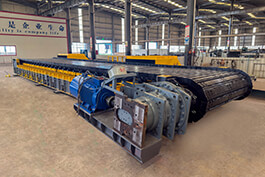
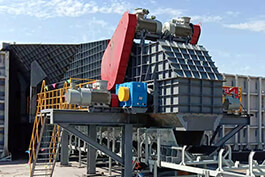
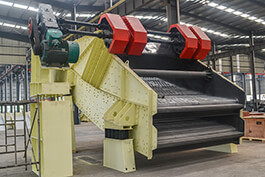
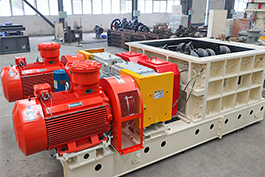
Apron feeder, as an important piece of equipment in the mining industry, is usually used in complex and harsh working conditions. As the most important traction construction chain and pan of the apron feeder, they are the components that come into direct contact with materials and are also the most vulnerable to damage.
How to Effectively Solve the Problem of Damage to the Apron Feeder Chain and Pans
Selecting appropriate materials and complementing them with exquisite heat treatment processes is the foundation for enhancing the wear resistance and impact resistance of chain and pan, and it is also the most crucial passive defense line.
Choose wear-resistant materials
Chain components generally adopt medium-carbon alloy structural steel with high strength and high toughness. Commonly used material grades include:
40Cr, 45# steel: These are very classic quenched and tempered steels, widely used in the manufacture of rollers and shaft parts. After quenching and tempering treatment, it has excellent comprehensive mechanical properties. Then, through surface quenching, a very high surface hardness can be obtained.
42CrMo: It has better strength and hardenability than 40Cr and is often used to manufacture critical components with higher requirements for strength and toughness, such as drive shafts and high-load pin shafts.
20CrMoTi, 35CrMo: These types of steel are typical carburizing or carbo-nitriding steels, used for manufacturing components that require "hard on the outside and tough on the inside", such as pins. After carburizing and quenching, the surface hardness is extremely high and the wear resistance is excellent, while the core maintains sufficient toughness to resist impact loads.
50Mn, 65Mn: Manganese steel has excellent wear resistance. Especially high manganese steel will undergo work hardening under strong impact loads, with a significant increase in surface hardness, making it very suitable for manufacturing chain plates (chain links).
Alloy cast steels such as ZG310-570 and ZG340-640: mainly used for manufacturing complex-shaped drive and driven sprockets. After casting, the matrix performance is improved through normalizing and quenching and tempering treatment, and then the tooth profile is surface quenched to obtain high wear resistance.
Pin: As the "skeleton" of the chain, it withstands shear stress and bending stress, and rotates relatively with the sleeve at the same time. The ideal pin shaft should have an extremely wear-resistant surface and a strong and impact-resistant core. Therefore, 20CrMoTi isocarburized steel is often selected for carburizing, quenching and low-temperature tempering. The surface hardness can reach above HRC55-60, while the core hardness is maintained at HRC30-40.
Bushing: The inner hole of the bushing fits with the pin shaft, and the outer circle meshes with the teeth of the roller or sprocket. Both the inner and outer surfaces are subjected to severe wear. Usually, materials and processes similar to those used for pin shafts are adopted, or medium carbon alloy steel with good high-frequency quenching performance is selected to achieve a hardness of HRC52-57.
Roller: The roller rolls on the track, enduring contact fatigue and abrasive wear. Generally, 45# steel or 40Cr is selected for overall quenching and tempering treatment to ensure toughness. Then, the rolling tread is subjected to high-frequency induction hardening, with a hardness requirement of HRC45-55 to resist crushing and wear.
Link Plate: The link plate bears the tensile load of the entire chain and requires high strength and high fatigue limit. Alloy steels such as 50Mn and 35CrMo are usually selected. The best matching of strength and toughness is achieved through quenching and medium-temperature tempering (quenching and tempering treatment), and the hardness is generally controlled at HRC36-42.
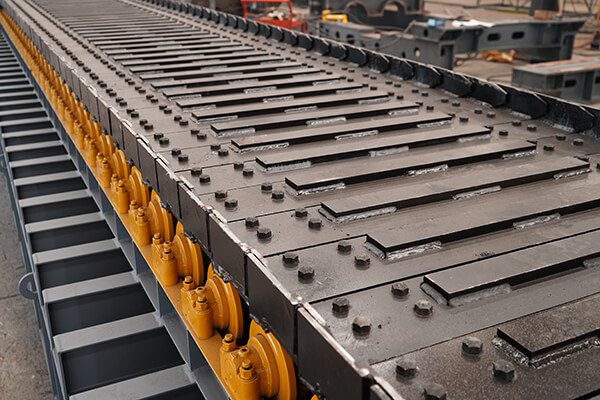
As a direct load-bearing surface of apron feeder, the core of Pan's material selection is to balance wear resistance and impact toughness.
Manganese Steel plates: especially medium manganese steels such as 16Mn (Q345) and high manganese steels (Hadfield Steel), are traditional advantageous materials for manufacturing channel plates. 16Mn, after cold pressing and heat treatment, has excellent comprehensive performance. High manganese steel performs exceptionally well under strong impact conditions. Its surface undergoes a phase transformation from austenite to martensite, generating a significant work hardening effect. The hardness can leap from HB200 to over HB500, forming a characteristic of "getting harder the more it is hit", making it extremely suitable for processing large pieces of ore.
Quenched and Tempered Steels wear-resistant steel: Through precise chemical composition design and strict quenching + tempering process, extremely high hardness (up to HB400-600) and excellent toughness are achieved. This type of steel plate is widely used as the base material for channel plates or as wear-resistant lining plates.
Advanced welding techniques enhance its wear resistance
On a common carbon steel or low alloy steel substrate with good toughness, one or more layers of high-hardness and high-wear-resistant alloy layers are surfacing through an automatic welding process. The surfacing layer is usually rich in carbides of elements such as chromium, tungsten, molybdenum and niobium, such as high-chromium cast iron series materials, whose macroscopic hardness can reach HRC58-65. This structure combines the impact resistance of the substrate with the ultra-high wear resistance of the surfacing layer.
Advanced spraying technology effectively enhances its wear resistance
Thermal spraying technology involves rapidly spraying molten or semi-molten coating materials onto the surface of workpieces to form a firmly bonded protective layer.
Process types: including plasma spraying, supersonic flame spraying (HVOF), arc spraying, etc.
Coating materials: The range of materials that can be sprayed is extremely wide, including metals, alloys, etc., and extremely thick wear-resistant layers can be prepared.
Application advantages: Especially the HVOF technology can prepare dense and high-bonding strength carbide coatings (such as tungsten carbide-based and chromium carbide-based), whose wear resistance far exceeds that of hard chromium coatings. It has been successfully applied to related components of feeders (such as rotary valves).
Excellent design effectively enhances the wear resistance and damage resistance of the chain and pan
1.Optimization of the meshing between sprockets and chains
The design of the head drive sprocket has a significant impact on the service life of the chain. The design of separate transmission for odd and even teeth is adopted, that is, if the number of chain links is even, the number of teeth on the sprocket is odd. This ensures that each roller of the chain alternately meshes with all the teeth of the sprocket instead of always meshing with a fixed few teeth, thereby evenly distributing wear and extending the overall service life of the sprocket and the chain
2.Innovative design of tensioning device and rollers
Toothless tensioner pulley: The tensioner pulley (driven pulley) at the tail adopts a toothless structure and only comes into contact with the chain roller through a smooth outer tread surface. This design avoids the impact and sliding friction during the meshing process, significantly reduces the wear on the traction chain, and lowers the operational vibration.
Rolling bearing rollers: Traditionally, there is sliding friction between the rollers and the bushings, which leads to high resistance and rapid wear. Modern design generally adopts the roller structure with built-in rolling bearings, which transforms sliding friction into rolling friction, greatly reducing running resistance, lowering energy consumption, and causing less wear and longer service life
3.The traction chain and the load-bearing chain are designed separately
In some heavy duty apron feeders, an innovative design concept of separating traction and carrying functions has been adopted. That is, two independent chain systems are set up: one is the traction chain installed on both sides, which is only responsible for providing tension; Another set is a multi-row load-bearing chain (or roller group) installed beneath the trough plate, specifically designed to support the weight of the material and the trough plate. This design enables the traction chain to no longer bear the vertical pressure of the materials, significantly reducing the dynamic load and greatly enhancing its service life.
Meanwhile, the online monitoring technology developed by our company can effectively prevent excessive wear of chains and pans, significantly extending their service life and lifespan. Here, my advice to all users is that during daily use, it is still necessary to pay attention to the maintenance and upkeep of the chain and pan. For instance, applying lubrication to the chain and regularly cleaning the debris and dust between the chain and the pallet can significantly extend the service life of the chain and pan.