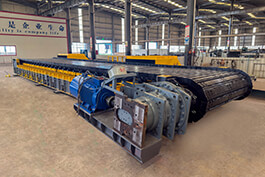
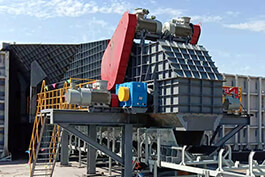
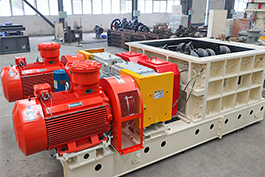
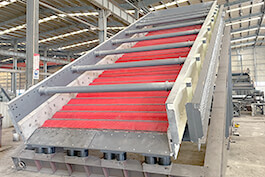
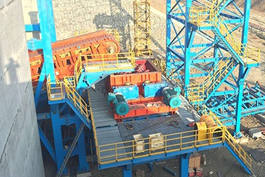
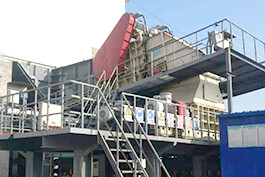
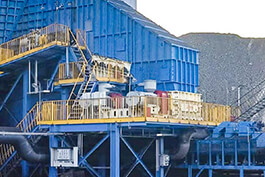
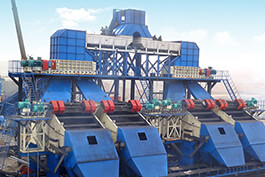
In the field of mining crushing, mineral sizer, with its unique toothed roller crushing principle, has become the core equipment for processing hard rock and wet sticky materials. The casting quality of the crushing teeth directly determines the crushing efficiency and operating cost of the entire machine.
Selection of material for broken teeth
High manganese steel series
It is the first choice under conditions of strong impact abrasive wear. Typical grades such as ZGMn13Cr2 and ZGMn18Cr2 usually have a Brinell hardness controlled within 300HB. When subjected to strong impacts, this type of material will undergo a work hardening effect on its surface, significantly increasing its hardness while maintaining high tensile strength, plasticity and toughness. It is highly suitable for the working conditions where mineral sizer processes large hard rocks. It is worth noting that the wear resistance of high manganese steel is highly dependent on impact loads. If the impact force is insufficient, its performance advantages are difficult to be demonstrated instead.
Alloy cast steel
For instance, ZG35CrMo and ZG35CrMnSi offer a more flexible hardness adjustment space. Through heat treatment processes such as quenching and tempering, the balance between hardness and toughness can be adjusted within a certain range. This type of material is suitable for crushing scenarios with moderate impact stress and has a cost advantage over high manganese steel. It is an economical choice for many small and medium-sized mineral sizer crushing teeth.
High-chromium cast iron
Cr26 and Cr27 are renowned for their high hardness and excellent wear resistance, but they are relatively brittle. Therefore, it is more suitable for fine crushing conditions without strong impact or can be used as a wear-resistant layer for tooth crowns in composite casting.
.jpg)
Casting process flow
Integral casting method
The most fundamental and widely applied process path. The process covers the smelting and precise composition control of casting alloys, pouring and molding, as well as subsequent heat treatment to achieve the target mechanical properties. For the crushing teeth of large-scale equipment like mineral sizer, integral casting can ensure the integrity of the structure and avoid assembly stress concentration.
Sand casting
The traditional and mature process of high manganese steel crushing teeth. Sand molds have good collapsibility and air permeability, which can effectively reduce the tendency of hot cracking in high manganese steel castings. Meanwhile, the cost of sand molds is relatively low, making them suitable for the production of single-piece small-batch or medium to large-sized crushing teeth. The key points of the process lie in the proportion of molding sand, the control of pouring temperature (usually 1450-1500℃), and the management of cooling rate to ensure the full formation of austenite structure.
Special casting process
Such as investment casting and metal mold casting, they serve special specification requirements. Investment casting can achieve near-net-shape forming of complex tooth profiles, with high dimensional accuracy and good surface quality, making it suitable for the batch production of small, precise broken teeth or irregular teeth. Metal mold casting features a fast cooling rate, refined grain size of the castings, and uniform mechanical properties. However, the mold cost is relatively high, making it more suitable for product series with a high degree of standardization.
How to scientifically choose the material for broken teeth?
The selection of materials needs to comprehensively consider the type of crusher, the characteristics of the materials and the working stress level. Due to the structural characteristics of single-roll crushers, the stress on the crushing teeth is relatively concentrated. Carbon steel and low alloy steel can be selected to balance strength and cost. When the double-roller mineral sizer is used to crush large pieces of high-hardness materials, the working stress increases significantly. At this time, the work hardening characteristics of high manganese steel can be fully exerted, making it the preferred material. If the stress level of the crushed material is not high or a higher cost performance is pursued, alloy steel or carbon cast steel combined with high-chromium cast iron composite tooth plates are a more economical alternative.
Where are the advantages of the high manganese steel casting process reflected?
It is necessary to clarify a common misunderstanding: compared with cast high manganese steel, forged high manganese steel has obvious advantages in wear resistance and better comprehensive mechanical properties. Forging process can break down the coarse grains and carbide network in the casting structure, refine the grains, increase the density, and thereby significantly enhance the wear resistance and impact resistance. For the critical tooth positions in mineral sizer that are subject to extreme impacts, forged high manganese steel is the ideal choice for pursuing an ultimate wear-resistant life, although its manufacturing cost and cycle increase accordingly.
How to systematically extend the service life of crushing teeth?
Extending life expectancy is a systematic project. The primary principle is to select the appropriate material grade based on the actual working conditions to avoid "overkill" or "overkill". Secondly, strictly follow the heat treatment process specifications to ensure that the material structure reaches the designed state. At the operational level, maintain a reasonable feeding particle size and feeding speed to prevent non-breakable materials such as iron blocks from entering the crushing chamber. Regularly lubricate the bearings and transmission components to keep the equipment running smoothly. Establish a periodic inspection system, and replace the crushing teeth that are worn beyond the limit in a timely manner to prevent subsequent damage to the roller shaft body. For the double-roller structure of mineral sizer, special attention should also be paid to the synchronous wear state of the tooth profiles of the two rollers. When necessary, they should be replaced in pairs to maintain the meshing accuracy.
Conclusion
As the core working component of the mineral sizer, the material selection, casting process and operation and maintenance management of the crushing teeth together form the basis for the efficient operation of the equipment. With the development of technologies such as composite casting and refined heat treatment, the performance boundaries of crushing teeth are constantly expanding. For end users, a thorough understanding of these technical key points helps them make more scientific decisions in equipment selection, spare parts procurement and daily maintenance, ultimately achieving the optimal balance between crushing efficiency and operating costs.