Introduction
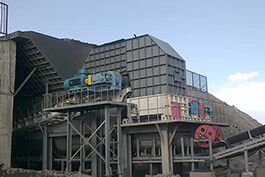
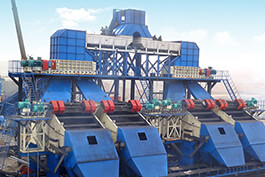
In the material screening process of heavy industries such as coal, mining, and metallurgy, the wobbler feeder has become an indispensable key device due to its advantages of simple structure, no vibrating parts, low noise, and easy sealing and dust removal. The core working component of the Wobbler feeder - the screen sheet - directly determines the screening efficiency, processing capacity and operational stability of the equipment. However, in practical engineering applications, problems such as material jamming, rapid wear, and low screening rate caused by improper selection of screen sheets are not uncommon. These not only affect production efficiency but also result in huge downtime losses. The shape design of the screen sheet determines the movement trajectory and looseness of the material on the screen surface, while the material selection is directly related to the wear resistance life and impact resistance performance.
The main shape types of the Wobbler Feeder screen sheet
Plum blossom-shaped screen sheet
The plum blossom-shaped screen sheet was the earliest classic structure adopted by the wobbler feeder. Its shape is in the form of multiple plum blossoms. It is integratively formed through the casting process, with a simple structure, convenient molding and relatively low manufacturing cost. It was widely used in the early field of coal screening.
However, the plum blossom-shaped screen sheet has obvious structural defects. The sharp corner design is very likely to cause material jamming and blockage when dealing with wet and sticky materials such as coal slime. The ejection Angle is relatively small, the loosening effect of the material on the screen surface is limited, and the screen penetration rate is relatively low. When used in working conditions with high viscosity, the problem of blockage is particularly prominent. The labor intensity of clearing the blockage is huge and the operation risk is high. The method of clearing the blockage that relies on manual labor often cannot completely clean it, seriously affecting the continuous operation of the equipment. Therefore, the plum blossom-shaped screen sheet is currently mainly applicable to the primary screening scenarios of dry, uniform particle size and non-sticky materials.
Eccentric screen sheet
The eccentric screen sheet adopts a special eccentric structure design, and the rotation center of the screen sheet does not coincide with the geometric center. When the wobbler feeder is in operation, the eccentric structure generates periodic radial displacement, which strongly disturbs and loosens the material layer on the screen surface. The core advantage lies in its ability to effectively break up the accumulated material layer, making it easier for fine particle materials to come into contact with the screen surface gap, thereby significantly improving the screen permeability.
This screen sheet is suitable for the screening operation of medium and small particle materials, as well as working conditions where the material needs to be strengthened to be loose. In the screening of fine-grained coal in coal preparation plants, it has good adaptability and can maintain a stable material conveying speed while ensuring the screening efficiency.
Parabolic screen sheet
The parabolic screen sheet is a major innovation in wobbler feeder technology in recent years. The working surface adopts a parabolic contour design and can project materials at an oblique Angle of approximately 45 degrees when rotating. Advantages: The smooth parabolic working surface effectively reduces the entanglement problem of soft impurities. The larger ejection Angle enables the blocky materials to move upwards to the greatest extent, which is conducive to the stratification and screening of the materials. Smooth curved surfaces reduce rotational resistance and lower energy consumption.
In practical applications, the rotational deflection of the parabolic screen sheet is generally greater than that of other types of screen sheets, which enables the material to be continuously thrown forward during its movement along the screen surface, effectively avoiding jamming.
Core material analysis of the Wobbler Feeder screen sheet
Wear-resistant cast steel material
Casting manganese steel (such as ZG40Mn2) is the traditional material choice for wobbler feeder screen sheets. Formed through casting processes, it features excellent fluidity and filling capacity, enabling the production of screen sheets with complex shapes. Moreover, its raw material and processing costs are relatively low.
However, it also has certain limitations. It is relatively brittle and has insufficient impact resistance. There is a risk of fracture when subjected to the impact of large pieces of materials. To ensure structural strength, the thickness of the cast steel screen sheet usually needs to reach more than 16 millimeters, which not only increases the weight of the equipment but also increases the rotational load. In actual operation, cast steel screen sheets are prone to cracking and fracture, especially when dealing with hard materials such as slow-freezing coal and gangue in winter, the failure rate is relatively high.
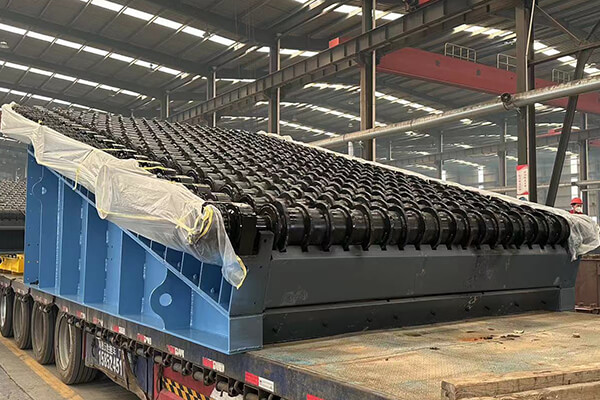
Weld NM400/NM500 wear-resistant steel
NM400 and NM500 are high-strength wear-resistant steels that comply with the GB/T24186 standard. The surface hardness of NM500 wear-resistant steel reaches 470 to 540HBW, its tensile strength is no less than 1350MPa, its longitudinal impact energy absorption is no less than 21J, and its elongation after fracture is no less than 7%, enabling it to maintain a long service life in high-wear environments.
The NM series wear-resistant steel acquires a high-strength and high-toughness martensitic structure through a heat treatment process of quenching and tempering. Studies show that within the temperature range of room temperature to 300℃, NM500 steel exhibits superior wear resistance than NM400. Under sliding friction conditions of 200 to 300N loads and 100 to 400r/min, the wear of NM500 is significantly lower than that of NM400, and its wear resistance is 3 to 5 times that of ordinary low alloy steel plates.
NM400 exhibits superior comprehensive performance in moderate wear environments. Its toughness is better than that of NM500, and it has better welding and cold forming properties. It is suitable for applications with high requirements for processing performance. In the specific application of the wobbler feeder screen sheet, the NM500 is suitable for extreme wear conditions, while the NM400 is suitable for moderate impact and wear environments.
Material comparison and analysis
Wear resistance
The NM series steel, with its high-hardness martensitic structure, has a wear resistance far superior to that of cast steel. In terms of toughness, NM steel, after an optimized heat treatment process, combines high strength with excellent impact resistance, while cast steel is brittle and prone to fracture.
Screening rate
NM steel can be manufactured with thinner plates, and the gap control of the screen sheet is more precise, which helps to improve the screening rate. In terms of service life, the service life of the NM500 screen sheet can reach over 25,000 operating hours, far exceeding that of cast steel materials.
Economy
Although the initial purchase cost of NM400/NM500 is higher than that of cast steel, considering its longer service life, lower maintenance frequency and less downtime loss, its overall usage cost is actually more advantageous. In the long-term operation of large-scale coal preparation plants and mining enterprises, the adoption of NM500 wear-resistant steel screen sheet has become a standard configuration for reducing the total cost of ownership.
The matching selection strategy of shape and material
Material characteristics
Large pieces of material
It is recommended to use parabolic screen sheet in combination with NM500 wear-resistant steel material. The 45-degree parabolic ejection Angle can effectively loosen large pieces of material and prevent jamming. The high hardness and excellent wear resistance of NM500 can withstand the severe impact and wear of large pieces of materials.
Small and medium-sized granular materials
The combination of eccentric screen sheet and NM400 wear-resistant steel is more economical and practical. The eccentric structure has a significant loosening effect on fine-grained materials. The toughness advantage of NM400 can adapt to medium-impact environments while controlling the initial investment cost.
Mixed miscellaneous materials
When the material contains a large amount of soft impurities (such as fabric strips and fibers), the smooth working surface of the parabolic screen sheet is the preferred choice. Its curved surface design without sharp corners fundamentally avoids the entanglement and accumulation of impurities.
Select based on the working conditions
High wear
Thick-walled NM500 material screen sheet should be selected, and high-chromium cast iron liners should be considered to be added in the areas prone to wear.
The impact load is relatively large
In addition to choosing high-strength and high-toughness NM500 material, a flexible base design should also be adopted. Through overload protection devices such as nylon rods and pins, the connection should be cut off at the moment when the screen shaft gets stuck, protecting the drive motor and the reducer.
Handle materials with high humidity and viscosity
The smooth working surface of the parabolic screen sheet, combined with the appropriate adjustment of the screen surface inclination Angle, can effectively prevent material adhesion and blockage. In addition, the interlaced arrangement of screen sheets can further reduce the jamming of materials between screen sheets through the movement of adjacent screen sheets on the screen shafts.
Conclusion
The selection of the Wobbler Feeder screen sheet needs to comprehensively consider the material characteristics, working conditions and economic requirements. In practical engineering applications, there is no universally optimal screen sheet solution. There is only the matching choice that is most suitable for specific working conditions. It is recommended that when selecting the model, the particle size composition, moisture content, viscosity and abrasiveness of the material be fully evaluated. Combined with the continuity of production and budget constraints, the best combination of shape and material be chosen.


.jpg)