Recently, EXCT received an inquiry about Tubular Drag Conveyors from a Brazilian customer. This customer is an industrial machinery manufacturing and automation engineering company in Brazil that focuses on the coffee processing industry. The main products include: Coffee roasting equipment (roasters), automatic control systems, grinding/crushing equipment, storage silos, factory line design and EPC consultation, equipment retrofit.
This inquiry for Tubular Drag Conveyors is for conveying roasted coffee beans and coffee powder. The pipe diameter is 4-6 inches, the horizontal conveying length is 6 meters, the vertical lifting height is 12 meters, the bulk density of the material is 550 kg/m³, and the conveying capacity requirement is 9 m³/h.
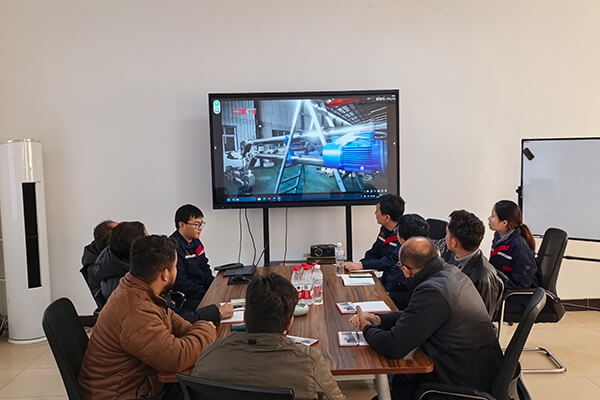
After communicating with the client online, the client specially arranged a time to visit the EXCT factory. During the visit, the customer first visited the equipment processing workshop, the finished product display area and the conveying equipment test platform, and inspected the processing accuracy of the core components of Tubular Drag Conveyors.
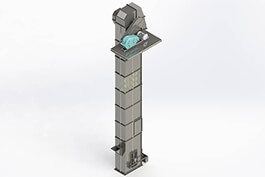
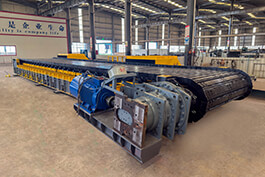
After the on-site inspection, the two sides went to the meeting room for a targeted technical discussion. Tubular Drag Conveyors include transmission components, chain assemblies, feed ports, discharge ports, and conveying pipes. The transmission components include a motor-reducer, a coupling, a main shaft, and a driving sprocket. The motor-reducer is connected to the main shaft through a coupling, and the main shaft is connected to the driving sprocket. The chain assemblies include chains and chain plates. The chain is connected to the driving sprocket for transmission. The chain plate is evenly arranged on the chain. The chain is located inside the feeding pipe and closely adheres to the inner wall of the feeding pipe. The feeding port is set on the feeding pipe, and the discharging port is set on one side of the transmission component.
During the meeting to discuss technical issues, the customer asked how to replace the damaged spare parts. Because the damaged spare parts of the wire rope type cannot be replaced, it was agreed to choose the Tubular Drag Conveyors of the plate chain type (only the damaged chain plates can be replaced without replacing the entire traction system).
Material Conveying Pipe
Carbon steel
Carbon steel has high strength and rigidity, but its corrosion resistance is relatively poor. It is prone to rust and damage in damp or corrosive environments. When choosing carbon steel as the material, special attention should be paid to whether the usage environment is suitable.
Stainless steel
Stainless steel has corrosion resistance and is not easily affected by oxidation and corrosion. It has a longer service life in humid or corrosive environments. Stainless steel material is also easy to clean and maintain, making it very suitable for industrial Settings with high requirements.
Aluminum alloy
Aluminum alloy has a relatively light weight, which can reduce the overall weight of the conveyor and enhance the flexibility of the equipment. Meanwhile, the specially treated aluminum alloy shell also has excellent wear resistance and fire resistance. However, the strength of aluminium alloy is relatively low, making it more suitable for light-load working conditions.
Chain
Carbon steel (such as 45 steel, Q235
Carbon steel is the material for the base of chains. It is low-cost and easy to process. Through heat treatment (such as quenching and tempering), the surface hardness and tensile strength can be enhanced (the tensile strength of 45 steel can reach over 600MPa).
Alloy steel (such as 40Cr, 42CrMo
By adding elements such as chromium (Cr) and molybdenum (Mo), the strength (tensile strength of 42CrMo exceeds 1000MPa), toughness and fatigue resistance are enhanced, making it suitable for heavy-duty working conditions.
Stainless steel (such as 304, 316
Austenitic stainless steel (304) is resistant to acid and alkali corrosion, while 316 can withstand chloride ion environments due to the presence of molybdenum (Mo), but it has a lower hardness (HB≤200) and is less wear-resistant than alloy steel.
Scraper
High manganese steel (such as ZGMn13
Under strong impact or compression, a hardened layer (hardness HB500+) forms on the surface, which enhances wear resistance. However, the effect is limited under static load conditions.
Polyurethane (PU) or nylon (PA
Non-metallic materials are light in weight, low in noise, resistant to weak acids and weak alkalis, and have a small coefficient of friction, but they have poor heat resistance (the long-term service temperature of PU is ≤80℃).
Ultra-high Molecular Weight polyethylene (UHMWPE
Its wear resistance is seven times that of carbon steel, it has good self-lubrication and strong impact resistance, but it has a high coefficient of thermal expansion and the working temperature needs to be controlled.


.jpg)