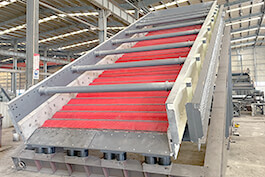
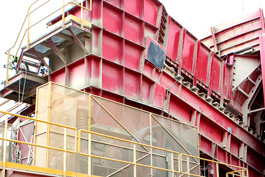
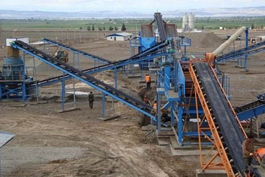
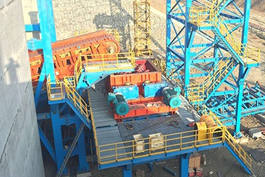
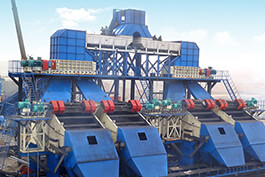
This project completed the overall replacement of the main body and screen plate of the vibrating screen on the basis of the customer's original equipment. After being put into use, it can be directly observed that the screening effect has changed significantly. According to the customer's description, this project involves the screening of andesite. The original screening equipment always experiences screen blockage during operation, requiring the machine to be shut down for cleaning every few hours, which greatly affects the screening efficiency.
After investigation, it is found that the screen plate of this equipment is a woven screen plate. The woven screen surface is woven from metal diameter wires (along the length of the screen surface) and weft wires (across the screen surface). To prevent the wire from shifting and ensure the screening accuracy, the metal wire is usually curled or pressed into a concave shape and then woven into a mesh. The outstanding advantages of this type of screen mesh are its high opening rate (up to 70% to 75%), light weight and convenient manufacturing. However, as the customer's screening material is andesite with a bulk density of 1.5t/m ³ and a processing capacity requirement of 698t/h, it far exceeds the stable processing load that the woven screen plate can bear. Moreover, the andesite particles have sharp edges and corners, and during the high-frequency screening process, they will continuously squeeze and get stuck in the gaps of the woven screen plate's mesh. As the screening continues, the number of stuck particles keeps increasing. Ultimately, it will cause the entire screen to be clogged, resulting in a significant reduction in the effective screening area and a sharp drop in screening efficiency, forcing frequent shutdowns for cleaning.
After the customer cooperated with our company, we replaced the polyurethane screen plate customized by our company with the new vibrating screen body based on the production requirements of the customer's site and the pain points of the original equipment. Compared with the original woven screen plate, the polyurethane screen plate has a more reasonable opening design, and the mesh is less likely to deform. It can reduce the probability of the sharp and angular andesite particles getting stuck and blocked. At the same time, the overall structural strength is higher, and it can fully meet the on-site large processing capacity requirement of 698t/h.
The customer indicated that after the replacement and operation, the screen surface was only simply cleaned once during routine inspections. There has never been a large-scale blockage of the screen again. The finished products screened out have uniform particle size and meet the requirements of downstream production. The problem of frequent shutdowns for cleaning has been completely solved.
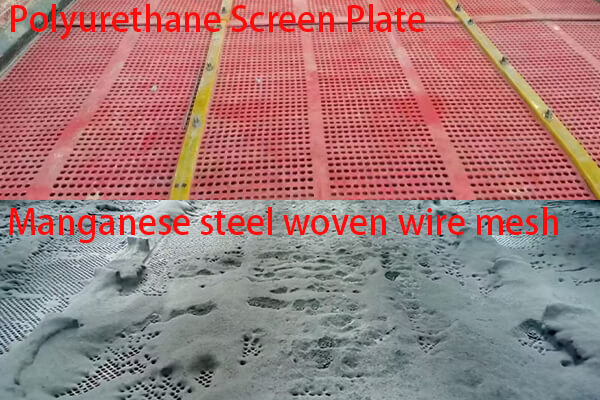
Why can polyurethane screen plates effectively prevent clogging?
Low surface tension
The surface tension of polyurethane is approximately 30 to 40 millinewtons per meter, which is much lower than that of metals. Water and sticky substances are difficult to wet and adhere to the surface, and the material is not easy to form a "material film" to clog the screen holes.
Elastic deformation
The elastic modulus of polyurethane is only one two-thousandth of that of metal. When vibrating, the screen holes undergo periodic elastic deformation, and the expansion and contraction rate can reach 15% to 25%. The particles stuck in the sieve holes are "squeezed out" or ejected, achieving dynamic anti-blocking.
Conical hole design
The sieve holes are usually designed in a conical or stepped shape with a smaller top and a larger bottom, which results in low resistance to material passage and a low probability of reverse jamming. The large opening at the bottom is conducive to screening through.
Key points of anti-blocking design technology
Sieve hole shape
Long strip holes and wavy holes are superior to square holes, and the clogging rate can be reduced by 40% to 60%. The long strip-shaped holes reduce the probability of particles getting stuck in multiple directions simultaneously, while the wavy holes increase the chance of material tumbling.
Screen surface inclination Angle
Appropriately increasing it to 20 to 25 degrees can enhance the material flow rate and optimize the residence time. However, an overly large inclination Angle may lead to insufficient screening, and it needs to be adjusted according to the specific characteristics of the material.
Thickness of sieve plate
The thin screen plate is conducive to the bouncing of materials and reduces the probability of material agglomeration. However, a balance needs to be struck between strength and elasticity; being too thin may lead to early damage.
Selection and considerations of vibrating screen plates
Material characteristics
Including the hardness, abrasiveness, moisture content and particle size distribution of the material. Materials with high hardness will accelerate the wear of the screen plate, and materials with high humidity are prone to adhesion and clogging. The particle size distribution directly affects the selection of the screen hole size.
Screening particle size
For coarse screening (greater than 10 millimeters), perforated screen plates or bar screens are usually selected. For fine screening (less than 3 millimeters), woven screen meshes or fine polyurethane screen plates need to be considered.
Opening rate requirement
The higher the opening rate, the greater the processing capacity per unit area, but if it is too high, it may affect the strength of the sieve plate. The opening rate of woven screen mesh can reach 70% to 80%, while that of polyurethane screen plates is usually between 50% and 65%.
Service life
Frequent replacement of screen plates not only increases direct costs but also leads to production downtime losses. In some highly abrasive mining environments, inferior screen plates may need to be replaced every week.
Woven screen mesh (metal/stainless steel
Suitable for fine particle size (0.02 to 10 millimeters), drying materials, and cost-sensitive projects. Its core advantages lie in the fact that the opening rate can reach 70% to 80%, it is lightweight and has a low initial cost. Typical applications include the classification of dry quartz sand, the detection of coal particle size, and the pre-screening of construction aggregates.
Polyurethane screen plate
The first choice for damp and sticky materials. Its core advantage lies in the fact that its wear resistance is 3 to 5 times that of steel screen plates, and its service life can reach 5,000 to 8,000 hours. Typical applications include wet screening, iron ore tailings treatment, and classification of viscous ores.


.jpg)