Introduction
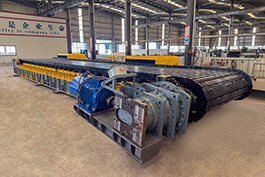
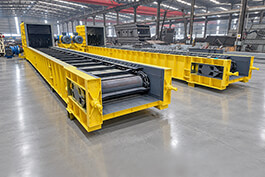
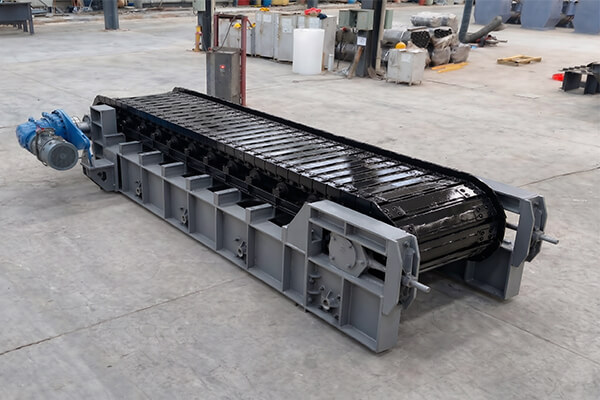
In the mining crushing production line, the pan of the heavy duty apron feeder directly comes into contact with the materials. Under the conditions of highly abrasive ores, the pan continuously withstands the impact of large rocks, the cutting of sharp mineral particles, and the fatigue effect of cyclic alternating loads. It is the most worn-out and frequently replaced component in the entire machine, and the material selection directly determines the operational reliability of the entire machine.
Characteristics and wear mechanism of high abrasiveness ore conditions
Typical types and characteristics of highly abrasive ores
|
Ore Type
|
Mohs hardness
|
Density
|
Abrasion Characteristics
|
|
Iron ore (Hematite / Magnetite)
|
5.5–6.5
|
4.5–5.2 g/cm³
|
High hardness + large lump size, combined impact and abrasive wear
|
|
Copper ore (Chalcopyrite)
|
3–4
|
4.1–4.3 g/cm³
|
Medium hardness with sharp edges and corners
|
|
Quartzite / Silica rock
|
7
|
2.65 g/cm³
|
Extremely high hardness, low toughness, brittle abrasion
|
|
Gangue
|
f coefficient=4–6
|
1.8–2.0 g/cm³
|
High abrasivity + high gangue content
|
|
Granite / Basalt aggregate
|
6–7
|
2.6–2.9 g/cm³
|
Sharp edges, continuous frictional wear
|
Wear of Apron Feeder pan
Impact wear
Large chunks of ore fall directly from the silo or unloading vehicle, with a drop of several meters to over ten meters. This sudden drop causes the pan to endure an instantaneous impact. The instantaneous impact load causes plastic deformation and work hardening of the pan's surface layer. Therefore, in this working condition, the pan material must possess the ability of work hardening and sufficient toughness to avoid brittle fracture.
Abrasive wear
For high-hardness and brittle materials such as quartzite and silica, the main wear form of the pan is abrasive wear. During the sliding and rolling of the ore on the pan surface, sharp edges continuously cut the metal matrix, forming grooves and peeling. Therefore, the pan material must have a sufficiently high hardness.
Fatigue wear
The Apron Feeder usually operates in a continuous cycle. The pan moves periodically with the chain around the sprocket, while also bearing the material load and the alternating stress caused by the vibration of the frame. Over a long period of use, fatigue cracks or even fractures may occur.
Requirements for pan under different working conditions
Wear resistance: Resisting the cutting and scraping by sharp mineral particles, which directly determines the service life of the pan;
Impact resistance: Withstanding the instantaneous impact load of large chunks of ore to prevent cracking and fracture;
Structural strength: Maintaining the geometric shape stable under long-term heavy load without excessive plastic deformation;
Weldability and repairability: Capable of on-site overlay welding for repair after wear, shortening the maintenance downtime and reducing the cost of spare parts.
Material classification and characteristics of Apron Feeder pan
High manganese steel
High manganese steel refers to an alloy steel with a manganese content of over 10%. After solution treatment (water hardening treatment), it can obtain a single-phase austenitic structure, featuring excellent strength, toughness and ductility. It is the traditional classic material of Apron Feeder pan and the typical grades are ZGMn13 and its improved type ZGMn13-4.
NM Series Wear-Resistant Steel Plate
The NM series wear-resistant steel plate is a low-carbon alloy wear-resistant structural steel produced by hot rolling and quenching and tempering. Typical grades include NM360, NM400, and NM500. By adding alloying elements such as chromium, molybdenum, nickel, and boron, the hardenability and hardness of the matrix are improved, making it the most widely used alternative material for apron plates in heavy-duty apron feeders.
Advantages: The initial hardness is stable at 360–500 HBW, and its resistance to plowing under abrasive wear conditions is far superior to that of high-manganese steel. The low-carbon matrix provides sufficient toughness to withstand impact loads from medium-sized ore. The plate has good formability and can be directly cut, bent, and welded to fabricate apron plates, with a self-weight 20%–30% lower than that of high-manganese steel castings of the same specifications. It has excellent weldability, and after field wear, the wear-resistant layer can be directly built up by overlay welding for repair, significantly shortening the downtime for maintenance.
Disadvantages: Its work-hardening effect is weaker than that of high-manganese steel, and under repeated severe impacts from oversized ore (exceeding the specified single-piece weight), fatigue spalling may occur on the surface. In high-temperature or highly corrosive conditions, the hardness degrades relatively quickly.
Typical applications: Conditions with strong abrasion but medium lump size, such as the conveying of crushed aggregates, quartz sand, and silica; it is also commonly used for apron plates in the non-impact zones of raw material batching lines in cement plant apron feeders.
Low-Alloy Steel Plate
Low-alloy steel plate is a steel plate material produced by adding small amounts of alloying elements, such as manganese, chromium, molybdenum, nickel, and silicon, to ordinary carbon steel during smelting. Common types include Q345B, Q355B, 16Mn, and low-alloy wear-resistant steel. Low-alloy steel plate is not equivalent to wear-resistant steel plate; its actual wear resistance, impact resistance, and service life depend on the alloy composition, heat treatment process, plate thickness, and structural design.
During operation, the pan is subjected to the static pressure of the material in the bin above (material column pressure) and the dynamic impact load during material drop. The high yield strength of low-alloy steel (355–460 MPa) effectively prevents permanent plastic deformation of the pan, such as collapse or bending.
Mining equipment often operates in open-air or semi-open-air environments. Low-alloy steel, especially grades D and E, retains high Charpy V-notch impact energy at low temperatures, preventing brittle cracking when large pieces of ore strike it.
The pans of modern heavy-duty apron feeders are mostly made using a press-forming (stamping) process, forming a structure with double-arc overlapping edges (a material-spillage prevention design) and stiffeners. Low-alloy steel has good cold-bending formability and is less prone to microcracking at bends. At the same time, it has stable weldability with the side baffles and bottom stiffeners (I-beams or channel steel), and the welds are less likely to develop cold cracks.
Conclusion
The pan material suitability of an apron feeder depends on the dominant wear mode and load characteristics under highly abrasive ore operating conditions. In actual selection, specific operating parameters such as ore hardness, lump size distribution, feed drop height, and continuous operation rate should be considered, with priority given to matching the material properties corresponding to the dominant wear mode.