Introduction
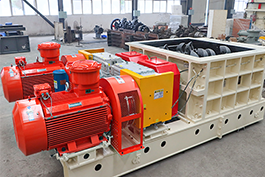
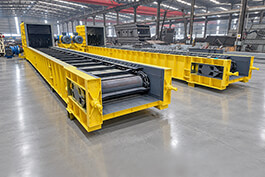
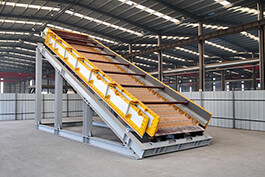
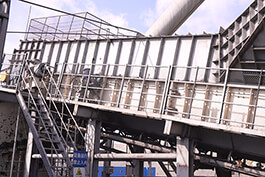
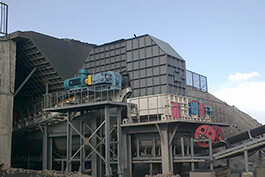
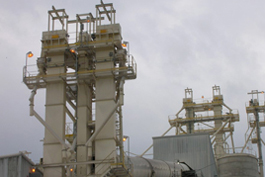
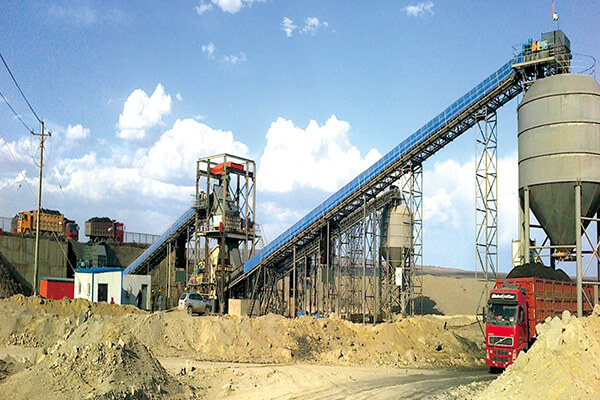
This project plans to build 4 open-pit coal mines and 6 underground mines, with a coal production capacity of over 60 million tons per year. All the coal produced by this project will be extracted through open-pit mining. This time, EXCT publicly won the bid for the design of a 1200t/h semi-mobile crushing station in the eastern mining area, providing it with a primary mineral sizer of model 2PLF120/200 and a secondary mineral sizer of 2PLF90/300, as well as a plate feeder and belt conveyor, etc., to form a crushing station. Regarding the design and selection of the double-toothed roller crusher used in this crushing station, it was carried out in combination with the working conditions of the project's open-pit coal mining and the operational requirements of the semi-mobile crushing station.
Technical Specifications of Twin Shaft Mineral Sizer
|
Parameters
|
Design
|
|
Equipment
|
primary and secondary mineral sizer
|
|
Models
|
2PLF120/200、2PLF90/300
|
|
Material
|
Coal
|
|
Capacity
|
1,200 t/h
|
|
Feed Size
|
≤1000mm、≤300mm
|
|
Output Size
|
≤300mm、50–150mm
|
|
Application
|
Semi-Mobile Crushing Station
|
Application of Mineral Sizer in semi-mobile crushing station
To meet the final required output particle size, primary crushing is necessary first. The maximum feed particle size is 1000mm, and the output is 300mm. The primary mineral sizer model selected is 2PLF120/200, with a roller diameter of 1200mm and a roller length of 2000mm, and the input size is ≤1200mm, and the output size is ≤300mm. The maximum processing capacity of this model of mineral sizer can reach 2000t/h.
The raw coal after primary crushing is transported by belt conveyors to the secondary crushing for fine crushing to meet the requirements of the finished product particle size. The secondary crusher model selected is 2PLF90/300, with a roller diameter of 900mm and a roller length of 3000mm, and the upper limit of the compatible feed particle size is 300mm, which precisely accommodates the output particle size range of the primary crushing. The final discharge particle size can be stably controlled within the range of 50–150mm, which is completely matched with the particle size requirements of the system's finished coal. From the perspective of capacity matching, the rated processing capacity of the 2PLF90/300 model can cover the system capacity of 1200t/h.
From the overall configuration logic of the semi-mobile crushing station, relying on the crushing mechanism of Mineral Sizer's shearing and extrusion, brittle raw coal is subjected to a step-by-step reduction in particle size under the action of different tooth shapes and different roller gaps. Compared with traditional jaw crushers, impact crushers, etc., the over-crushing rate is lower, and the finished product particle shape is uniform and the proportion of fine coal is controllable.
Why choose Mineral Sizer for the semi-mobile crushing station?
Mineral Sizer mainly relies on shear and compression for crushing, with high energy utilization and low electricity consumption per unit; it operates smoothly, has a lower rotational speed, stable motor load, no severe impact, and achieves significant energy-saving effects.
Compared with traditional jaw, impact or hammer crushers, Mineral Sizer has advantages such as low over-crushing rate, strong anti-blocking performance, low energy consumption, simple structure, and controllable maintenance costs when processing wet, sticky, brittle and ductile materials.
In large open-pit coal mines with semi-mobile crushing stations, Mineral Sizer adopts two rollers rotating in opposite directions to simultaneously apply shear and compressive forces to the materials, forming an efficient composite crushing mode. The single-machine processing capacity is significantly ahead, and it can meet the high throughput requirements of large mines.
Here is a comprehensive comparison:
|
Comparison item
|
Mineral Sizer
|
Jaw Crusher
|
Impact Crusher
|
Hammer Crusher
|
|
Broken
Principle
|
Shear, compression, tension, splitting
|
Compression, bending
|
High-speed impact, counterattack
|
High-speed impact, hammering
|
|
Adapt to moisture
|
Excellent: Suitable for wet, sticky and muddy materials
|
Average: Prone to blocking with wet sticky materials
|
Poor: Prone to blocking with wet sticky materials
|
Poor: Easy screen blinding
|
|
Over-crushing
|
low
|
Medium
|
Relatively high
|
High
|
|
Discharge particle size
|
Uniform & adjustable, low fines content
|
Coarser, requires secondary crushing
|
Finer, good particle shape
|
Fine, high fines content
|
|
Energy consumption
|
Relatively low, energy saving approx. 25.0%–30.0%
|
Relatively high
|
Relatively high
|
High
|
|
Noise dust
|
low
|
Medium
|
High
|
High
|
|
Structural volume
|
Compact, suitable for semi-mobile
|
Large, high foundation requirement
|
Relatively large
|
Medium
|
|
Maintenance
|
Tooth plate, long service life & easy replacement
|
Jaw plate, frequent replacement
|
Blow bar & impact plate, fast wear
|
Hammer head, fast wear
|
|
Applicable
|
Coal, coke, soft ore, wet sticky materials
|
Primary crushing of hard rock
|
Secondary & fine crushing of medium-soft materials
|
Fine crushing of soft materials
|
How to select the size of the crushing rollers
Diameter of the crushing roller and feed particle size
The upper limit of the feed particle size for this project is 1000mm, corresponding to the selected 2PLF120/200 Primary Mineral Sizer, with the roller diameter reaching 1200mm. The larger the tooth roller diameter, the more reasonable the biting angle of the teeth for large pieces of material, which can smoothly roll in the crushing chamber the 1000mm-sized large raw coal and avoid the problem of large pieces of material slipping at the entrance of the crushing chamber and being unable to enter the machine.
If the roller diameter is too small, not only will it not be able to bite the super-large raw coal, but it is also prone to jamming and blockage, affecting the continuous operation efficiency of the semi-mobile crushing station.
The length of the crushing rollers and the system production capacity requirements
Under the premise of determining the roller diameter, the working length of the roller directly determines the effective flow area of the crushing chamber. In this project, the total system production capacity is 1200t/h, and the roller length of the primary crushing 2PLF120/200 is 2000mm, with its rated maximum processing capacity reaching 2000t/h, leaving sufficient production capacity margin, which can adapt to the fluctuations in the mining volume of open-pit coal mines and the unevenness of the material size, and avoid production capacity impacts.
The roller length of the secondary crushing section 2PLF90/300 is 3000mm, although the roller diameter is smaller than that of the primary crushing, the longer roller surface ensures that its processing capacity fully covers the 1200t/h system production capacity, and can smoothly receive the ≤300mm raw coal discharged from the primary crushing, without encountering a production capacity bottleneck.
Clearance and tooth shape design
The clearance between the crushing rollers determines the final output particle size. In the primary crushing section, by matching a larger clearance, the ≤1000mm raw coal is crushed to ≤300mm, providing uniform feeding conditions for the secondary crushing; in the secondary crushing section, by reducing the clearance between the rollers and combining with the appropriate fine crushing tooth shape, the ≤300mm raw coal is further processed to a finished particle size range of 50–150mm.
At the same time, the arrangement and number of teeth will also be adjusted in combination with the material characteristics. For raw coal with high brittleness and prone to over-crushing, a shear-type tooth arrangement is adopted to ensure the crushing efficiency while controlling the powder content ratio, balancing the uniformity of particle shape and crushing efficiency.
Conclusion
This 1200t/h semi-mobile crushing station uses two types of mineral sizer for primary and secondary crushing. Considering the characteristics of the open-pit coal mine, such as large fluctuations in coal size, high coal gangue content, and wet and sticky materials, it achieves the classification and crushing of raw coal of size ≤ 1000mm to finished coal of 50–150mm. Since the project started operation, there have been no incidents such as equipment shutdown or production halt due to quality issues. The equipment has reached the expected processing capacity and crushing particle size.