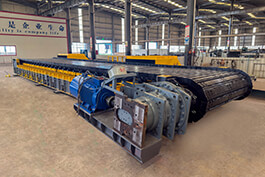
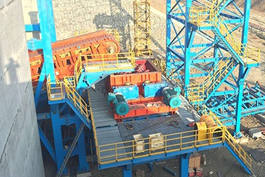
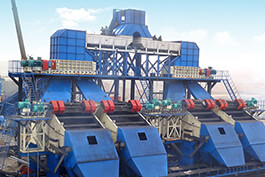
Apron Feeder is one of the feeding equipment in material crushing systems. It can be divided into heavy-duty, medium-duty and light-duty types, among which the heavy-duty type is commonly used at present. Heavy Duty Apron Feeder is suitable for short-distance conveying of materials with large conveying capacity and large particle size. It can also be used for feeding primary crushers from surge hoppers. It can continuously and uniformly feed materials to the next process and withstand large hopper pressure. Its characteristics include large feeding capacity, low speed and high torque. The working principle of Heavy Duty Apron Feeder is that the motor drives the driving sprocket to rotate, which drives the chain to move. Through the material carrying function of the pans, the material conveying purpose is finally achieved. Therefore, in the design of Heavy Duty Apron Feeder, the chain pulling force must be calculated first.
Generally, the chain selection of Heavy Duty Apron Feeder is relatively easy. However, for large Heavy Duty Apron Feeders (with a length greater than 20m), chain selection has a significant impact on the working performance and equipment cost of the whole machine. A more detailed calculation of the chain tension is required. Through analysis and calculation, the chain pulling force can be adjusted and reduced to select a suitable chain. Therefore, this article takes a large Heavy Duty Apron Feeder in a mobile crushing station as an example, analyzes the composition of chain pulling force, and calculates the influence of different feeding thicknesses on chain tension.
Driving Sprocket Circumferential Force
The circumferential force transmitted from the driving sprocket to the chain is balanced with the friction resistance and slope resistance during operation. The friction resistance is the combination of friction forces from various parts, mainly including the main friction resistance, additional resistance, and friction resistance between material and side plates. The main friction resistance is generated by the friction caused by the operation of the upper strand, lower strand, and chain during the conveying process.
The additional resistance consists of friction between chain links, friction between the chain and sprocket, friction of sprocket shaft bearings, and friction between the chain and upper and lower supports. The friction resistance between material and side plates is generated by the friction between the conveyed material and the side plate structure.
The slope resistance is calculated according to the conveying height and the linear load distributed on each section.
Calculation of Chain Pulling Force
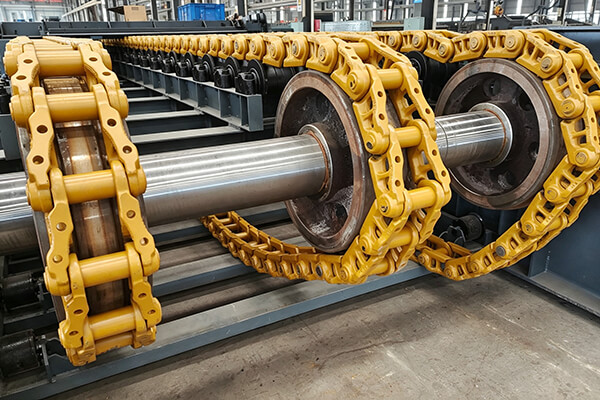
The chain pulling force consists of the circumferential force, chain self-weight, initial chain tension, and additional dynamic tension generated by the polygonal effect during chain operation. It is an important data for the design of the main shaft.
The initial tension keeps the chain properly tensioned. Therefore, the initial tension should be selected appropriately to prevent failures caused by chain slack when the chain disengages from the sprocket.
When calculating the chain pulling force, the larger value between the carrying strand and the return strand should be selected for the calculation of the initial tension. The additional dynamic tension of the chain is generated by the moving mass and the maximum acceleration of the chain.
Relationship Between Material Layer Thickness and Driving Wheel Circumferential Force
For Heavy Duty Apron Feeder, reducing the chain pulling force is very important for the design cost of the whole machine and the design, selection and matching of components. It directly affects the selection of external supporting components such as chains, motors, reducers and hydraulic systems, and also has a direct impact on the design strength and rigidity of the whole machine. The most direct and effective method to reduce chain pulling force is to control the feeding thickness of Heavy Duty Apron Feeder.
Under the condition of unchanged conveying capacity, as the feeding thickness of Heavy Duty Apron Feeder decreases, the chain speed increases, and the motor power does not decrease significantly, but the driving circumferential force and chain pulling force on the chain decrease greatly. Therefore, during design, controlling and selecting an appropriate feeding thickness has a significant impact on chain selection and service life.
Material Friction Resistance
During the conveying process of Apron Feeder, the material will generate friction with the side plates, pans and guiding structures. Its magnitude mainly depends on: material particle size, material moisture content, angle of repose, side plate height and material layer thickness, among which material layer thickness is an important factor affecting this resistance.
When the material layer thickness increases:
The material mass per unit length increases, the pressure on the pans increases, the contact area between material and side plates increases, and the material extrusion force increases.
Therefore, an increase in material layer thickness will cause a rapid increase in chain pulling force.
Conclusion
The chain pulling force of Heavy Duty Apron Feeder is an important parameter affecting the design of the whole machine. Its magnitude not only depends on equipment length, chain weight and drive system, but is also closely related to material layer thickness, material characteristics and operating conditions.
For large Heavy Duty Apron Feeders, by optimizing material layer thickness and reasonably matching chain speed and conveying capacity, the chain pulling force can be effectively reduced, thereby reducing:
Chain specifications;
Driving power;
Reducer load;
Equipment manufacturing cost.
At the same time, during chain design, static strength, fatigue life and dynamic impact loads should be comprehensively considered to ensure the long-term stable operation of Heavy Duty Apron Feeder in continuous mining production environments.


.jpg)