Heavy Duty Apron Feeder Applications and Scope
The Heavy Duty Apron Feeder is widely used in industries such as mining, metallurgy, building materials, and coal. It is primarily installed beneath silos or hoppers with certain pressure levels to deliver large volumes of material over short distances in a uniform and continuous manner to various crushing, screening, or conveying equipment—particularly suitable for use after primary crushing. It is effective not only for coarse particles but also for fine materials, capable of performing heavy-duty tasks under harsh conditions. The feeder demonstrates strong adaptability to variations in particle size, temperature, viscosity, and moisture content, ensuring uniform, accurate, and reliable feeding. Depending on customer requirements, the apron feeder can be designed with different installation angles ranging from 0° to 25°.
Apron Feeder Structure and Components
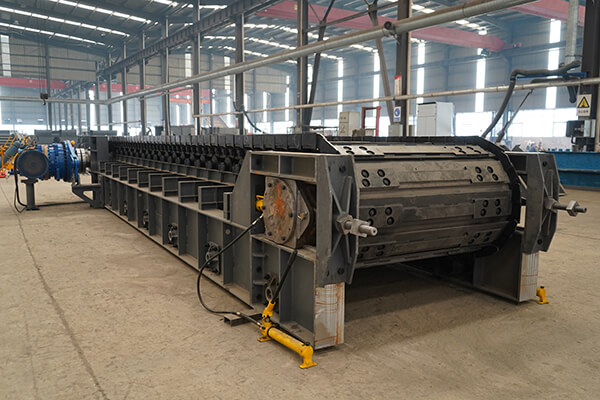
The apron feeder consists of a drive unit, main shaft assembly, tensioning device, chain plate assembly, frame, idler wheels, drag chain wheels, and other components.
Drive Unit
The drive unit comprises a main motor, coupling, right-angle planetary gearbox, drive frame, and torque rod. Its primary function is to provide the power source for the feeder.
Main Shaft Assembly
The main shaft assembly mainly includes the main shaft, bearings, bearing housing, positioning sleeve, sprocket, and other components. Its primary role is to transmit the torque generated by the drive unit to the sprocket, which then drives the chain plates.
Tensioning Device
The tensioning device is a screw-type tensioning mechanism designed to maintain proper pre-tension on the chain plates. It consists of a tensioning shaft, sprocket, positioning sleeve, sliding bearing housing, lead screw, and locking nut.
Pans
The pans bolted to the chain with high strength bolts and nuts,which can be replaced individually in situ without disturbing the rest of the apron feeder. According to different working conditions, apron feeder can choose heavy duty cast manganese steel or welded construction with ribbed reinforcements, which is suited for materials with high load and high impact conditions.
Chains Rollers
The chain uses an off the shelf dozers chain (Track chain), which is characterized by small pitch error, smooth movement, high strength, large pulling force, and the chain has a self-lubricating device and a sealing device.
The rollers are designed as a standard tractor rollers with sealed and lifetime lubricated bearings, mounted on the main feeder frame.The rollers has suitably spaced to provide adequate support for the chain assembly.
Tail Tension Device
The tension device is used to tighten and adjust the horizontal position of the chain to ensure that the chain tightness is moderate and make it run smoothly. When the pans are suddenly impacted by the material, the composite spring can play a buffer role to protect the pans and other components from damage.
Design Details and Key Factors of Heavy Duty Apron Feeders
Drive Power Calculation
For Heavy Duty Apron Feeders, accurate calculation of drive power is crucial and plays a prominent role in many aspects. In current mining and transportation operations, the demand for conveying capacity continues to increase. Any deviation in the mechanical drive power can directly result in abnormal operation of downstream equipment. Based on past operational experience and current selection criteria, several key considerations must be observed when calculating the drive power for Heavy Duty Apron Feeders:
First, power calculations must strictly follow relevant formulas.
Second, all influencing factors must be comprehensively considered. For example, if only the frictional resistance between ore and the apron plate during operation is taken into account while ignoring other factors, it will inevitably lead to significant errors in the calculated drive power, ultimately preventing the Heavy Duty Apron Feeder from achieving desired efficiency and performance.
Third, detailed calculations and analyses must be conducted regarding the total resistance along the transmission chain. The tangential force that the drive sprocket transmits to the chain belt must be fully accounted for to obtain an accurate drive power value.
Analysis of Total Operating Resistance
During the design process, attention must also be paid to the total operating resistance of the Heavy Duty Apron Feeder. In daily applications, due to increasing conveying volumes and higher efficiency requirements, the total operating resistance of the feeder has significantly changed under various practical working conditions. The analysis of total resistance includes the following aspects:
First, since multiple types of resistances are involved, the overall friction generated by the feeder’s mechanical motion should be fully considered, including frictional resistance caused by conveyed materials and side plates, as well as potential energy resistance associated with lifting height.
Second, important parameters such as the self-weight-induced friction resistance of the chain conveyor system and the friction resistance resulting from the normal pressure exerted by the conveyed material must be included.
Clearly, the total operating resistance of a Heavy Duty Apron Feeder involves diverse components; failure to properly analyze and manage these factors will inevitably degrade the machine's performance.
Frictional Resistance Between Material and Chain Plate
During operation of the Heavy Duty Apron Feeder, the material forms a rectangular cross-sectional flow between the chains and chain plates. The frictional resistance between the material and the chain plate primarily depends on the contact pressure between the material and the plate surface, as well as the coefficient of friction. This resistance is a critical factor that must be considered in the force analysis of the Heavy Duty Apron Feeder.
Discussion on Heavy Duty Apron Feeders
At the current stage of operations, the importance of Heavy Duty Apron Feeders is particularly evident, and their performance and service life are significantly influenced by various factors. To objectively improve operational efficiency, a comprehensive calculation and analysis should be conducted regarding the feeder's power requirements, resistance, and other parameters, based on specific workload, operating schedules, and task demands. Functional settings and operational design must be effectively aligned with on-site usage requirements and process standards.
On the other hand, in designing Heavy Duty Apron Feeders, every detail must be thoroughly examined to ensure that the equipment operates flawlessly during daily use and meets production targets. It is important to note that in actual operation, some users continuously increase output or violate standard procedures, causing the feeders to operate beyond capacity. This creates serious safety risks and potential hazards. Such practices require immediate attention; users must be promptly informed and instructed not to overload the equipment, so as to prevent damage that could disrupt normal production operations.
Conclusion
This article discusses the design details and key elements of Heavy Duty Apron Feeders, analyzing them objectively. At present, Heavy Duty Apron Feeders have achieved significant improvements in performance and efficiency in many aspects, providing substantial support for production operations.


.jpg)