Introduction
In large-scale screening systems for coal, ores, construction aggregates, etc., Disc Screen usually needs to operate continuously for a long time. The screen shaft is the core component directly involved in material transportation and screening. If the rotational speeds of each screen shaft are not consistent, it will cause uneven distribution of materials on the screen surface, fluctuations in the thickness of the material layer, a decrease in the through-rate of the screen holes, and even local accumulation, blockage, and increased wear. Therefore, the drive system determines the overall operating quality of the entire machine.
Components of the Disc Screen Drive System
Motor
Provide power input, usually an AC asynchronous motor or a variable frequency motor. For large Disc Screens, dual-motor drive or multi-motor grouped drive is often adopted to meet the requirements of high torque and redundancy.
Reducer
Convert the high-speed and low-torque output of the motor into a low-speed and high-torque output. The deceleration device can be an independent reducer, a gearbox with a built-in reduction stage, or a combination of chain drive and reducer.
Drive Shaft
Transfer the reduced power to the driving sprocket or driving gear.
Chain / Gear Transmission
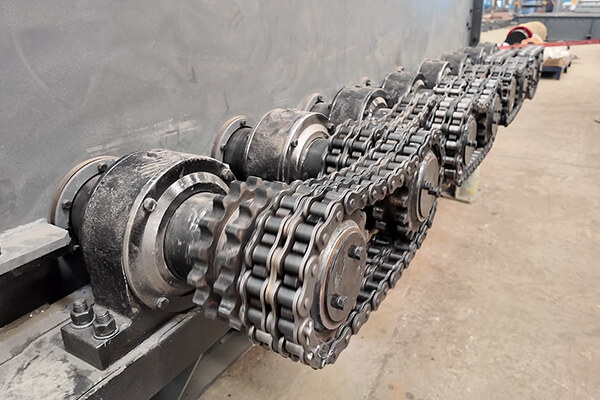
The chain drive connects each sieve shaft through sprockets and roller chains; the gearbox drive transmits power through gear pairs or gear distribution mechanisms.
Screening Shafts
The disc shaft is equipped with a screen plate, wear-resistant device or special-shaped blades, and it achieves the transportation, loosening and screening of materials through rotation.
Chain Drive Disc Screen System
Working principle
After the motor is slowed down and torque increased by the reducer, it drives the driving sprocket. The driving sprocket drives the driven sprockets on each sieve axis through one or more roller chains. Due to the flexibility of the chains, multiple sieve axes can be arranged within a certain center distance range, without the strict requirement of axial spacing like gears. Chain drive also has certain buffering capacity, which can absorb some impact loads and is suitable for working conditions with significant changes in material particle size.
Advantages
Simple structure
The chain drive has a simple structure, with high component commonality, convenient replacement, and lower maintenance costs. For small and medium-sized Disc Screens, chains and sprockets are common wear parts, with a short procurement cycle and easy mastery by on-site maintenance personnel. Compared to enclosed gearboxes, the chain drive does not require complex oil circuits, seals, and gear assembly, and has stronger on-site operability.
Buffering capability
The chain drive has certain buffering capacity, which can absorb some impact loads, suitable for working conditions with large variations in material particle size. When large pieces of material suddenly enter the screen surface, the chain can absorb some energy through elastic deformation and tensioning devices, reducing the instantaneous impact on the motor and screen shaft. In addition, the chain drive has lower requirements for center distance accuracy, suitable for scenarios with certain errors in screen shaft spacing or thermal expansion variations.
Applicable to medium processing capacity applications
The chain drive is suitable for small and medium-sized Disc Screens, conventional coal screening, limestone screening, and other scenarios. For projects with small processing capacity, limited equipment length, and simple maintenance conditions, the chain drive is often selected due to its cost and maintenance simplicity. Relevant selection data shows that the chain drive structure is relatively simple, with lower installation accuracy requirements, and suitable for medium-load working conditions.
Limitations
Chain wear and elongation
After long-term operation, the chain will wear, the pitch will increase, and the tension state will change. This may further lead to a decrease in the synchronism of the screen shaft, an increase in running noise, and even skipping teeth. Chain wear is an inevitable degradation process of chain drive, especially in high-dust, high-impact, and poorly lubricated conditions, the wear speed will accelerate. Once the chain elongates to a certain extent, the meshing position between the chain and the sprocket changes, the instantaneous speed fluctuation increases, and the multi-axis synchronism deteriorates.
High maintenance frequency
The chain drive requires regular lubrication, checking the tightness of the chain, replacing the chain and sprocket. In open-pit mines, high-dust environments, and scenarios with impact from large pieces of material, the maintenance frequency is higher. If the chain is not tightened in time, it may jump or fall off; if not lubricated in time, the chain links will wear more severely; if not clearing the accumulated materials, the chain wheel may get stuck.
Impact of dust and material impact
In high-dust environments, the chain drive requires more complete protective design. Search results show that although the chain drive is suitable for dusty environments, attention should be paid to the lubrication method to avoid using high-viscosity grease, which may cause joint clogging due to dust adsorption. At the same time, it is necessary to prevent material accumulation on the chain wheel, and in some cases, a chain and chain wheel cleaning device should be used to prevent sticky material accumulation. Moreover, for working conditions with impact loads, the number of teeth on the small sprocket should be increased to 25 or more to improve smoothness. These measures will increase the complexity of design and maintenance.
Gearbox-driven Disc Screen system
Working principle
After the motor power enters the gearbox, it undergoes deceleration and distribution, and is then driven by multiple output shafts to the sieve shafts. The gearbox can be a parallel-axis gearbox, a cone-cylinder gearbox, a planetary gearbox or a combined distribution gearbox. Compared with chain drive, the shaft spacing of the gearbox is guaranteed by the processing accuracy of the housing, the transmission ratio is fixed, and the synchronization between each output shaft is higher.
Advantages
High transmission efficiency
Gear transmission has the characteristics of high transmission efficiency, stable speed output, and reduced power loss. For large Disc Screens, the motor power can reach tens or even hundreds of kilowatts, and every 1-2 percentage points increase in efficiency leads to significant differences in long-term electricity consumption. Moreover, the gearbox is closed for lubrication, less affected by dust, and its efficiency retention ability is usually better than exposed chain transmission.
Synchronization of the screen shafts
Compared to chain transmission, the gearbox can maintain a more stable speed and more precise synchronization of the screen shafts. The transmission ratio of gear transmission is constant, with small instantaneous speed fluctuations, and high stability. This is particularly important for high-precision screening and multi-axis large Disc Screens. If the synchronization of the screen shafts is poor, the conveying speed of the material on the screen surface will be inconsistent, which can easily cause uneven layer thickness, reduced screening efficiency, and local wear. For scenarios requiring uniform material distribution and high screening accuracy, the gearbox drive has an advantage.
Suitable for heavy-load continuous operation
Gearbox drive is suitable for large coal screening systems, ROM coal pre-sieving, and primary coal screening in mines, with high reliability and long-term operation capabilities. Comparative product analysis indicates that modern gearbox transmissions have a long service life, up to 10-12 years, stable transmission ratios, and reliable operation; compared to traditional chain-driven systems, gearbox transmission requires simpler daily maintenance and chain replacement, lower maintenance costs, and better control accuracy. Of course, the "replacing chains" in this context might be a statement highlighting the maintenance pain points of traditional chains, but the core meaning is that the enclosed gearbox can reduce frequent maintenance due to exposed wear parts during long-term operation.
Limitations
Higher initial investment
Compared to chain transmission, the manufacturing cost of the gearbox is higher, resulting in increased initial investment. The gearbox requires high-precision processing, housing, bearings, seals, lubrication systems, and assembly, with costs far exceeding those of chains and sprockets. For small and medium-sized projects with limited budgets, the gearbox may not be economically viable.
More complex maintenance
Gearbox maintenance involves gear inspection, lubricant management, seal maintenance. Although the maintenance frequency may be lower than chain transmission, the technical threshold for a single maintenance is high. Lubricants need to be regularly tested and replaced, and seal failure can lead to oil leakage and dust intrusion. Gear pitting, adhesion, or tooth breakage require professional repair. If on-site maintenance capabilities are insufficient, gearbox failures can lead to long-term downtime.
Weak buffering capacity for impact loads
If oversized materials enter or sudden overload occurs, the gearbox needs to be equipped with overload protection and torque-limiting devices. Gear transmission is a rigid transmission and does not have the elastic buffering capability of chains. Once the impact exceeds the design limit, it can lead to gear breakage, bearing damage, or box deformation. Therefore, gearbox-driven Disc Screens usually require hydraulic couplings, limit-type hydraulic couplings, safety clutches, or electrical overload protection.
Conclusion
Both chain drive and gearbox drive have their own advantages and disadvantages. When selecting the Disc Screen, it should be based on the quantitative analysis of the working conditions, and a comprehensive assessment should be made of the processing capacity, particle size, impact, dust, moisture content, space, maintenance capability, downtime cost and total cost of ownership. For small processing capacity, budget-sensitive, variable impact projects, chain drive should be given priority; for large, highly synchronized, heavy-load continuous, high-dust projects, gearbox drive should be given priority.


.jpg)