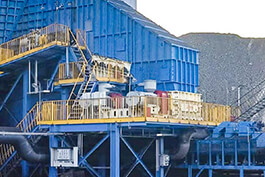
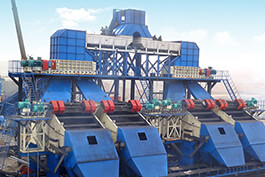
Working Principle of Flip Flow Screen
The Flip Flow Screen is composed of two independent sieve frames (referred to as the inner and outer frames), and between the inner and outer frames, certain trapezoidal beams with a certain spacing are fixedly connected. When the inner and outer frames are assembled and superimposed, the trapezoidal beams on the inner and outer frames are distributed at intervals. At the same time, elastic screens are equipped between the spaced trapezoidal beams.
When the machine operates, the eccentric shaft drives the outer frame to move, and its mechanism can be simplified to be regarded as a crank-slider mechanism, converting the shaft's movement into the horizontal reciprocating motion of the outer frame. Thus, the relative motion between the inner and outer frames occurs, driving the screen mesh to form a relaxation downward and tension upward movement. The material performs a bouncing movement similar to a trampoline on the screen surface, ultimately achieving the effect of bouncing loose and falling through the screen, completing the screening operation.
Structure of Flip Flow Screen
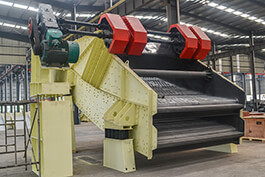
It mainly consists of the drive system, shaft protection cover, shaft system, inner frame, outer frame, screen cover, support, and some connecting parts. The drive system is fixed on the support, and its interior is equipped with a motor. The motor is reduced by V-belt and directly connected to the shaft system through a universal joint.
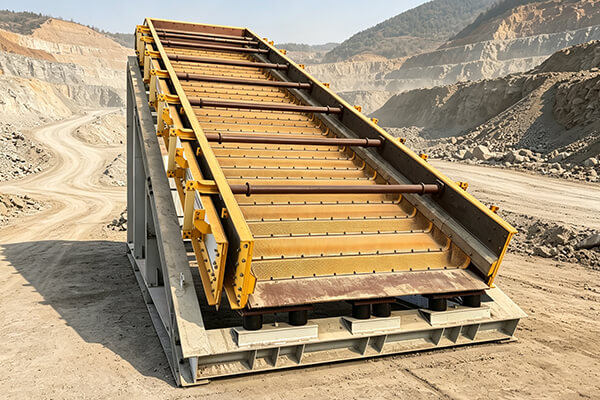
The outer side of the shaft system is equipped with a shaft protection cover, and at the same time, the shaft protection cover is fixedly connected to the inner frame and connected to the outer frame through a horizontal push-pull rod (the material of the push-pull rod is the same as the spring plate). The inner and outer frames are connected vertically through guide plates, that is, the outer frame is only connected through elastic materials, maintaining suspension, and the inner frame is fixed at one end to the shaft protection cover and connected to the support through a cylindrical rubber seat at the other end.
The cylindrical rubber here plays a damping role. Above the screen box, there is a screen cover, which is connected to the support through legs. During operation, according to the screening requirements, the machine is set at a 15-25° inclination angle. To prevent excessive dust during operation, two dust collection holes are set above the screen cover, which can collect the dust and avoid pollution.
Amplitude and Frequency of Flip Flow Screen
Huang Shaofu et al. established a simple geometric model to study the increase in vibration amplitude. An increase in amplitude will cause the material to pass through the sieve aperture quickly, reducing the occurrence of blockage, and also allowing the particles of different particle sizes to separate. An increase in the vibration frequency of the screen surface can prolong the jumping time of the material on the surface, increasing the opportunity to pass through the aperture, which is conducive to improving the separation speed and efficiency.
The selection of amplitude depends on the particle size of the screened materials. When screening larger materials, the amplitude can be appropriately increased, and the screening effect will improve. Similarly, when screening smaller fine powder materials, a smaller amplitude is more suitable. When dealing with difficult-to-screen materials, such as damp and high-viscosity materials, a larger amplitude should be selected. The screened materials of Flip Flow Screen are generally damp coal mines, so the amplitude should be as large as possible.
Effect of Screen Surface Process Structure on Screening Effect
Width and Length of Screen Surface
Generally, the lateral length of the screening surface will have a significant impact on the overall working effect of the Flip Flow Screen. The larger the lateral length, the greater the screening volume; the longitudinal length of the screening surface has a great impact on the working efficiency. The longer the longitudinal length, the shorter the time required to process a certain amount of materials; however, due to the overall design limitations, it is impossible to increase the length of both the lateral and longitudinal directions blindly.
Generally, the larger the lateral length, the stronger the overall frame vibration, which will shorten its service life. When the longitudinal length reaches a certain value, its working efficiency basically reaches the peak and no longer increases.
In this case, the effect of increasing the length of the above two directions is simply to increase the weight and volume of the equipment. For the two most critical indicators of a screening equipment - efficiency and processing capacity - they should be balanced when influencing each other.
Research on the inclination angle of the Flip Flow Screen surface
The inclination angle of the Flip Flow Screen will have a significant impact on the working efficiency and processing effect of the entire equipment. When the inclination angle increases, the separated substances on the screening device will be thrown upward with higher intensity, thereby increasing the linear movement speed of the separated substances on the screening surface and increasing the amount of screened materials.
Due to the higher upward throwing intensity, the retention time of the materials on the screening device surface will be reduced, significantly reducing the probability of material particles passing through the screening surface, thus reducing the working efficiency. In the opposite case, the processing effect will be reduced and the working efficiency will be increased. In order to enable the screening equipment to work in a high-efficiency state, the inclination angle of the circular vibration screening surface will be between 15 and 25 degrees, and the inclination angle of the linear reciprocating screening surface will be between 0 and 8 degrees.
The size, shape and distribution of the screening holes
If the screening hole size is larger, a larger amount of material can be separated on a certain area of the screening surface, and the working efficiency will be higher. The size of the screening holes is mainly determined by the working requirements of the Flip Flow Screen and the final desired effect. Generally, if the particle size of the material is large, the screening hole diameter can be designed to be the same as the particle diameter of the material during the design stage. When the particle size of the material is relatively small, the screening hole diameter should be slightly larger than the particle diameter; in the approximate vibration separation process, the screening hole diameter should be much larger than the particle diameter of the material.
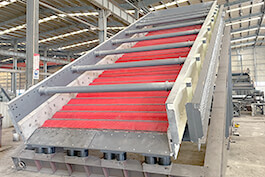
Usually, the shapes of the screening holes mainly include the following types: circular, square and rectangular. If the particle shapes of the materials to be screened are relatively regular, circular and square screening holes can be used; if the particle shapes are slender or flat, rectangular screening holes should be selected. Thus, it can be seen that the manufacturing process of rectangular screening holes is more delicate.
If the materials to be separated contain a lot of moisture and have a high viscosity, the longer side of the rectangular holes can be arranged along the longitudinal movement direction of the particles, effectively reducing the friction between the particles and the screening surface, making the particles easier to pass through the screening surface. If the opening of the hole is larger, the number of openings in a certain area will be more, and under the condition of a fixed size of the screening holes, the more the number of holes, the better the processing effect.
However, it is not allowed to increase the number of openings infinitely; it is necessary to comprehensively consider the strength of the screening surface and the working conditions of the equipment.


.jpg)