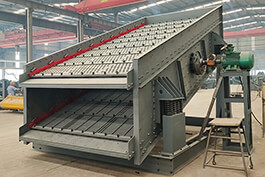
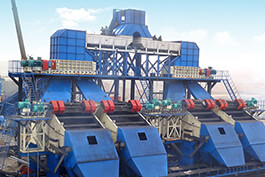
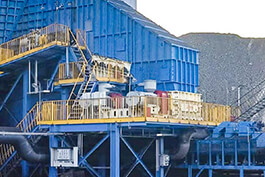
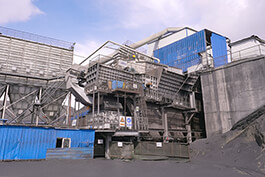
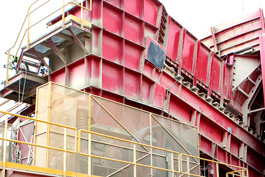
In traditional bulk material handling and transportation systems, in order to achieve direct unloading by trucks or loaders, enterprises usually need to dig deep pits and undertake expensive fixed civil engineering works. Surface Feeder is a heavy-duty continuous feeding and conveying equipment specially designed for surface operations and harsh industrial environments. It receives, regulates, and safely transports bulk materials, transporting them from trucks, loaders, or stockpiles to downstream crushing, screening, or processing systems efficiently and smoothly. Whether it is huge and hard rock blocks or poorly flowing muddy materials, Surface Feeder can easily handle them with its strong adaptability.
Core advantages of Surface Feeder
The equipment adopts an integrated compact design, which can be directly placed on a flat surface for operation, completely eliminating the need for digging deep pits and the high cost of underground civil engineering, making project deployment more flexible and rapid.
Wide rubber-tired belt design allows heavy trucks or loaders to unload directly at a very low height. Combined with a large-capacity receiving hopper, its maximum processing capacity can reach 2000 TPH (tons per hour), significantly reducing the waiting time for trucks.
The equipment combines the high traction of chains with the smoothness of belt conveyance. Through speed-controlled feeding, it completely eliminates the risk of "bridging" or blockage of materials during transportation, ensuring continuous feeding to downstream equipment.
Whether it is dry and flying dust, damp and sticky soil, or highly abrasive and rough ores, Surface Feeder can maintain stable conveying efficiency, and the system has little dust emission, with extremely low maintenance requirements.
Structure of Surface Feeder
The reason why Surface Feeder can maintain a long lifespan in high-intensity industrial environments is due to its heavy-duty precision mechanical structure design.
Body and protective system
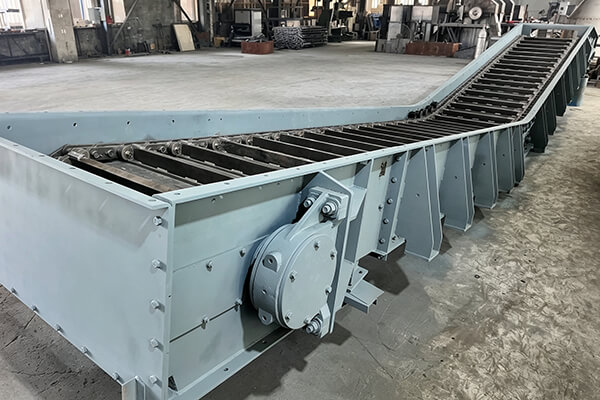
The body adopts a high-strength box-shaped structure, divided into a horizontal section buried in the material pile and an upward climbing inclined section.
Baffle design
At the junction of the horizontal and inclined sections, there are heavy-duty baffles, effectively blocking the spread of materials and concentrating the materials in the receiving area, significantly improving the stacking and conveying efficiency.
Removable protective and environmental dust cover
On both sides of the body, there are wide and narrow upper and lower steel plates for removable protection, facilitating later maintenance. Above the inclined section, there is a dust cover composed of profiled steel frames and color steel plates, effectively suppressing the leakage of particle dust and meeting modern industrial environmental standards.
Chain conveying system
To handle high-erosive materials, Surface Feeder abandons the ordinary roller chain and adopts the heavy-duty transmission technology of excavator level:
Tractor Chains
The internal sections are lubricated throughout their lifespan and are strictly sealed, completely preventing dust and water from entering. They possess extremely high breaking strength.
Apron Pans
It is made by welding high manganese steel or Hardox wear-resistant alloy. The adjacent bearing plates adopt an arc-shaped lap design to ensure that no matter how the chain bends and climbs, the materials will not fall through the gaps.
Split chain wheel
The teeth of the drive and redirecting chain wheels are subjected to deep surface hardening. When the teeth wear out, maintenance personnel can simply remove the chain wheel flap to replace them, without having to dismantle the heavy main shaft and bearings, greatly reducing the downtime.
Automatic tensioning device
The tail is equipped with a hydraulic or screw tensioning system to automatically compensate for the natural wear and elongation of the chain under long-term high-load conditions, eliminating skipping teeth and derailment.
Anti-leakage sealing system
The equipment adopts a combination of anti-leakage skirt plates and sealing pressure plates/locking plates. The upper half of the anti-leakage skirt plate is firmly clamped, and the lower half is closely attached to the conveying surface. Combined with the flow control device, it ensures a smooth transition of the materials, with the maximum climbing slope angle reaching 35°, truly achieving no leakage during the conveying process.
Application scenario
Mining
Suitable for both open-pit and underground operations, it efficiently transports raw coal, highly abrasive ores and waste rock, and seamlessly integrates with mobile crushing stations or fixed screening buildings.
Building materials and metallurgy
Continuous transportation of sand, gravel and aggregates, as well as clinker, in cement plants and mixing stations; stable processing of iron ore, coke and high-temperature slag in steel mills to ensure continuous feeding of the smelting lines.
Thermal power generation and new energy
Responsible for the stable supply of raw coal to power plants, as well as the efficient and environmentally friendly treatment of waste residues such as desulfurization gypsum and fly ash.
Chemical industry and grain warehouse logistics
The closed transportation design can effectively prevent the leakage and pollution of chemical raw materials; in large grain warehouses, it can be used for the large-scale loading, unloading and transfer of crops such as wheat and soybeans, minimizing the damage rate of the materials.
Conclusion
In the highly competitive modern industrial production, the efficiency of the front-end feeding process directly determines the production capacity limit of the entire production line. Surface Feeder is redefining the standards for bulk material handling by eliminating the need for complex infrastructure, boasting an extremely large processing capacity, and offering extremely low maintenance costs.


.jpg)