Introduction
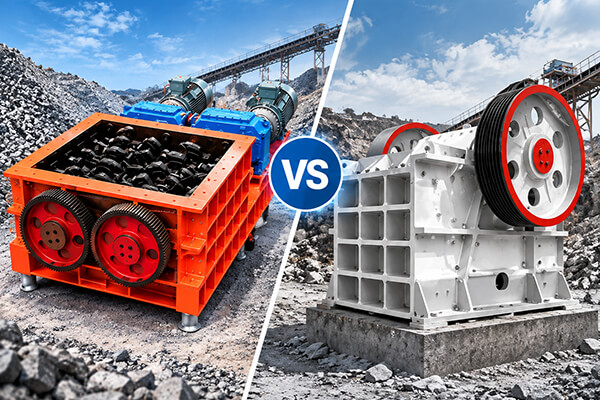
In the mining crushing system, the Primary Crusher is a crucial equipment that determines the efficiency of the entire production line. Currently, the common first-level crushing equipment includes: Mineral Sizer and Jaw Crusher. Although both can handle large pieces of material, their design concepts are different.
This article will compare 10 key differences between Mineral Sizer and Jaw Crusher from multiple dimensions such as structural design, working principle, and crushing performance.
Differences in crushing principles
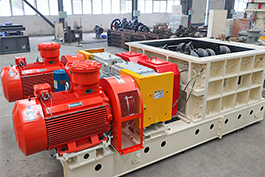
The Mineral Sizer uses a combined action of shearing, bending, and splitting to crush the ore. Two toothed rollers rotate in opposite directions synchronously, forming a controllable shear force field and a progressive bite-in path through precise tooth engagement. Large pieces of material are gradually divided and crushed between the toothed grooves instead of relying on instantaneous violent impact. This force distribution is more uniform, and the crushing process is smooth.
Jaw Crusher mainly relies on high-intensity unidirectional compression, supplemented by splitting and bending. The material is sandwiched between the moving jaw plate and the fixed jaw plate, and is subjected to huge pressure during the closing of the moving jaw until it breaks. Then, it is discharged from the bottom discharge port by gravity. This design highly relies on local high pressure and lacks directional shear control.
Differences in applicable material hardness
Mineral Sizer: It is designed specifically for medium and soft hardness materials (typically with compressive strength below 150-200 MPa), and is ideal for coal, raw ore (ROM), mudstone, bauxite, limestone, and shale.
Jaw Crusher: It has strong adaptability to extremely hard and highly abrasive materials and is the preferred choice for hard rocks such as granite, basalt, iron ore, and quartzite.
Differences in maximum feed capacity
The Mineral Sizer has a strong ability to capture large pieces of material, suitable for direct feeding of ROM (Run of Mine) raw ore. Its actively rotating toothed rollers can forcibly bite in the crushing chamber beyond the conventional size.
Jaw Crusher relies entirely on the physical size of the feed inlet (width and length) to receive the material. The material size must be strictly smaller than the feed inlet size; otherwise, it is prone to getting stuck and bridging at the feed opening, and usually requires careful selection of the model in combination with the material's extreme size, target output, and subsequent processes.
Particle size control and crushing ratio difference
The product particle size of Mineral Sizer is more uniform. Its discharge upper limit is controlled by three rigid parameters: tooth spacing, tooth shape design, and the center distance between the two rollers. This three-dimensional spatial limitation effectively reduces the generation of oversize materials.
Jaw Crusher controls the discharge by adjusting the bottom discharge opening (CSS, Closed Side Setting). Although the adjustment is relatively simple, due to the free sliding of the materials by gravity, it is easy to produce a wide particle size distribution and a large amount of needle-like and flake-like particles.
Difference in handling wet and sticky materials
The challenge for Jaw Crusher: Wet materials (such as during the rainy season in coal mines or clay) easily adhere to the V-shaped crushing chamber and the jaw plates, causing material accumulation, difficult discharge, and even complete blockage of the crushing chamber, leading to machine shutdown for cleaning.
The advantage of Mineral Sizer: Low-speed operation and open crushing area design. The rotating tooth rollers have a self-cleaning effect during operation (scraping knives or relative movement between teeth), and soil and high-water-content sticky materials cannot easily adhere, making it very suitable for rainy season construction and high-water-content clay mines.
Difference in over-crushing and fine powder generation rate
The "shear + squeeze" method of Mineral Sizer belongs to selective crushing. When the material reaches the qualified particle size, it will quickly fall through the gap between the teeth. The proportion of fine powder generated is extremely low. In coal applications, this can significantly increase the proportion of merchant lump coal and significantly reduce the load on subsequent screening equipment.
The blind compression crushing process of Jaw Crusher inevitably crushes already fragmented materials multiple times, resulting in a significant increase in fine particles (Fines) and dust in the product.
Difference in energy consumption and operating costs
Mineral Sizer operates at a low speed and high torque, implementing continuous crushing operations. The motor energy is efficiently converted into shear force, and the crushing energy consumption per ton of material is lower, making it very suitable for large-scale continuous non-stop production.
Jaw Crusher belongs to periodic crushing operations (jaw moving in and out), requiring overcoming huge mechanical inertia and providing peak compression force. The motor load fluctuates greatly, and the overall energy consumption is higher than that of Sizer equipment.
Difference in maintenance focus and wear parts
The main wear parts of Mineral Sizer: crushing teeth (Crushing teeth), tooth plates (Tooth plates), and bearings. The daily maintenance focus is on regular inspection of tooth wear. After wear, the modular wear-resistant teeth or online welding can be used to quickly restore.
The main wear parts of Jaw Crusher: jaw plates (Jaw plates), toggle plates (Toggle plate), and bearings. Jaw plates wear extremely fast when dealing with hard rocks, and the overall replacement of jaw plates requires the cooperation of lifting equipment, which is time-consuming.
Equipment structure and installation space requirements
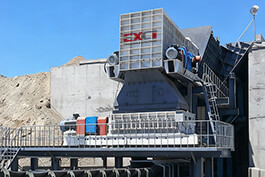
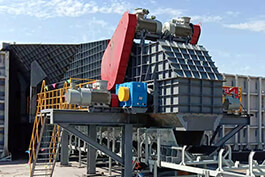
The Mineral Sizer has an extremely compact structure, a low profile, and operates smoothly, generating relatively small dynamic loads on the foundation, thus saving a significant amount of civil engineering and building height costs.
The Jaw Crusher equipment is overall tall and heavy, and when the eccentric shaft rotates, it will generate huge reciprocating inertial forces, which must be installed on extremely sturdy and costly concrete-reinforced bases.
Choose Mineral Sizer
The main materials are coal, mudstone, bauxite, etc., which are soft rocks.
The materials have a high moisture content or contain a large amount of clay.
The process requires strict product particle size requirements, and it is necessary to minimize the generation of fine powder to increase product value.
A continuous crushing system needs to be constructed, especially for the IPCC project planned to be combined with the Apron Feeder.
The factory space is limited or a mobile/semi-mobile crushing station is required.
Conclusion
By comparing, it can be observed that Mineral Sizer and jaw crushers have their own suitable production scenarios. For the large-scale continuous mining scenarios of medium-hardness and high-humidity and high-viscosity materials, Mineral Sizer has more significant comprehensive advantages in multiple aspects such as reducing energy consumption, controlling particle size, and saving space.


.jpg)