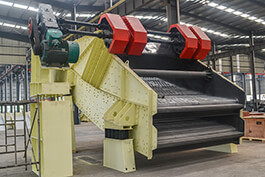
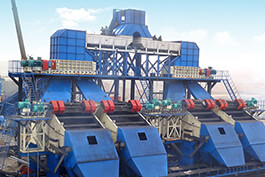
Screening is an important process in coal processing, widely used in coal classification, dehydration, dewatering and desilting operations in screening plants and coal preparation plants. The screening process and effect of Linear Vibrating Screen are related to many factors, including the properties of the materials, the selection of the motion parameters of Linear Vibrating Screen, the performance of the screening equipment, as well as the operation and management of the screening equipment.
The influence of material properties on the screening effect
The influence of particle size on the screening efficiency
The existence of easily screened particles, difficultly screened particles and obstructive particles in the screened material has an obvious impact on the screening process. The more easily screened particles there are, the better the screening effect will be. Under certain processing capacity conditions, a better screening effect can be achieved. Since easily screened particles can easily pass through the sieve holes, the amount of material remaining on the sieve decreases rapidly, thereby greatly reducing the interference factors of difficultly screened particles passing through the sieve. The screening efficiency increases as the content of easily screened particles increases.
The influence of material moisture on the screening effect
There are three types of material moisture: bound water, which is closely combined with the material; adsorbed water, which is widely present in the pores and cracks of the material; and external water, which is attached to the surface of the material. The first two types of moisture have little effect on the screening process. The moisture of the material is the main factor that affects the screening process. When the moisture of bituminous coal reaches 6%, the screening process cannot be carried out. Although the moisture of lignite is as high as 45%, the screening process can still be carried out. The reason is that the external moisture of lignite is low.
When the same material is screened using different sieve holes, the influence of moisture on the screening efficiency is different. The larger the sieve hole, the less the influence of moisture. Because the larger sieve hole can quickly allow high-moisture fine particles to pass through, thereby greatly reducing the moisture on the sieve and reducing the influence of moisture on the screening process. Therefore, when processing high-moisture materials, it is possible to consider increasing the sieve hole size to improve the screening efficiency.
When the sieve hole is small, the influence of moisture on the screening efficiency is particularly prominent. This is because the external moisture of the material causes the particles to stick together into clumps and attach to large particles, resulting in sieve blockage. In addition, the moisture attached to the sieve wire will form a water film under the action of surface tension, covering the sieve holes. All these situations interfere with the layering of materials by size on the sieve and the passage of fine particles through the sieve, seriously affecting the screening efficiency.
When the moisture of the material exceeds a certain range, that is, when it reaches the conditions for wet screening, the activity of the particles will increase, and the screening process will be easier to proceed. As the moisture of the material increases, the screening efficiency drops sharply. When the moisture of the material increases to a certain extent, the activity of the particles increases, and the screening efficiency also increases.
The influence of fine mud on the screening efficiency
If the material contains agglomerated clay minerals, even if the moisture of the material is very low, screening is very difficult. Because when the clay minerals agglomerate, they attach a large amount of fine particles and mix them into the sieve product, resulting in a decrease in screening efficiency. In addition, agglomerated materials are prone to block the sieve, and once the sieve is blocked, it is difficult to remove. Solutions: One is to spray water on the material moving along the sieve surface; the other is to de-powder or de-clay before screening.
The influence of particle shape on the screening efficiency
The influence of particle shape on the screening process mainly depends on the shape of the sieve hole. For square or circular sieve holes, flat-shaped or rectangular-shaped materials are more difficult to pass through the sieve; spherical, cubic and polygonal-shaped materials have better screening effects. In actual production, the shape of the sieve hole can be appropriately selected to reduce the influence of particle shape on the screening efficiency.
Particle density has an influence on the screening efficiency
The density composition of the material will affect the screening process. For example, when there are more large rock fragments in the coal, the rock fragments will be at the bottom layer during the screening process, which will to some extent affect the passage of fine particles. However, this influence is not prominent.
Selection of Linear Vibrating Screen Parameters
Sieve Plane Inclination Angle
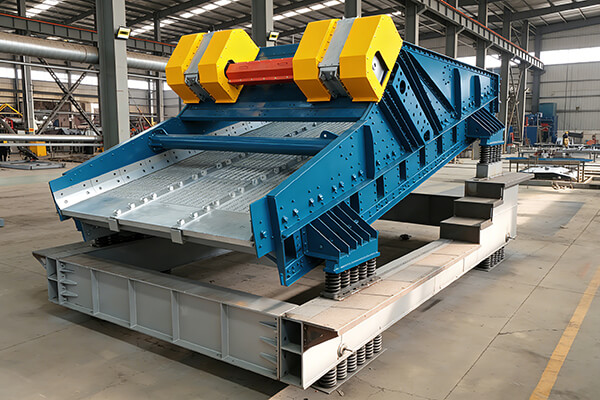
The sieve plane inclination angle (α) mainly depends on the required processing capacity and screening efficiency. When the other parameters of the screening machine are determined, the larger the sieve plane inclination angle, the higher the processing capacity, but the lower the screening efficiency. The opposite is also true. According to practical experience, when Linear Vibrating Screen is used for screening materials larger than 50mm, the sieve plane inclination angle a = 5° to 10°; when used for screening medium and fine-grained materials smaller than 40mm, the sieve plane inclination angle = 0°. When used for dewatering, desilting and desliming, the sieve plane inclination angle α = -5° to 0°.
Sieve Plane Vibration Direction Angle
The sieve plane vibration direction angle (B) for Linear Vibrating Screen is the throwing angle of the material. Linear Vibrating Screen is generally installed at a nearly horizontal angle. To ensure the forward jumping of the material, a certain vibration direction angle must be provided. Generally, when the vibration direction angle B = 30° to 40°, the material moves faster, the processing capacity is higher, but the screening efficiency is lower, which is suitable for easily screened materials; when the vibration direction angle is about 60°, the throwing angle of the material is large, the screening efficiency is high, but the processing capacity is not high, which is suitable for difficult-to-screen materials.
Sieve Plane Amplitude
According to practical experience, the amplitude (A) of Linear Vibrating Screen is related to the specifications, purpose and particle size of the materials processed by the vibrating screen. Generally, the larger the specifications of the vibrating screen, the larger the selected amplitude. The opposite is also true. When Linear Vibrating Screen is used for classification, the amplitude is slightly larger; when used for dewatering, desilting and desliming, the amplitude should be smaller. When the particle size of the materials processed is large, the amplitude should also be correspondingly increased; when the particle size of the materials processed is small, the amplitude should be smaller. Usually, the single amplitude A of Linear Vibrating Screen = 3.5 to 5.5mm.
Performance of screening equipment
Motion characteristics of the screen surface
Although the screening effect mainly depends on the properties of the screened material, the same material can achieve different screening effects when using different types of screening equipment. For example, the screening efficiency of a fixed screen is relatively low. For a vibrating screen, its screening efficiency is related to the movement form of the screen surface: on the vibrating screen surface, particles are shaken in the direction close to the vertical position of the sieve holes, and the higher the vibration frequency, the better the screening effect; on the shaking screen surface, particles mainly slide along the screen surface, because the shaking frequency of the shaking screen is lower than that of the vibrating screen, therefore the screening effect of the shaking screen is poorer; for the circular sieve, due to the easy blockage of the screen surface, the screening efficiency is low.
Structural parameters of the screen surface
When the feeding quantity and screening conditions are fixed, the width of the screen surface determines the processing capacity of the screening machine, and the length of the screen surface determines the screening efficiency. Correctly selecting the width and length of the screen surface is very important for improving the processing capacity and screening efficiency of the screening equipment. Generally, the width of the screen surface is usually below 2.5m, and the width of large vibrating screens has reached 5.5m. However, due to the limitations of the screen frame structure and material strength, the width of the screen surface cannot be infinitely widened, and the length cannot be arbitrarily lengthened. The optimal ratio of screen surface length to width is usually 2-2.5.
Screen surface inclination angle
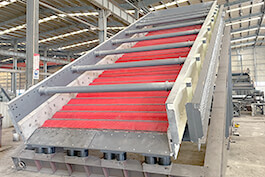
The inclination angle of the screen surface directly affects the processing capacity and screening efficiency of the screening equipment. The larger the inclination angle, the faster the speed at which the material group moves forward on the screen surface, and the greater the processing capacity. However, a large inclination angle means that the retention time of the material on the screen surface is short, and the screening efficiency is low.
Screen hole shape
The selection of screen hole shape mainly depends on the requirements for the particle size of the screened product and the processing capacity of the screening machine. Circular screen holes result in smaller particle sizes and lower sieve permeability. Rectangular screen holes are more likely to allow strip or sheet-shaped particles to pass through, so the particle size of the screened product is uneven, but the yield of the screened product is high. For materials that are wet, sticky, and prone to clogging the screen holes, rectangular screen holes are recommended. Square screen holes are suitable for processing materials in the form of blocks.
Screen hole size
The larger the screen hole, the greater the processing capacity per unit screen surface area and the higher the screening efficiency. Generally, the size of the screen hole is selected based on the required grading particle size.
Conclusion
The feeding requirements for screening equipment should be uniform, continuous and in appropriate amounts, ensuring that the materials are evenly distributed along the entire width of the screen surface, which is conducive to the passage of fine particles and thus enables higher processing capacity and screening efficiency. In addition, regular maintenance and upkeep should be strengthened, and the screen surface should be promptly cleaned and any damaged screen surfaces repaired or replaced to ensure the good condition of the Linear Vibrating Screen.


.jpg)