Introduce
At a certain open-pit coal mine's coal preparation plant, it has been operating at full capacity. Since its commissioning, due to problems such as high gangue content, severe mudization and high moisture content in the raw coal, the quality of the products cannot be guaranteed. Due to the low proportion of coal washing and the low recovery rate of clean coal, the economic benefits of the coal preparation plant cannot meet the increasingly severe coal market. To enhance the economic benefits of the coal preparation plant, technical renovations are carried out on the raw coal screening system of the plant. Fine particles in raw coal tend to adhere easily when exposed to water.
After being screened through a banana screen, they are prone to clogging the screen holes, reducing the screening efficiency and affecting the continuity of screening and classification. The Flip Flow Screen with relaxation motion can effectively overcome the clogging of the screen holes, significantly improve the processing capacity of the screen plate, thereby achieving the feed ratio, greatly increasing the yield of clean coal and the calorific value of the product, and enhancing the economic benefits of the enterprise.
The working principle of Flip Flow Screen
The structure of Flip Flow Screen is shown in the following figure. The Flip Flow Screen adopts a polyurethane rubber screen surface. Under the control of the dual-mass vibration system, any two adjacent crossbeams supporting the screen surface belong to two vibrating bodies respectively. One of the bodies is the screen box, and the other is the counterweight. When two bodies vibrate in phase w, any two adjacent crossbeams sometimes approach each other and sometimes move away from each other. The elastic screen surface also relaxes at times and tightens at others accordingly. That is, while the screen surface moves in connection with the screen box, it also moves relatively to the screen box. This relaxation movement not only causes the screen holes to constantly deform but also increases the vibration intensity of the screen surface, thereby effectively overcoming the phenomenon of screen hole blockage and significantly enhancing the processing capacity of the screen machine.
The features of Flip Flow Screen
The Flip Flow Screen achieves vibration by using the principle of sub-resonance, so the power demand required by the device is relatively small. The Flip Flow Screen has no complex mechanical transmission device and a compact structure. Although the surface acceleration of the screen surface can reach 50g, the impact load of the screen body vibration on the foundation is much smaller than that of traditional screen machines. Other one-layer or multi-layer floating bed tensioning is driven by elliptical vibration. Moreover, the amplitude of the floating bed tensioning vibration of Flip Flow Screen is much greater than that of traditional vibration equipment, effectively solving the problems of screen plate and screen hole blockage and low screening efficiency, and can efficiently handle viscous and difficult-to-screen materials of 6mm or less.
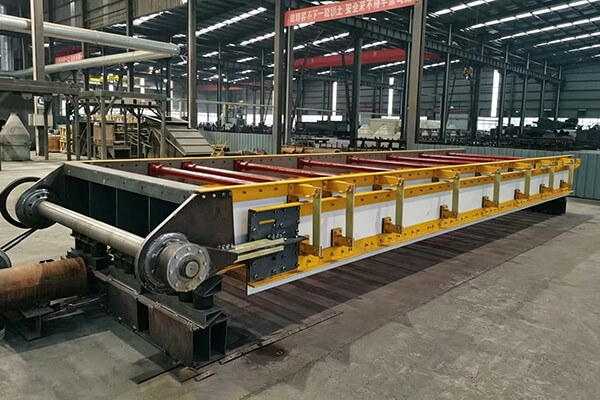
The material speed at the feeding end of the Flip Flow Screen is fast and the material layer is thin, which results in a high material screening rate and a high processing capacity. Due to the low inclination Angle of the screen surface at the discharge end, the material movement speed is relatively slow. The remaining material under the screen can be thoroughly screened during this process, thereby achieving a higher screening efficiency. According to the regularity of the movement of the material group itself, Flip Flow Screen can effectively loosen, stratify and sieve the wet sticky material layer. The Flip Flow Screen has a simple structure and can be driven by only one motor. The overall weight of the screening machine is light, its energy consumption is low, it can operate smoothly and reliably, and the failure rate is low. It requires little daily maintenance, has low noise during operation and a long service life.
The box-type exciter operates in a linear motion mode, featuring high reliability, simple daily maintenance and low cost.
The side of the screening machine adopts a U-shaped design to create a sealed environment, reducing the wear rate of the side plates and effectively preventing the materials on the screen from entering the underside of the screen.
The sieve plate is fixed with wedge-shaped rubber strips and does not require any bolts. It is convenient and quick to disassemble and assemble during maintenance.
The differences and advantages of Flip Flow Screen compared with other sieves
The driving mode adopted by the common vibrating Screen is that the vibrator drives the screen machine to move, while the Flip Flow Screen adopts the mechanical driving mode, thereby ensuring the stability of the amplitude under different working conditions. The actual operation on site indicates that although the processing capacity is temporarily increased, the Flip Flow Screen can still operate smoothly, and the situation where the Flip Flow Screen has no amplitude caused by the increase in processing capacity is effectively avoided. Since the movement mode is not crankshaft transmission, the Flip Flow Screen becomes "swinging" in the direction of the Screen surface. Compared with the situation where the side plate of the screen machine driven by the exciter is prone to stress concentration, the side plate and crossbeam of the Flip Flow Screen are subjected to force more evenly. Therefore, the phenomenon of cracking on the side plates or crossbeams of the Screen machine can be fundamentally reduced, and the reliability of the Flip Flow Screen operation can be improved.
The influencing factors of the screening effect of Flip Flow Screen
Amplitude
The movement law of difficult-to-screen materials indicates that only with a sufficiently large amplitude and vibration intensity can a good screening effect be guaranteed. However, it is not the case that the larger the amplitude, the better. To achieve a good screening effect, when it is necessary to screen difficult-to-screen materials or coarse screens, a larger amplitude should be selected, while for small-sized or powdered materials, a smaller amplitude should be chosen. Although the Flip Flow Screen has a large amplitude, its transmission components and the screen box still operate at a relatively low vibration. Due to the special design, the components of Flip Flow Screen have a longer lifespan than the conventional components.
Screen surface width
The dynamic analysis of the Screen surface of the screening machine indicates that the width of the screen surface will directly affect the screening process of the Flip Flow Screen. The increase in the width of the screen surface hardly affects the movement speed of the screen surface. However, it can increase the amplitude of the screen surface, which is conducive to thoroughly screening the material. When the width of the screen surface reaches a certain extent, the acceleration of the screen surface will instead decrease, which is not conducive to the thorough screening of the material and may cause the "ore entragging" phenomenon. At the same time, increasing the width of the screen surface can reduce the stress on the screen surface during the screening process and lower the impact of stress concentration on the screen surface
The loss of life.
Screen surface tension
The tension of the screen surface refers to the difference between the maximum distance between the crossbeams at both ends of the screen surface and the length of the screen plate. As the tension decreases, the average speed of the screen surface drops, and the movement of the screen surface gradually slows down, hindering the transmission of motion between the screen surface and the material, which affects the loosening and separation of the material layer and reduces the screening efficiency. However, excessive tension will increase the burden on the screen surface and reduce its service life.
Rotational speed
Studies show that the ejection of the screened object is affected by the angular velocity of the Flip Flow Screen. The increase in angular velocity accelerates the bouncing of the screen surface, making it easier for damp and sticky materials to be thrown up, which can promote the dispersion and penetration of materials through the screen. By analyzing the equation of the material movement trajectory on the Flip Flow Screen surface during the movement process, it can be known that when the rotational speed of the Flip Flow Screen is constant, the time taken for the material to be ejected once is equal to the time taken for the screen surface to rotate once. In this way, after one ejection, the material can still return to its previous ejection state. At this point, the screening effect is relatively good, and this rotational speed is the first critical speed. It is known from experience that when other conditions are fixed and the rotational speed of the Flip Flow Screen is closer to the first critical speed, the screening effect is better.
Conclusion
The materials pass through the Flip Flow Screen. The materials are sieved on the flexible screen surface, so that the particles that are prone to adhere to the screen plate can be quickly crushed and immediately bounced off the screen surface, reducing the occurrence of screen hole blockage caused by excessive moisture of the materials. Meanwhile, due to the application of large-amplitude design and the special structure of Flip Flow Screen, Flip Flow Screen can solve the deep screening of wet fine coal while maintaining a long service life. The Flip Flow Screen has fewer transmission components and high reliability in daily operation, resulting in less maintenance workload and high utilization rate.
Due to the adoption of special screen plates, the materials do not stick to the screen surface and have an automatic cleaning function, effectively reducing the labor intensity of the on-site workers. Due to the high sorting efficiency and good screening effect of Flip Flow Screen, the amount of fine coal entering the coal washing system is reduced, thereby alleviating the burden of coal slime water treatment and correspondingly saving the material cost consumption in the coal slime water treatment process, which has very good economic benefits.


.jpg)
.jpg)