Introduction
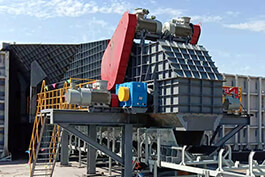
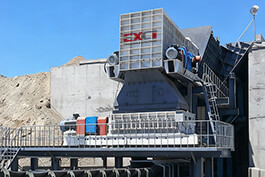
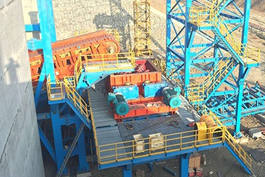
Mineral Sizer, as a commonly used equipment in the field of mineral crushing and screening, the performance of its core transmission component - the forged shaft - directly determines the operational stability and service life of the entire machine. Compared with traditional cast shafts and ordinary rolled shafts, the forged shaft has essential differences in production processes and material properties, thus forming unique advantages suitable for high-load mineral sorting conditions.
Technical Requirements for the Manufacturing Process of the Shaft in Mineral Sizer
Material Selection and Inspection
The material of the shaft should be determined based on the specifications of Mineral Sizer, the diameter of the tooth roller, the maximum feed particle size, the hardness of the crushed material, and the driving torque.
45 steel: Suitable for shafts with relatively moderate load and cross-sectional requirements, but must be verified through strength checks to determine its suitability.
40Cr: After appropriate heat treatment, it can achieve better strength, toughness, and comprehensive mechanical properties.
42CrMo: Suitable for heavy-load shafts with high requirements for strength, toughness, and fatigue resistance. Specific performance depends on heat treatment and cross-sectional dimensions.
Forging of Shaft Blank
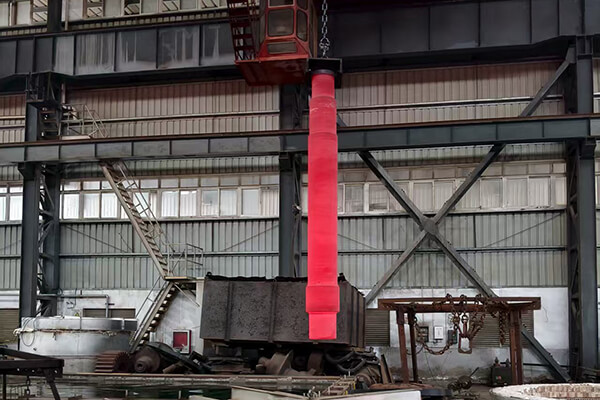
For Mineral Sizer, using qualified forgings to manufacture the shaft is usually beneficial for obtaining reliable internal quality and comprehensive mechanical properties.
The Role of Forging:
Improves the metal structure and fiber flow lines.
Improves the problems left in the cast structure through appropriate forging deformation.
Provides a suitable microstructure basis for subsequent heat treatment.
Reduces the risk of internal defects such as shrinkage cavities and porosity, but cannot guarantee the complete elimination of internal defects.
Heat treatment
Heat treatment is used to adjust the microstructure, strength, hardness and toughness of materials.
|
Heat treatment process
|
Primary purpose
|
|
Normalizing or annealing
|
Improve the microstructure, reduce some processing stresses, and improve cutting processing conditions
|
|
Quenching and tempering treatment
|
Obtain better strength, toughness and comprehensive mechanical properties
|
|
Surface hardening (if required)
|
Increase the hardness and wear resistance of specific working surfaces
|
For gear roller shafts that bear large impacts and alternating loads, it is not enough to only pursue high hardness. The shaft core needs to have sufficient toughness to reduce the risk of impact fracture.
Rough processing
The rough processing mainly involves removing excess metal to gradually bring the shape of the shaft closer to the designed dimensions.
The main processing areas include:
- The bearing installation section;
- The gear roll or hub mating section;
- The installation section of transmission components such as couplings and gears;
- The shaft shoulder, end, and subsequent processing reference points.
Ultrasonic testing
Large Mineral Sizer shafts typically endure high alternating loads. Ultrasonic testing is mainly used to inspect possible defects within the forgings, such as internal cracks, inclusions, and other discontinuities.
Technical Requirements:
The inspection is carried out according to the prescribed testing standards, probes and inspection coverage.
Full inspections are conducted on key sections and high-stress areas.
The nature, location and equivalent of defects are evaluated according to the acceptance standards.
Unqualified forgings should be reviewed and shall not be directly put into subsequent manufacturing without approval.
Ultrasonic testing mainly checks internal defects and cannot replace surface crack detection; when necessary, magnetic particle or penetrant testing should also be used.
Technical differences between forged shafts and cast shafts
|
Comparison items
|
Forged shaft
|
Cast shaft
|
|
Forming principle
|
Plastic deformation of solid metal
|
Solidification and formation of molten metal
|
|
Internal structure
|
Reasonable forging can improve the structure and compact some internal defects
|
Due to the influence of solidification conditions, defects such as shrinkage porosity may occur
|
|
Metal flow lines
|
The direction of flow lines can be optimized through forging process
|
Does not have the same forging flow line characteristics
|
|
Impact resistance
|
When the material, heat treatment are the same and the forging quality is qualified, it usually has an advantage.
|
Dependent on the casting quality, material and heat treatment.
|
|
Fatigue performance
|
Under reasonable design and manufacturing, it is usually more suitable for high-cycle heavy-duty shafts.
|
Needs to be evaluated based on the specific material and casting quality.
|
|
Complex shapes
|
There are more restrictions on the formation of complex overall shapes.
|
Suitable for complex shapes and internal structures.
|
|
Manufacturing cost
|
Large forging equipment, processing allowances and heat treatment costs may be relatively high.
|
Certain complex shapes can reduce the forming cost.
|
|
Quality Control
|
It is necessary to control the forging ratio, heat treatment, internal defects and processing accuracy.
|
It is necessary to control the pouring, solidification, shrinkage porosity, inclusions and internal defects.
|
Note: Forging does not mean there are no internal defects, and casting does not mean there are necessarily defects. The final performance also depends on material grade, section size, heat treatment system, defect acceptance standards and actual processing quality.
Why is Mineral Sizer more suitable for using forged shafts?
The working characteristics of Mineral Sizer are different from those of ordinary low-load transmission shafts. The two gear rollers interact through tooth shapes to perform low-speed, large-torque shearing and extrusion crushing of raw coal, oil shale or ores. When encountering large pieces of materials or hard inclusions, the shaft may also bear larger transient loads.
Impact load
When large pieces of material enter the toothed rollers of the mineral sizer, the crushing resistance may increase significantly in a short period of time. After the forged shaft undergoes appropriate heat treatment, it usually can balance strength and toughness, which is helpful for withstanding such impact loads and reducing the risk of brittle fracture.
Alternating load
When the Mineral Sizer operates continuously, the bending moment and torque borne by the shaft will change with the crushing load. The forging process can improve the material structure. Under reasonable design, heat treatment and surface processing conditions, the fatigue reliability of the shaft can be enhanced.
Reduce failure risk
The porosity, inclusions and cracks inside the shaft may serve as the starting point of fatigue cracks. Reasonable forging deformation can improve the original structure and help to eliminate some internal defects; combined with ultrasonic testing and other inspections, the internal quality risks can be further controlled.
Conclusion
The Mineral Sizer adopts forged shafts. This choice is fundamentally determined by its characteristics of low-speed heavy-load operation, ability to withstand transient impacts and alternating loads. Compared to traditional cast shafts, qualified forged shafts have a more comprehensive performance in terms of internal structure, mechanical properties, and fatigue resistance. They better meet the requirements of high-load mineral crushing operations and can reduce the probability of sudden equipment failure at the core component level, thereby extending the overall service life of the equipment.


.jpg)