Introduction
At present, the two most popular conveying equipment on the market are Tubular Drag Conveyors and Screw Conveyor. Both can achieve continuous conveying of bulk materials and are suitable for most conventional production conditions. However, in actual production applications, there are significant differences in the conveying methods, working condition adaptation, material protection, energy consumption and environmental protection, operation and maintenance costs, and service life between the two equipment. This article comprehensively compares Tubular Drag Conveyors and Screw Conveyor based on their working principles, structural characteristics, advantages and disadvantages, operation and maintenance details, and applications in the entire industry.
Working principles and structural characteristics of Screw Conveyor and Tubular Drag Conveyors
Screw Conveyor
The Screw Conveyor is a classic and traditional steel-made conveying equipment. Its core working principle is that the motor drives the spiral blades to rotate at high speed. The blades' thrust pushes the materials to move axially, converting the rotational motion into linear conveying motion of the materials, thereby achieving continuous material transmission.
The overall structure of the equipment is simple, with a small cross-sectional area of the body. It has built-in basic sealing conveying capacity. The operation process is simple, and the difficulty of entry-level maintenance is low. The procurement cost is low. It is the mainstream basic equipment for short-distance and simple-condition material transportation. However, due to the structural limitations, it only supports linear conveying and cannot achieve turning, three-dimensional layout, and the adaptability to working conditions is relatively limited.
Tubular Drag Conveyors
Tubular Drag Conveyors are a new type of highly efficient closed transportation equipment, suitable for transporting powders, small particles, small block-like materials and small objects. The core consists of chains or steel wire ropes as the traction components, and fixed discs as the conveying elements. The material is made to move uniformly and synchronously within the fully enclosed pipeline, enabling multi-dimensional combined three-dimensional transportation in horizontal, inclined and vertical directions, with no dead zones in the transportation path.
Detailed working process: The material enters the closed pipeline material trough from the feeding port. The chains and discs pull the material to run synchronously, moving smoothly along the preset transportation route, and finally discharging at the discharge port. The equipment's hopper is divided into a bearing branch and a return branch. The independent cylindrical cavities can restrain materials with strong fluidity and low internal friction coefficient, preventing the materials from scattering or slipping, and ensuring the stability of the transportation.
Closed structure design: Both sides of the active box and the passive box of the equipment are equipped with connecting branch pipes, which are respectively equipped with active wheels and redirecting wheels to form a complete closed cavity. The conveying pipeline is connected by flange plates and is combined with a closed chain transmission structure. This eliminates the飞扬 of materials and leakage from the source, achieving dust-free and environmentally friendly transportation. The overall features include stable performance, energy-saving and low consumption, full enclosure without pollution, and adaptability to complex working conditions.
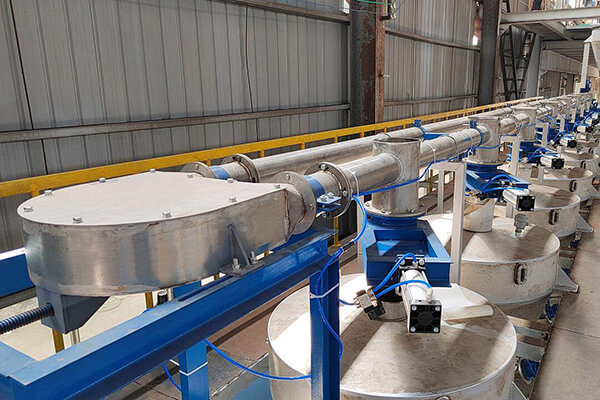
Tubular Drag Conveyors VS Screw Conveyor
Conveying Principle
The Screw Conveyor relies on the high-speed rotation of the spiral blades, through continuous squeezing and friction to push the materials, and completes the linear material transportation with mechanical thrust; it belongs to the compression type conveying mode. The Tubular Drag Conveyor adopts a chain + disc closed-loop traction structure, where the disc drives the materials to move forward uniformly and synchronously. The materials are not subjected to forced squeezing and belong to a smooth dragging type conveying mode.
Conveying Method and Layout
The Screw Conveyor only supports pure linear short-distance transportation, without the ability to turn or reroute, and the production line layout is rigid and monotonous, unable to adapt to complex workshop conditions. The Tubular Drag Conveyor supports multi-dimensional flexible transportation in multiple directions in a horizontal, inclined, and vertical manner. It can turn at multiple angles according to the layout of workshop equipment, with flexible pipeline installation, no dead zones in the entire process of transportation, and is suitable for various complex production line renovations and new construction scenarios.
Conveying Capacity and Distance
The Screw Conveyor has a short conveying distance and limited material lifting height, unable to meet the requirements of medium and long-distance, high-drop material transportation, and is only suitable for short-distance connection transportation. The Tubular Drag Conveyor has a significantly higher conveying capacity. The maximum horizontal conveying distance can reach 60 meters, and the maximum material lifting height can reach 40 meters. The total conveying distance is several times that of the Screw Conveyor. It also supports centralized material feeding at multiple points and decentralized material discharging at multiple points, and is suitable for large-scale assembly line transportation needs.
Material Integrity
The high-speed rotation of the Screw Conveyor blades will continuously squeeze and friction the materials, resulting in a high particle material breakage rate, which easily causes product loss, and is completely unsuitable for fine particles and high-purity material transportation. The Tubular Drag Conveyor adopts a low-speed synchronous conveying mode, where the materials and the disc run synchronously and smoothly, without strong squeezing or violent friction, and the material breakage rate is extremely low, able to retain the original shape and integrity of the materials to the greatest extent.
Probability of Blockage and Operating Stability
The Screw Conveyor is extremely sensitive to the uniformity of material input and equipment overload conditions. Once the material input is uneven, materials accumulate or there is a slight overload, it is very likely to cause blockage, jamming, and machine stoppage, resulting in poor production continuity and stability. The Tubular Drag Conveyor has a smooth conveying rhythm and is not affected by uneven material input or slight overload of the equipment. It fundamentally eliminates the problems of blockage and jamming, and has an extremely low equipment failure rate.
Energy Consumption and Environmental Performance
The Screw Conveyor has a high unit operating power and overall high energy consumption. The equipment has a general sealing performance, and slight dust is generated during material transportation. The environmental adaptability is relatively weak, and additional dust removal equipment is required under strict environmental protection conditions. The Tubular Drag Conveyor has lower overall energy consumption. It adopts an integrated closed-pipe transportation mode, with no dust, no material leakage, and no secondary pollution throughout the process. No additional dust removal equipment is required, and it supports custom explosion-proof structures, perfectly adapting to strict environmental protection and explosion-proof production conditions.
Environmental Adaptability
The Screw Conveyor is highly dependent on the layout of the production workshop, climate environment, and the layout of surrounding equipment. The flexibility of site adaptation is poor, and the renovation of old workshops is difficult to adapt. The Tubular Drag Conveyor is not limited by climate, site environment, or workshop layout. Whether it is the renovation of an old production line or the establishment of a new production line, pipelines can be flexibly installed, and it can adapt to various complex production environments.
Scene-based selection guide and industry applications
Preferred scenarios for Tubular Drag Conveyors
- Modern production lines with long distances, high lifting heights, requiring multi-angle three-dimensional steering, and complex pipeline layouts;
- Particle materials, fine powders, small block materials, and small items transportation, with extremely high requirements for material integrity and product yield;
- Chemical, pharmaceutical, food, explosion-proof and other environmentally friendly and safety-controlled scenarios with strict requirements for dust-free, pollution-free, and closed transportation;
- Long-term continuous production, high-frequency operation, pursuing low energy consumption, low failure rate, and less downtime maintenance for large-scale production lines;
- Scenarios with uneven feed and complex conditions, where blockage and jamming problems have frequently occurred during transportation;
- The need for centralized feeding at multiple points and decentralized discharging at multiple points to achieve long-distance automated transportation for production needs.
Tubular Drag Conveyors industry applications
- Chemical and food industries: Perfectly solve the problem of dust leakage during the transportation of powdery and fine granular materials, prevent material pollution, and ensure production safety and product quality;
- Agricultural field: Suitable for the transportation of solid pesticides, pesticide additives, and livestock feed, can be linked with automatic feeding and manure cleaning in the breeding base, significantly reducing breeding labor costs;
- Building materials industry: Stable transportation of bulk materials such as cement, sand, and limestone powder, suitable for continuous operation requirements of building material production lines;
- Solid waste recycling industry: Can transport waste materials such as used batteries, glass bottles, etc., effectively improve material recovery efficiency, and help with environmental recycling production;
- Pharmaceutical and coal chemical industries: Suitable for the sealed transportation of fine chemical materials and pharmaceutical powders, meeting the clean, explosion-proof, and dust-free production standards of the industry.
Summary
The Screw Conveyor is an economical and simple conveying equipment. Its core advantages lie in low initial investment and simple structure. It is only suitable for short-distance linear conveying within a limited budget, simple working conditions, and short-term production lines without material protection and strict environmental requirements. It is suitable for small-batch and temporary production scenarios.
The Tubular Drag Conveyor is an upgraded industrial conveying equipment that is efficient, environmentally friendly, and long-lasting. With core advantages such as long-distance three-dimensional flexible conveying, zero material fragmentation, fully enclosed dust-free and environmentally friendly, low energy consumption, automated operation, low failure rate, it perfectly addresses the pain points of Screw Conveyor such as blockage, dust, material loss, cumbersome operation, and poor adaptability to working conditions. It is suitable for complex working conditions in various industries including chemicals, building materials, medicine, agriculture, and solid waste recycling, and is the preferred equipment for modern large-scale production lines.