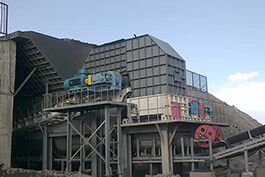
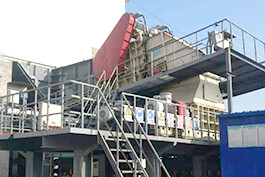
Structure of the Flip Flow Screen
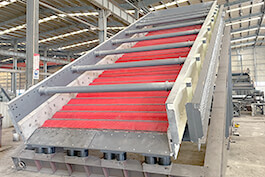
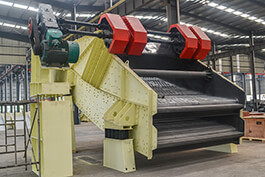
The Flip Flow Screen consists of a main screen frame, a floating screen frame, a flexible screen mesh, an excitation mechanism, and a support structure. The floating screen frame is connected to the main screen frame via flexible components. Different sections of the same flexible screen mesh are fixedly mounted on the fixed cross beams of the main screen frame and the floating cross beams of the floating screen frame, respectively. The excitation mechanism is fixedly installed on the main screen frame and includes a vibrating drive shaft assembly. The connection between the main screen frame and the support structure is a flexible one. When there is more than one drive shaft, all drive shafts rotate in the same direction.
Polyurethane Sieve Surface
Made by casting polyurethane elastomer, the sieve plate features uniformly distributed apertures. During operation, the main sieve frame and floating sieve frame move in opposite directions, causing the polyurethane sieve surface mounted on the crossbeams of both frames to alternately tighten and relax. This action enables material stratification and screening, while the dynamic tension changes also help remove wet, sticky materials adhering to the apertures, preventing clogging.
Compared to metal sieve plates used in conventional vibrating screens, polyurethane elastomer sieve surfaces are lighter in weight and impose less overall load on equipment. They can dynamically deform the apertures through their inherent elasticity, effectively reducing clogging at the source. Additionally, they offer advantages such as high wear resistance, excellent elasticity, and corrosion resistance, making them particularly suitable for grading wet and sticky materials. However, under continuous alternating tension and relaxation loads, stress concentration occurs persistently at the mounting points where the sieve surface is fixed to the sieve beams. The magnitude of this stress is directly related to the installation method and is a critical factor affecting the sieve surface's service life.
.jpg)
Advantages of Polyurethane Screen Panels
The Flip Flow Screen is a device designed for classifying difficult-to-screen materials such as fine, sticky, and wet substances (e.g., medium to fine-sized high-moisture raw coal and coke with high viscosity). It achieves high screening efficiency using a relatively small screening area while ensuring that screen openings remain unclogged.
The screen panels of the Flip Flow Screen are made of polyurethane elastomer. The unique molecular structure of this material provides excellent mechanical properties: ① outstanding wear resistance; ② high elasticity across a wide hardness range (Shore A10 to Shore D80); ③ high load-bearing capacity and strong vibration damping ability; ④ good oil and corrosion resistance. These combined characteristics are unmatched by other commercial rubber materials, making polyurethane elastomer widely used in industries such as mining, oil fields, machinery, and textiles.
Flip Flow Screen Screen Surface Installation Methods
Depending on their working mechanisms, Flip Flow Screens can be divided into two types: ① Crank-and-Connecting-Rod Flip Flow Screens, in which the inner screen frame is driven by an eccentric shaft, forcing the inner and outer frames to undergo periodic reverse motion with a phase difference of 180°; ② Vibrating Flip Flow Screens, operating on the principle of damped forced vibration of a two-mass system. The working frequency is set between 0.85 and 0.95 times the system's second natural frequency. Within this range, the main and floating screen frames vibrate in opposite directions, enabling the system to achieve large, stable amplitudes with relatively low excitation force. Currently, there are two installation methods for screen surfaces and screen beams in Flip Flow Screens: bolt-fastened and slot-inserted.
For the crank-and-connecting-rod type, the screen surface is installed using bolts. The screen plate spans the full width of the screen box, with its width determined by the screen box dimensions and length ranging from 275 to 330 mm. Uniformly spaced bolt holes are arranged along both sides of the screen plate. To ensure even stress distribution at the contact area between the screen plate and the screen beam, the screen plate is connected to bolts mounted above the screen beam via pressure strips. Protective covers are installed over the bolts to prevent wear.
For the vibrating type, the screen surface is installed using a slot-inserted method. The screen parameters are identical to those of the former type. Each fixed beam and floating beam is equipped with horn-shaped grooves. The screen plates feature slot designs along their widths on both sides, with adjacent plates sharing a single horn-shaped groove. Wedge strips are used to seal the gaps between the screen plates.
Differences and Advantages of Flip Flow Screen vs Conventional Vibrating Screens
(1) Different Vibration Principles: Conventional vibrating screens generate only circular or linear vibration through an exciter, with the screen surface vibrating as a single unit. In contrast, the Flip Flow Screen combines two types of vibration: one generated by the exciter (circular or linear), and another caused by the floating screen frame producing a tensioning vibration on the screen surface. This dual-vibration mechanism effectively prevents screen aperture clogging.
(2) Higher Vibration Intensity for Material Separation: Thanks to its dual-vibration principle, the Flip Flow Screen delivers a vibration intensity of up to 50g for screening materials, whereas conventional vibrating screens can achieve a maximum of only 5g. As a result, the Flip Flow Screen achieves significantly higher screening efficiency.
(3) Stronger Adaptability to Materials: The Flip Flow Screen is highly adaptable to various materials, including wet and sticky, difficult-to-screen substances, without causing screen hole blockage.
(4) Lightweight Design and Low Power Consumption: Due to its advanced vibration technology, the Flip Flow Screen is lighter in overall weight and requires lower-powered drive motors.
(5) Lower Maintenance and Operating Costs: The equipment offers higher operational safety compared to conventional vibrating screens. With fewer rotating components, it requires minimal maintenance, making repairs simple, convenient, and cost-effective.


.jpg)