Introduction
In industrial production such as chemical, building materials, mining, chemical fibers, and food, the transportation of powders, small particles, and small block-shaped bulk materials is a core process. Tubular Drag Conveyors are flexible in operation, fully enclosed without dust, with low damage, low energy consumption, and no material blockage. They can achieve multi-combination horizontal, inclined, and vertical transportation, and are suitable for most bulk material transportation scenarios.
Core Principle And Application Scenarios Of Tubular Drag Conveyors
Working principle
Tubular Drag Conveyors are continuous conveying equipment for transporting powdery, small granular, and small block-like bulk materials. They can be combined for horizontal, inclined, and vertical conveyance. Within a sealed pipeline, the material moves along the pipeline by means of the chain segments as the driving components, which are driven by the chain segments in the direction of movement.
When conveying horizontally, the material particles are pushed by the chain segments in the direction of movement. When the internal friction force between the material layers is greater than the external friction force between the material and the pipe wall, the material moves forward along the chain segments, forming a stable material flow.
When conveying vertically, the material particles in the pipe are pushed upward by the chain segments. Due to the prevention of the upper material from sliding down by the lower feeding, a lateral side pressure is generated, thereby enhancing the internal friction force of the material. When the internal friction force between the materials is greater than the external friction force between the materials and the inner wall of the pipe and the material's own weight, the material moves upward along the chain segments, forming a continuous material flow.
.jpg)
Structural composition
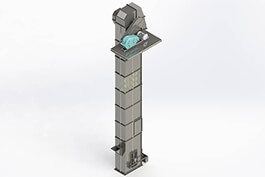
Tubular Drag Conveyors are mainly composed of the driving box, the driven box, the eight-tooth sprocket, the motor reducer, the conveying chain with disc plates, and the conveying pipeline.
The driving device includes the motor reducer and the driving box, etc.; the traction and bearing components are the conveying chain with disc plates, which contains horizontal links and vertical links of the same anchor chain shape. The vertical links are fixedly installed with circular discs.
The conveying pipeline is a circular-section conveying pipe, connected by flanges between each section, and the ends of the pipeline are connected respectively with the side branch pipes of the driving box and the driven box, forming a closed conveying channel.
The from-and-tensioning device includes the driven box and the sprocket inside it, which support the chain and can adjust the tightness of the chain through the tensioning device. The auxiliary device can be set with multiple feeding ports and discharge ports according to process requirements, and a reversing sprocket is set at the bending part of the pipeline to change the direction of the chain.
Common materials for the main components include: the discs can be made of engineering plastics such as nylon and PU; the pipeline, the chain, the sprocket, and the box are mostly made of carbon steel or stainless steel materials such as 304 or 316L.
Advantages of the Tubular Drag Conveyors System
- Compact structure, small footprint, and the ability to change the conveying direction in three dimensions.
- Fully enclosed conveying, no dust spillage, and the outlet does not require a dust collector. Gas can be filled during material conveying.
- The material is smoothly conveyed along the tube, with little material damage. The slow curved path conveys very few material particles to produce debris.
- The lowest energy consumption - the lowest operating cost, and the entire system is driven by only one motor.
- No system blockage - suitable for conveying various forms of materials.
Environmentally friendly, low energy consumption, no dust from raw materials, and a clean working environment. High safety, no cluttered pipelines, unaffected by any terrain, angle, or height, and the raw materials will not get clogged. Large conveying capacity, conveying distance; the horizontal maximum conveying distance of a single equipment is 60 meters, and the vertical maximum lifting height is 40 meters, with a power of 0.2 - 11 kilowatts.
Material Component Material Selection
- All components such as driving wheels, passive wheel housings, pipes, flanges, etc. are made of 304. This material is commonly used in chemical fiber equipment and can fully meet the usage requirements.
- Driving shafts and passive shafts are selected.
- Chain wheels are selected as 301.
- Chains are selected as 301.
- The material plates use modified polymers, with good wear resistance and no pollution to the raw materials. It can also reduce the production cost for users.
- The Tubular Drag Conveyors complete control system includes frequency converters, overcurrent protection, material bin level interlock, fault alarm, etc.
Conclusion
The core logic of Tubular Drag Conveyors' selection is the combination of material characteristics, operating conditions parameters, and material compatibility. It is not merely about price or model. Precise selection can completely solve production problems such as dust pollution, material loss, equipment blockage, high energy consumption, and high failure rate. At the same time, it can significantly reduce equipment operation and maintenance costs and extend the equipment's service life.


.jpg)