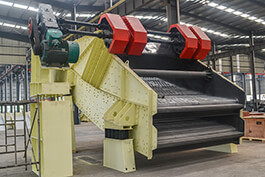
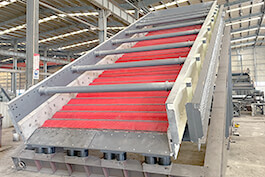
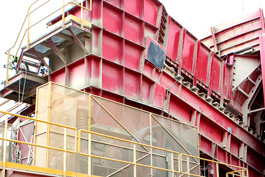
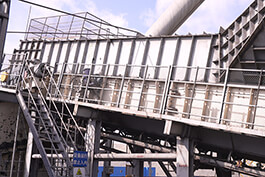
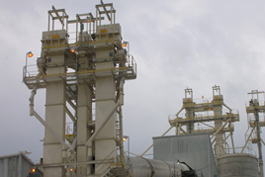
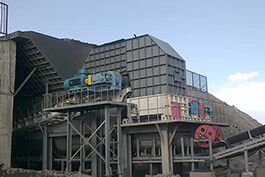
In the coal mining industry, after raw coal is extracted from the coal yard, there are variations in both diameter and quality of the coal. Some raw coal particles can reach up to 400 mm in size, while smaller particles may even be airborne coal dust. To separate fine coal particles smaller than the screen aperture and ensure overall coal quality, many coal mines employ linear vibrating screens for material classification. The screening efficiency of a linear vibrating screen directly affects actual production efficiency. However, during the screening process, some fine particles smaller than the aperture often remain on the screen surface, while coarse particles larger than the aperture may still appear in the undersize product. During operation, a linear vibrating screen primarily relies on directional excitation force generated by vibration motors or exciters to drive the screen box into linear vibrations in a specific direction.
Overview of the Working Principle of Linear Vibrating Screen
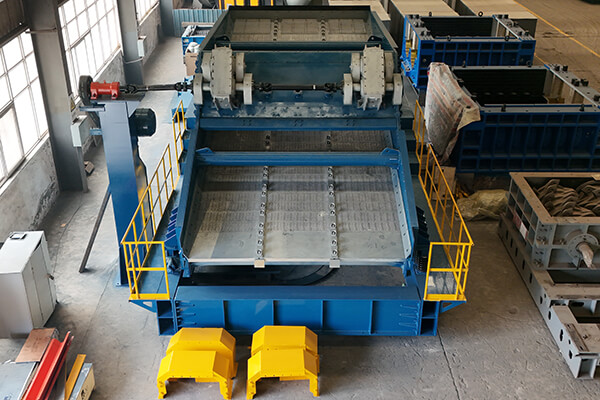
Linear vibrating screens can be categorized into two types based on their vibration source: one uses a vibrating motor as the source, and the other employs an exciter driven by a motor. The exciters come in various forms, such as eccentric shaft type and box-type exciters.
In practical installation, when a linear vibrating screen is equipped with two vibrating motors, these motors generate counter-phase synchronized vibrations, causing the screen box to vibrate in a straight line.
During operation, centrifugal force generated by the screen box induces vibration, ensuring that the direction of vibration forms a certain angle with the screen surface. As materials pass through the screen, the vibration of the linear vibrating screen causes them to be projected and dropped. Particles smaller than the screen openings fall through, while larger particles remain on the screen surface, thereby ensuring efficient material classification.
Factors Affecting the Screening Efficiency of Linear Vibrating Screens
Actual Material Density
The bulk density of the material significantly influences the screening efficiency of a linear vibrating screen. During the screening process, materials with higher bulk density generally achieve better screening results. Conversely, if the bulk density is relatively low or the material is in a powdered form, it often becomes difficult to screen effectively, resulting in lower screening efficiency.
Particle Size and Mesh Opening Dimensions
Linear vibrating screens handle a wide variety of materials during operation. To ensure optimal screening efficiency, it is essential to accurately determine the particle size distribution of the material prior to screening. Based on this analysis, appropriate mesh opening sizes should be selected so that the material's particle size remains strictly within the technical parameters of the screen openings. This helps prevent excessive variation in particle size, which could otherwise lead to reduced screening efficiency and decreased processing capacity. When the ratio of material particle size falls within the range of 0.71, it indicates that the chosen mesh size is reasonably matched to the material for effective screening. In practice, the higher the proportion of difficult-to-screen materials, the lower the actual screening penetration rate, directly reducing overall screening efficiency. On the contrary, when the proportion of hard-to-screen materials is low, the screening penetration rate increases, thereby ensuring high screening efficiency. Therefore, during material classification, it is important to minimize the total content of difficult-to-screen materials and maintain consistent particle size distribution to stabilize screening quality.
Measures to Ensure the Screening Efficiency of Linear Vibrating Screens
Proper Motor Selection
The selection of motors for a Linear Vibrating Screen directly determines its actual power source during screening operations. To ensure optimal performance and avoid unnecessary energy loss, it is essential to choose an appropriate motor. When selecting a motor, factors such as motor structure, energy efficiency, ease of installation, excitation force, and operating frequency should be carefully considered. The selected motor must operate within a suitable frequency range and work condition, taking into account the specific characteristics of the material being screened, so that the motor operates at maximum efficiency with optimal excitation force.
Proper Adjustment of Vibration Source
Excitation force is a critical foundation for the production capacity of a Linear Vibrating Screen, with actual productivity exhibiting an exponential relationship to this force. Increasing excitation force effectively enhances the screen's processing capacity; however, excessive force may lead to screen mesh clogging. Clogged screens increase the vibrating mass, thereby reducing amplitude. During operation, if the motor's excitation force exceeds the standard range, friction between eccentric blocks on both ends of the motor shaft may occur. Prolonged operation under such conditions can degrade motor performance and shorten the motor’s service life. Therefore, based on different production requirements, the overlap degree of the eccentric blocks should be adjusted to control excitation force accordingly. By properly regulating the excitation force, the actual service life of the vibration motor can be extended.
Control of Material Quality
The looseness, particle composition, and grain size of materials directly affect the screening efficiency of a Linear Vibrating Screen. Thus, during the screening and classification process, the physical properties and particle size distribution of the material should be thoroughly analyzed, and appropriate screen aperture sizes selected accordingly. To ensure high screening efficiency, the ratio of material particle size to screen aperture size should ideally be maintained at 0.71 before screening begins. This helps prevent excessively low bulk density of the feed material, ensuring optimal screening performance from the material side.
Conclusion
In-depth research has been conducted on the factors affecting the operational efficiency and screening performance of linear vibrating screens, and the various performance parameters have been reasonably designed based on these factors. To ensure the screening efficiency of a linear vibrating screen, considerations must be given to multiple aspects, including the selection of vibration motors, adjustment of excitation force, material characteristics, and screen aperture size.


.jpg)