Introduction
Before initiating the procurement process for the mineral sizer, the information that needs to be clarified is not limited to the processing capacity. As a manufacturing company, when we receive inquiries from customers, many of them state "I need a mineral sizer with a processing capacity of 1000 tons per hour". However, we cannot simply make the selection and quote based solely on the processing capacity. There are many other issues that need to be considered. Let's discuss below: What technical information needs to be provided before purchasing a Mineral Sizer?
Material Information
Material Type
It is necessary to clearly specify the specific names of the materials to be processed.
Coal: Bituminous coal, Anthracite coal, Lignite coal, Oil shale
Metal ores: Iron ore, Bauxite, Red earth nickel ore, Copper ore, Gold ore
Non-metallic minerals: Limestone, Gypsum, Phosphate ore, Potash
Others: Oil sands, Construction waste, etc.
Different materials have different crushing characteristics. The compressive strength of granite is usually between 200-250 MPa, while soft coal may be lower than 30 MPa. When mentioning red earth nickel ore or bauxite, one would think of their high viscosity and high moisture content characteristics. The structure design and accessory selection of the crushing equipment need to be considered based on these characteristics, which in turn affects the final equipment selection plan and quotation.
Material Hardness and Abrasiveness
The hardness of the material affects the driving power and torque of the mineral sizer. The higher the hardness of the material, the more energy is required for crushing, which directly leads to the need to configure a motor with greater power and a reducer with higher torque.
Abrasiveness is related to the tooth shape and material of the crushing teeth. When dealing with materials of high hardness, special tooth shapes and materials designed for hard rocks must be adopted to resist huge impact forces and wear. For medium and low hardness but highly abrasive materials, the focus is on optimizing the wear-resistant layer.
Bulk Density
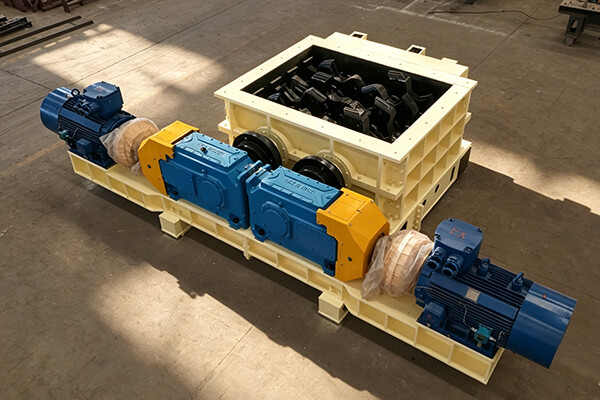
The theoretical processing capacity of Mineral Sizer is usually calculated first in terms of volumetric flow rate (m³/h), and then converted to mass flow rate (t/h) based on the bulk density. The theoretical production capacity formula is usually in the form of Q = f(D, L, n, r), where Q represents the processing capacity, D is the roller diameter, L is the roller length, n is the rotational speed, and r is the bulk density. The bulk density of the material also affects the power selection of the upstream feeding equipment (such as plate feeders) and the structural design of the silo.
Moisture Content
The high moisture content leads to poor adhesion and fluidity of the materials, which is also the reason for the blockage of traditional crushing equipment. The unique design of the mineral sizer ensures that the teeth during rotation will interlock with each other, just like a comb. This enables it to effectively scrape off the wet and sticky materials adhering to the root and surface of the teeth. The teeth are arranged in a spiral pattern, and when picking up the materials, it also generates a lateral thrust, guiding the materials to move smoothly towards the discharge port and preventing accumulation in the crushing chamber.
Clay and Sticky Content
The clay content usually occurs together with moisture and is the main cause of material adhesion, especially when dealing with ROM (raw ore) from open-pit mines. When processing such materials, engineers often consider installing special comb-shaped wear-resistant liners on the side walls of the mineral sizer crushing chamber. The comb teeth can extend into the tooth gaps of the toothed roller, continuously scraping off the materials that may adhere to the end face and side walls of the toothed roller, ensuring the effective width of the crushing chamber.
Feed particle size
Maximum feed size
This parameter is directly related to the design choices of the tooth roller diameter, pitch, and gap. The crushing principle of Mineral Sizer relies on the biting and shearing of the tooth roller on the material. Only when the size structure of the tooth roller can accommodate the maximum size of the feed, can the material be smoothly captured and enter the crushing chamber for crushing. If the feed size is far beyond the upper limit allowed by the equipment, it will not only significantly reduce the crushing efficiency, but also may cause equipment blockage and even irreparable damage to the tooth roller and transmission components.
Feed size distribution
If the proportion of large-sized materials in the feed is very high, it may be necessary to adopt a more aggressive tooth shape in the initial section of the crushing chamber to ensure effective capture and one-time crushing. Conversely, if the proportion of fine materials is high, it is necessary to ensure that the discharge channel is smooth enough to quickly discharge these materials that do not need to be crushed.
Processing capacity requirements
Required Throughput
The model of the Mineral Sizer is usually directly related to the size (diameter and length) of its toothed rollers. The product manual will clearly list the rated processing capacity range for each model under specific operating conditions. Processing capacity is related to the driving power. Higher processing capacity means that more materials need to be crushed per unit time, thus requiring a higher power input.
Operating Hours and Production Requirement
Based on the operating time of the equipment, the selection of key components such as bearings, gearboxes, and hydraulic couplings should be considered. The lubrication system is generally a fully automatic centralized lubrication system to ensure that all lubrication points receive timely and quantitative lubrication, thereby significantly extending the service life of moving parts such as bearings.
Grinding material particle size requirements
Target Product Size
The target discharge particle size determines the gap between the toothed rollers and the tooth shape design. The Mineral Sizer can control the maximum particle size of the final discharge by adjusting the gap between the two toothed rollers. The finer the target particle size, the smaller the required gap between the toothed rollers, and the stronger the compression and shear force required during the crushing process. This also means that a larger driving power needs to be matched. At the same time, the tooth shape design also needs to be adjusted to ensure the stability of the discharge in the fine crushing condition.
Product Size Distribution Requirement
Different production scenarios have different requirements for the particle size distribution of the crushed products: If the crushed materials will directly enter the next stage of screening, some production scenarios only require controlling the maximum discharge particle size and do not have strict requirements for the proportion of each particle size; if the crushed products are directly sent to the subsequent separation operation, usually it is necessary to clearly stipulate and limit the proportion of the products below the screen, to avoid the particle size distribution not meeting the requirements of the downstream process, which will affect the final separation efficiency and beneficiation benefits.
Conclusion
Complete and accurate technical information forms the basis for us to match the most suitable Mineral Sizer selection plan for our clients and provide precise quotations. Any omission of a key piece of information can lead to selection errors, which in turn will affect the subsequent production efficiency and even result in excessive equipment wear and tear or failure to meet production requirements.


.jpg)