Introduction
In the material conveying process of industrial production, Tubular Drag Conveyors, with its unique closed conveying advantages, flexible layout capabilities and stable conveying performance, demonstrate efficient and low-loss transfer advantages when conveying fine materials in powder and granular form, as well as small block mixed materials. It has effectively solved the problems of dust overflow, restricted layout and high material damage rate of traditional conveying equipment.
How does Tubular Drag Conveyors work
Working principle
Tubular drag conveyors drive the sprocket to rotate through a dedicated drive device, which in turn drives the chain and chain plates inside the conveying pipe to form a circular motion. Utilizing the frictional force and thrust between the chain plates and the materials, the materials are pushed to move stably forward along the interior of the conveying pipe, ultimately achieving the directional transfer of materials.
Workflow
Feeding
The materials are precisely fed into the sealed conveying pipeline through the dedicated feeding port. The design of the feeding port can adjust the feeding speed according to the characteristics of the materials to avoid material accumulation.
Chain slice push
After the drive unit is started, the sprocket drives the chain and chain plates to move. The chain plates penetrate into the material pile and use their own thrust or dragging force to move the material.
Inside the pipe
Under the continuous action of the chain plates, the materials move smoothly along the preset path of the conveying pipeline. The closed environment of the pipeline ensures that the materials will not scatter or generate dust.
Discharge
When the material moves along with the chain plates to the discharge port position, it is discharged from the discharge port under the combined action of gravity and the thrust of the chain plates, completing the entire conveying process.
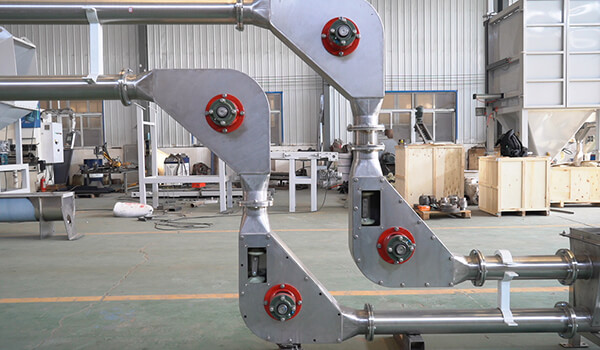
The core structural composition of Tubular Drag Conveyors
Drive unit
As the power core of Tubular Drag Conveyors, it mainly provides continuous and stable power for the operation of equipment, and usually adopts the combination form of motor and reducer. The motor provides the original power. The reducer reduces the rotational speed and increases the torque to ensure that the power output meets the conveying requirements. At the same time, it has an overload protection function to prevent equipment damage caused by excessive material or jamming.
Conveying pipeline
It is a closed channel for material transportation, mostly made of high-strength seamless steel pipes, which have good pressure resistance and wear resistance. Anti-corrosion materials such as stainless steel can be selected according to the transportation environment. The conveying pipes can be flexibly cut and spliced, and can achieve various path layouts such as horizontal, vertical and inclined, which directly determines the flexibility of the conveying path of Tubular Drag Conveyors.
Chains and chain plates
It is the core traction and load-bearing component of the equipment, directly in contact with the material and driving it forward. The chain adopts high-strength wear-resistant chain to ensure the stability and service life of the traction. The chain plates are designed in different shapes (such as straight plate type, U-shaped, etc.) according to the characteristics of the materials to increase the contact area with the materials, improve the pushing efficiency, and at the same time reduce the squeezing damage to the materials.
Sprocket
It is divided into the head wheel and the tail wheel. The head wheel is connected to the drive device and is responsible for driving the chain to move in a cycle. The tail wheel serves a redirecting function, enabling the chain to achieve a closed-loop circulation. The surface of the sprocket is usually provided with tooth grooves that match the chain to ensure precise meshing with the chain, prevent slippage and guarantee the stability of power transmission.
Tensioning device
The main function is to maintain the appropriate tension of the chain and prevent problems such as tooth skipping and deviation caused by chain relaxation during operation. The common tensioning devices are screw type or counterweight type, which can be flexibly adjusted according to the degree of chain relaxation to ensure the long-term stable operation of the equipment.
Inlet and outlet ports
It is a key component for controlling the input and discharge of materials. The feed port is usually equipped with a hopper or a feed valve, which can achieve quantitative and uniform input of materials. The discharge port is equipped with a discharge valve, which can precisely control the discharge speed and prevent material accumulation. The positions of the inlet and outlet ports can be flexibly set according to the conveying layout to enhance the adaptability of the equipment.
Features of Tubular Drag Conveyors
Fully sealed conveying
The entire conveying process is completed in a closed pipeline, which can effectively prevent the overflow of material dust. It not only avoids pollution to the working environment but also prevents the material from getting damp, caking or being contaminated. It is especially suitable for the conveying of flammable, explosive, toxic, harmful or high-precision materials.
High space utilization
According to the layout of the workshop site, various combined conveying methods such as horizontal conveying, vertical lifting, inclined conveying and curve turning can be flexibly realized. There is no need to set up additional transfer equipment, which can make the most of the limited space and adapt to the complex workshop environment.
Compact structure
The main body of the equipment is composed of core components such as pipes and chains, with a simple and compact structure. Compared with traditional conveying equipment, it significantly reduces the occupied area and space, making it convenient to install and modify in narrow workshops or existing production lines, and lowering the cost of site renovation.
Easy to maintain
The core component structure is relatively simple, with a small quantity. Moreover, the installation and disassembly of each component are convenient. Daily maintenance only requires regular checks of the chain tension, lubrication condition, and pipeline wear, resulting in a small amount of maintenance work. Meanwhile, the equipment has low energy consumption during operation and long service life of components, which can effectively reduce long-term operating costs.
Wide adaptability to materials
It can be widely adapted to the transportation of powdery materials (such as flour, cement), granular materials (such as white sugar, mineral powder), small block materials (such as feed granules, small pieces of ore), and mixed materials. Whether it is materials in high-temperature and humid environments or those with weak corrosiveness, it can be stably conveyed to meet the needs of different industries.
Smooth conveying
It adopts a gentle conveying method of push or drag. The contact between the chain plates and the materials is uniform, and the materials move smoothly inside the pipe without severe impact or friction. This can effectively reduce the breakage and wear of the materials, and is especially suitable for industries with high requirements for material integrity (such as the food and pharmaceutical industries).
In which industries are Tubular Drag Conveyors used
Chemical industry
It is mainly used for conveying powdery and granular chemical materials such as pigments, resin powder, chemical auxiliaries and raw materials for laundry powder. Most chemical materials have corrosive, toxic or flammable and explosive characteristics. The fully enclosed Tubular Drag Conveyors can avoid material leakage and cause safety accidents, and at the same time prevent the materials from coming into contact with air and having chemical reactions, ensuring the safety of conveying.
Food industry
It is suitable for conveying food raw materials such as flour, white sugar, grains, milk powder, cocoa powder and food additives. The food industry has extremely high requirements for material hygiene. The sealed structure of Tubular Drag Conveyors can prevent materials from being contaminated by dust and impurities, and the conveying is stable with a low breakage rate, which can ensure the integrity and safety of food raw materials.
Building materials industry
It can convey materials such as cement, mineral powder, fly ash, sand and gravel additives, and raw materials for ceramic tiles. Most building materials are in powder or granular form and are prone to dust pollution. The fully enclosed Tubular Drag Conveyors can effectively control dust overflow and improve the working environment. Meanwhile, its flexible layout capability can adapt to the complex site environment of building materials factories, enabling direct transportation of raw materials from warehouses to production equipment.
Conclusion
Tubular Drag Conveyors, as an efficient, environmentally friendly and flexible material conveying equipment, with its unique pushing/dragging working principle and fully enclosed core structure, possess significant advantages such as low breakage rate, high space utilization rate and wide material adaptability. The wide range of application scenarios Its role in the industrial automated production system will also become increasingly important. If you need to select the appropriate Tubular Drag Conveyors based on the specific material characteristics or site requirements, you can combine their working principles and structural features to specifically match the optimal solution.