Background
Philippine GR customer is a mining company in the Philippines, mainly engaged in gold exploration, development, and mining operations. Its core assets are located in the Philippines, with a focus on the development of large-scale gold projects.
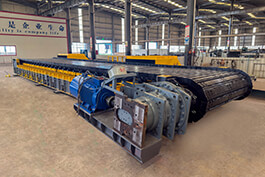
The Apron Feeder supplied by EXCT will be applied in the ore conveying process of the customer’s large-scale mining project. During this no-load test, the EXCT technical team strictly followed industry testing standards and conducted comprehensive inspections on the equipment’s operating stability, speed control, drive system response, overall vibration parameters, and other key performance indicators.
The test results showed that all parameters met the design requirements and the customer’s project specifications. The Apron Feeder successfully completed the no-load test.
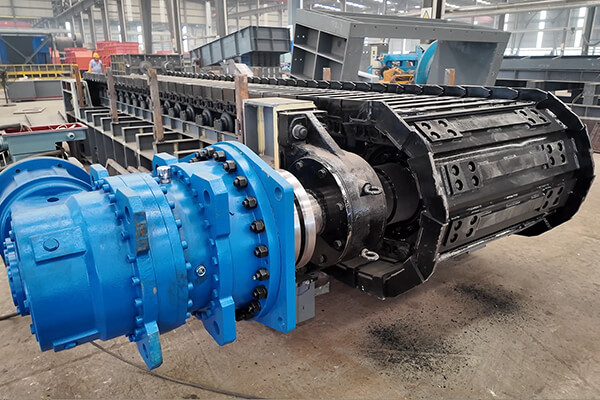
Equipment model: BL1200×6m
Material name: Clay-type ore
Material particle size: ≤600mm
Handling capacity: 300t/h
Bulk density: 2.1t/m³
Pan width: 1200mm
Center distance between head and tail sprocket: 6m
Inclined angle: 0°
Chain speed: 0–0.3m/s
Chain pitch: 171mm
Requirements for Apron Feeder No-load Test
The equipment shall operate smoothly and normally. The rotating parts shall be flexible without jamming or interference. The operating sound shall be uniform without obvious vibration or impact.
The sealing parts and joint surfaces of all lubrication points shall have no oil seepage or leakage.
All fasteners at connection points shall be properly tightened, especially the connection bolts between apron plates and chain links, which shall not have any looseness.
The upper and lower support rollers shall rotate flexibly. The overlapping amount of the two arcs at the bending section of the apron plate shall not be less than 10mm.
The temperature rise of bearings shall not exceed 30℃, and the maximum bearing temperature shall not exceed 60℃.
After the Apron Feeder completes the no-load operation test and passes inspection, a load test shall be carried out before formal production. The duration of the load test shall be determined according to actual site conditions, but the continuous operation time shall not be less than 2 hours. The load shall be gradually increased to the maximum capacity, and inspection shall be carried out according to the technical parameters specified in the drawings. The equipment can only be put into formal operation after passing the inspection.


.jpg)