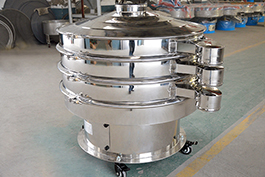
Recently, the Ultrasonic Vibratory Separator customized by our company for an Australian customer has completed all production processes and has officially entered the stage of pre-delivery test runs. This equipment is specifically designed to meet the high-precision screening requirements for metal powders, featuring a double-layer sieve structure that enables simultaneous impurity removal and fine powder classification.
Customer Requirements Alignment
At the end of April this year, an Australian customer clearly stated their screening requirements, requesting a double-layer Ultrasonic Vibratory Separator for processing metal powders with a particle size range of -150 microns to 45 microns (80 mesh to 325 mesh). The customer demanded effective removal of larger impurities larger than 160 microns or 180 microns, while separating fine dust smaller than 45 microns, ensuring that the particle size distribution of the finished powder strictly complies with the process standards.
In response to the screening challenges of metal powders such as strong adsorption, easy agglomeration, and high static electricity, the technical team recommended a diameter 600mm Ultrasonic Vibratory Separator solution. Compared to traditional vibrating screens, the Ultrasonic Vibratory Separator introduces low amplitude and high frequency ultrasonic vibration waves (mechanical waves) to generate superimposed ultrasonic vibrations on the screen surface, effectively solving technical bottlenecks such as static electricity agglomeration and clogging of mesh holes, making 325 mesh ultrafine screening a straightforward task.
.jpg)
Core Configuration
The Ultrasonic Vibratory Separator adopts a two-layer screen design. The upper layer is equipped with an 80-mesh screen, which is used for pre-screening and removing large particles of impurities; the lower layer is equipped with a 325-mesh screen (approximately 45 micrometer pore size), which precisely retains qualified particle size powders and separates ultrafine dust. This dual-layer structure of coarse screening and fine screening can complete multi-level particle size control in a single processing, significantly improving the screening efficiency.
In terms of material selection, the equipment strictly follows the customer's requirements for SUS304 stainless steel standards. All components in contact with the materials are made of food-grade stainless steel. The thickness of the sieve basket is 2mm and the thickness of the upper cover is 0.8mm, ensuring corrosion resistance and structural stability during the metal powder processing. Non-contact components are made of carbon steel, optimizing cost while ensuring performance.
Power System Configuration: 0.55KW motor, compatible with the local 415V/50Hz three-phase power supply standard in Australia, meeting the customer's requirements for direct connection on-site use. The equipment is designed to produce 10-20kg per day, using manual feeding method, which is in line with the actual production scenarios of small batch and high precision metal powder processing.
Ultrasonic technology
For metal powder screening, especially for ultrafine specifications above 325 mesh, during the screening process, problems such as electrostatic adsorption causing powder to stick to the screen, micro-powder agglomeration resulting in screen blockage, and high-density metals getting stuck at the screen opening are prone to occur. When dealing with such materials using traditional vibrating screens, the screening efficiency is usually only 60%-70%, and frequent shutdowns for screen cleaning are required.
The ultrasonic vibration separator works by applying 36KHz high-frequency vibration waves to the screen, causing the screen holes to generate high-frequency secondary vibration, creating a self-cleaning effect. Actual application data shows that in the screening of 325 mesh nickel powder and cobalt powder, ordinary screens need to be screened 3 times to meet the requirements, while the Ultrasonic Vibratory Separator can complete it in just 1 time; in the 300 mesh screening of neodymium iron boron powder, the residue of ordinary screens reaches 32.2% after 30 minutes, while the ultrasonic screen can be reduced to 6.9%.
For the metal powder materials tested in this trial, the ultrasonic technology can significantly improve the phenomenon of high-density metals getting stuck at the screen opening, prevent impurities larger than 160 microns from wedging into the screen holes, and ensure that fine dust as small as -45 microns can pass through the screen smoothly, achieving the dual goals of impurity removal and fine material preservation.
Factory trial run
At present, the Ultrasonic Vibratory Separator has been fully assembled and is undergoing a comprehensive factory trial run inspection. During the trial run, the technical team focused on monitoring the mesh penetration rate of the 325-mesh screen and the separation effect of the 80-mesh screen to ensure that there is no material leakage or clogging when the two layers of screens work together. At the same time, the intermittent/continuous working mode of the ultrasonic control instrument was switched for testing to verify its net cleaning stability under different load conditions.